1 Now JoabI sonII of ZeruiahIII
Notes on verse 1a
I “Joab” = Yoab. From YHVH (proper name of the God of Israel; God, Lord; the self-existent or eternal one); {from havah (to become) or hayah (to be, become, happen)}. + ab (father, ancestor, grandfather; father in a literal or figurative sense). This is Joab or Yoab, meaning “the Lord is father.”
II “son” = ben. From banah (to build or obtain children). This is son, age, child. It is son in a literal or figurative sense.
III “Zeruiah” = Tseruyah. Related to “Joab” in v1.From the same as tsori (root might be to crack as under pressure, to leak; gum from the balsam tree – perhaps commiphora gileadensis) + Yah (the shortened form of the name of the God of Israel; God, Lord); {from YHVH (see note I above)} OR tsur (rock, stone, cliff, boulder, rocky; a refuge, God); {from tsur (to confine, cramp, or bind in a literal or figurative sense; to besiege, assault, or distress)} + Yah (see above). This is Zeruiah, meaning “wounded” or “balsam of the Lord” or “his rock is the Lord.” See https://www.abarim-publications.com/Meaning/Zeruiah.html & https://en.wikipedia.org/wiki/Balsam & https://en.wikipedia.org/wiki/Balm_of_Gilead.
perceivedIV that the king’sV mindVI was on Absalom.VII
Notes on verse 1b
IV “perceived” = yada. This is to know, acknowledge, advise, answer, be aware, be acquainted with. Properly, this is to figure something out by seeing. It includes ideas of observation, recognition, and care about something. It can be used causatively for instruction, designation, and punishment.
V “king’s” = melek. From malak (to be or become king or queen, to rise to the throne, to be crowned; by implication, to take counsel). This is king or royal.
VI “mind” = leb. From the same as lebab (the heart, courage, one’s inner self, the mind, the will; only used in a figurative sense in the Bible); may be related to labab (to encourage; properly, to be encased as with fat; used in a good sense, this means to transport someone with love; used in a bad sense, it can mean to dull one’s senses).. This is inner self, mind, will, feelings, the center.
VII “Absalom” = Abshalom. Related to “Joab” in v1.From ab (see note I above) + shalom (completeness, soundness, welfare, favor, friend, good health; to be safe and figuratively well, happy, at peace, friendly; abstractly, includes the ideas of welfare and prosperity – not in excessive wealth, but in having enough); {from shalam (to be complete or sound; to have safety mentally, physically, or extending to one’s estate; so, if these things are safe and complete, the implication is that one would be friendly; and, if being friendly, one would make amends and that friendship would be reciprocated)}. This is Absalom or Abishalom, which means “my father is peace” or “father of peace” or “friendly.”
2 Joab sentVIII to TekoaIX and broughtX from there
Notes on verse 2a
VIII “sent” = shalach. This is to send out, away, send for, forsake. It can also mean to divorce or set a slave free.
IX “Tekoa” = Teqoa. 7x in OT. From taqoa (a sound from a trump or other wind instrument; a blast); from taqa (clap, clatter, thrust, sound an instrument, hammer a nail, be a bondsman). This is Tekoa or Tekoah, a city whose name means “trumpet” or “sudden thrust” or “firm” or “settlement” or “pitching.” See https://www.abarim-publications.com/Meaning/Tekoa.html
X “brought” = laqach. This is to take, accept, carry away, receive. It can also have the sense of take a wife or take in marriage.
a wiseXI woman.XII He saidXIII to her, “Pretend to be a mourner;XIV, XV
Notes on verse 2b
XI “wise” = chakam. From chakam (to be wise or teach wisdom; this is wisdom in thought, word, or action). This is wise, skillful, cunning, or artful.
XII “woman” = ishshah. From ish (man); perhaps from enosh (human, humankind, mortal); from anash (to be weak, sick, or frail). This is woman, wife, or female.
XIII “said” = amar. This is to speak, say, answer, command, promise, report.
XIV “pretend to be a mourner” = abal. This is to mourn, bewail.
XV {untranslated} = na. This particle is used for requests or for urging. It can be we pray, now, I ask you, oh. This is the same “na” in “hosanna.”
put onXVI, XVII mourningXVIII garments,XIX
Notes on verse 2c
XVI “put on” = labash. This is to wrap around, which implies clothing oneself or someone else. This is wrapping around in a literal or figurative way.
XVII {untranslated} = na. Same as {untranslated} in v2. See note XV above.
XVIII “mourning” = ebel. Related to “pretend to be a mourner” in v2. From abal (see note XIV above).This is mourning or lamentation.
XIX “garments” = beged. From bagad (to cover or conceal; figuratively, to act in a covert or treacherous way, to transgress or pillage). This is clothing, garment, robe, or some other kind of clothing. Figuratively, it can be treachery or pillaging.
and do not anointXX yourself with oil,XXI but behaveXXII like a woman who has been mourningXXIII
Notes on verse 2d
XX “anoint” = suk. 9x in OT. This is to smear or pour oil. By implication, it is to anoint.
XXI “oil” = shemen. From shamen (to shine, which implies being oily, growing fat). This is fat, oil, grease, olive oil – often with perfume. Used figuratively for fertile, lavish, rich.
XXII “behave” = hayah. Related to “Joab” and “Zeruiah” in v1. See note I above.
XXIII “mourning” = abal. Same as “pretend to be a mourner” in v2. See note XIV above.
manyXXIV daysXXV for the dead.XXVI
Notes on verse 2e
XXIV “many” = rab. From rabab (increasing in any aspect whether quantity, authority, size, quality, greatness, etc.). This is abundance, many, elder, exceedingly, great. It refers to abundance of amount, rank, or status.
XXV “days” = yom. Root may mean being hot. This is the day in a literal or figurative sense. It can also mean birth, age, daylight, continually or other references to time.
XXVI “dead” = mut. This is to die in a literal or figurative sense. It can also refer to being a dead body.
3 GoXXVII to the king and speakXXVIII to him as follows.”XXIX And Joab putXXX the wordsXXXI into her mouth.
Notes on verse 3
XXVII “go” = bo. This is to enter, come in, advance, fulfill, bring offerings, enter to worship, attack. It can also have a sexual connotation.
XXVIII “speak” = dabar. This is generally to speak, answer, declare, or command. It might mean to arrange and so to speak in a figurative sense as arranging words.
XXIX “follows” = dabar. Related to “speak” in v3. From dabar (see note XXVIII above).This is speech, a word, a matter, an affair, charge, command, message, promise, purpose, report, request. It is a word, which implies things that are spoken of in a wide sense.
XXX “put” = sim. This is to put or place in a literal or figurative sense. It can be appoint, care, change, make, and may other things.
XXXI “words” = dabar. Same as “follows” in v3. See note XXIX above.
4 XXXIIWhen the woman of TekoaXXXIII came to the king, she fellXXXIV on her faceXXXV
Notes on verse 4a
XXXII {untranslated} = amar. Same as “said” in v2. See note XIII above.
XXXIII “Tekoa” = Teqoi. Related to “Tekoa” in v2. 7x in OT. From Teqoa (see note IX above). This is someone from Tekoa.
XXXIV “fell” = naphal. This is to fall, whether by accident, to fall prostrate, or to fall in violent death. Figuratively, it can refer to personal ruin or calamity, a city falling, an attack or a falling away. It can also be a deep sleep or wasting away.
XXXV “face” = aph. From anaph (to be angry; properly, breathing hard as a signifier of being enraged). This properly refers to the nose or nostril and by extension the face. It can specifically refer to anger or wrath as one breathes hard and nostrils flare in times of great anger.
to the groundXXXVI and did obeisanceXXXVII and said, “Help,XXXVIII O king!”
5 The king askedXXXIX her, “What is your trouble?”
Notes on verses 4b-5a
XXXVI “ground” = erets. Root may mean to be firm. This is earth, ground, field land, or country.
XXXVII “did obeisance” = shachah. This is to bow down, make a humble entreaty, to do homage to royalty or to God.
XXXVIII “help” = yasha. To deliver, defend, help, preserve, rescue, be safe. Properly, to be open, wide or free, which implies being safe. Used causatively, it means to free.
XXXIX “asked” = amar. Same as “said” in v2. See note XIII above.
She answered,XL “Alas,XLI I am a widow;XLII my husbandXLIII is dead.XLIV
Notes on verse 5b
XL “answered” = amar. Same as “said” in v2. See note XIII above.
XLI “alas” = abal. Related to “pretend to be a mourner” and “mourning” in v2. 11x in OT. Perhaps from abal (see note XIV above). This is truly, indeed, but.
XLII “widow” = ishshah + almanah. Ishshah is the same as “woman” in v2. See note XII above. Almanah is related to alman (widowed); from alam (to be silent, bound). This is a widow or a house that is desolate.
XLIII “husband” = ish. Related to “woman” in v2. See note XII above.
XLIV “is dead” = mut. Same as “dead” in v2. See note XXVI above.
6 Your servantXLV had twoXLVI sons, and they foughtXLVII with one anotherXLVIII in the field;XLIX
Notes on verse 6a
XLV “servant” = shiphchah. Root may mean to spread out – it would be the same root used in mishpachah, which means family or clan. This is maidservant, female slave, or female bondslave.
XLVI “two” = shenayim. From sheni (double, again, another, second); from shanah (to fold, repeat, double, alter, or disguise). This is two, both, second, couple.
XLVII “fought” = natash. 11x in OT. Properly, this is to beat or pound as when something is beaten in order to expand or disperse. It can be leave, abandon, allow, neglect, spread, fall, or thrust out.
XLVIII “one another” = shenayim. Same as “two” in v6. See note XLVI above.
XLIX “field” = sadeh. From the same as shadday (almighty, field, land); from shadad (to devastate, ruin, destroy, oppress, be powerful). Or, it may be from a word that means to spread out. This is field, ground, soil, or land. It can be used to mean wild as in a wild animal.
there was no oneL to partLI, LII them,
Notes on verse 6b
L “no one” = ayin. Perhaps from a word that means to be nothing. This means nothing, none, non-existent. It can also simply mean not or are not.
LI “part” = natsal. This is to snatch someone or something away in a good sense – as rescue, defend, or deliver – or in a bad sense – as strip or plunder.
LII {untranslated} = bayin. From bin (to discern, consider, attend to; distinguishing things in one’s mind or, more generally, to understand). This is among, between, interval.
and oneLIII struckLIV the otherLV and killedLVI him.
Notes on verse 6c
LIII “one” = echad. Perhaps from achad (to unify, continue on a path; figuratively, to gather one’s thoughts). This is the number one, first, united. It can also be alone, altogether, a certain, a few.
LIV “struck” = nakah. This is to hit whether lightly or severely. It can be used in a literal or figurative sense. So, this could be beat, punish, give wounds, kill, or slaughter.
LV “other” = echad. Same as “one” in v6. See note LIII above.
LVI “killed” = mut. Same as “dead” in v2. See note XXVI above.
7 NowLVII the wholeLVIII familyLIX has risenLX against your servant.
Notes on verse 7a
LVII “now” = hinneh. From hen (lo! Behold! If, though; an expression of surprise). This is to draw attention, show suddenness or surprise, or to emphasize the importance of the coming statement. See! Lo! Behold!
LVIII “whole” = kol. From kalal (to complete). This is all or every.
LIX “family” = mishpachah. Related to “servant” in v6.From the same as shiphcah (see note XLV above); root means to spread out. This is one’s circle of relatives – clan, family, kindred.
LX “risen” = qum. To arise, stand, accomplish, establish, abide. This is rising as in rising against, getting up after being sick or asleep, arising from one state to another, becoming powerful, or rising for action. It can also be standing in a figurative sense.
They say, ‘Give upLXI the man who struck his brother,LXII so that we may kill him for the lifeLXIII of his brother whom he murdered,LXIV
Notes on verse 7b
LXI “give up” = natan. This is to give, put, set, offer. It is to give literally or figuratively.
LXII “brother” = ach. This is brother, kindred, another, other, like. It is literally brother, but it can also be someone who is similar, resembling, or related to.
LXIII “life” = nephesh. Related to naphash (to refresh or be refreshed). This is soul, self, person, emotion. It is a breathing creature. Can also refer to appetites and desires.
LXIV “murdered” = harag. This is to strike with deadly intent so it can be kill, destroy, murder, or put to death.
even if we destroyLXV the heirLXVI as well.’LXVII Thus they would quenchLXVIII my one remainingLXIX emberLXX
Notes on verse 7c
LXV “destroy” = shamad. This is to demolish, destroy, perish, overthrow, pluck down.
LXVI “heir” = yarash. This is inheriting or dispossessing. It refers to occupying or colonizing – taking territory by driving out the previous inhabitants and living there instead of them. By implication, it can mean to seize or rob, to expel, ruin, or impoverish.
LXVII “as well” = gam. This is also, moreover, again.
LXVIII “quench” = kabah. This is to quench or extinguish. It could refer to a fire or to anger.
LXIX “remaining” = shaar. Properly, this is swelling up i.e. being left over, a remnant, remaining, being redundant.
LXX “ember” = gechel. 18x in OT. Root may mean to glow or kindle. This is a cot or hot ember.
and leaveLXXI to my husband neitherLXXII nameLXXIII
Notes on verse 7d
LXXI “leave” = sim. Same as “put” in v3. See note XXX above.
LXXII “neither” = bilti. From balah (to grow old, wear out, consume, waste, enjoy, fail, decay). This is nothing, not, lest, or except. From its root, it means “a failure of” – used for negative particles.
LXXIII “name” = shem. Related to “put” in v3. Perhaps from sim (see note XXX above). This is name, fame, renown. A name was thought to indicate something essential about a person – something about their individuality. So, this word can also mean honor, authority, or character.
nor remnantLXXIV on the faceLXXV of the earth.”LXXVI
Notes on verse 7e
LXXIV “remnant” = sheerith. Related to “remaining” in v7.From shaar (see note LXIX above). This is a remainder, residue, or survivor. It can also refer to posterity.
LXXV “face” = paneh. From panah (to turn, face, appear). This is face in a literal or figurative sense. It could be face, presence, anger, respect. It can also be used of God to indicate divine favor or presence.
LXXVI “earth” = adamah. From the same asadam (man, humankind); perhaps from ‘adom (to be red). This is ground, earth, soil as red, or land.
8 Then the king said to the woman, “GoLXXVII to your house,LXXVIII and I will give ordersLXXIX concerning you.”
Notes on verse 8
LXXVII “go” = halak. This is go, come, walk. It is walk literally and figuratively and includes people and animals. It can be used figuratively for one’s moral life – how we walk according to God’s way or against it. It can also refer to the walk of life as in the course one’s life takes, the choices we make, etc.
LXXVIII “house” = bayit. Related to “son” in v1.Probably from banah (see note II above). This is house, court, family, palace, temple.
LXXIX “give orders” = tsavah. This is to charge, command, order, appoint, or enjoin. This is the root that the Hebrew word for “commandment” comes from (mitsvah).
9 The woman of Tekoa said to the king, “On me be the guilt,LXXX my lordLXXXI the king, and on my father’sLXXXII house; let the king and his throneLXXXIII be guiltless.”LXXXIV
Notes on verse 9
LXXX “guilt” = avon. Perhaps related to avah (to bend, twist, be amiss). This is sin, mischief, guilt, fault, punishment for iniquity, or moral evil.
LXXXI “lord” = adon. From a root that means ruling or being sovereign. This is lord, master, or owner.
LXXXII “father’s” = ab. Related to “Joab” and “Absalom” in v1. See note I above.
LXXXIII “throne” = kisse. From the same as kese (full moon); perhaps from kasah (to cover, conceal, overwhelm; to cover as clothes do or to hide a secret). This is throne – a seat that is covered or has a canopy. Thus, it is a seat that conveys authority.
LXXXIV “guiltless” = naqi. From naqah (to be empty, cleanse, acquit; to be clean in a literal or figurative sense). This is blameless, innocent, free from punishment, or clear.
10 The king said, “If anyone saysLXXXV anything to you, bringLXXXVI him to me, and he shall never touchLXXXVII you again.”LXXXVIII
Notes on verse 10
LXXXV “says” = dabar. Same as “speak” in v3. See note XXVIII above.
LXXXVI “bring” = bo. Same as “go” in v3. See note XXVII above.
LXXXVII “touch” = naga. This is touch, reach, arrive, come near, strike. This is touching for any reason including sexual or violent.
LXXXVIII “again” = yasaph + od. Yasaph is to add, increase, continue, exceed. Od is from ud (to admonish, repeat, duplicate, testify, restore, record, relieve). This is still, yet, again, more.
11 Then she said,LXXXIX “Please,XC may the king keep the LordXCI your GodXCII in mind,XCIII
Notes on verse 11a
LXXXIX “said” = amar. Same as “said” in v2. See note XIII above.
XC “please” = na. Same as {untranslated} in v2. See note XV above.
XCI “Lord” = YHVH. Related to “Joab” and “Zeruiah” in v1 & “behave” in v2. See note I above.
XCII “God” = Elohim.
XCIII “keep…in mind” = zakar. This is to remember, to mark something so that it can be recalled, to be mindful of, to mention.
so that the avengerXCIV of bloodXCV may killXCVI no moreXCVII and my son not be destroyed.”
Notes on verse 11b
XCIV “avenger” = gaal. This is to redeem someone or something according to kinship laws. So, it could be acting on a relative’s behalf to buy back their property, to marry one’s brother’s widow, etc. This could be more briefly translated as to redeem, acts as kinsman, or purchase. As a noun, it could be deliverer or avenger.
XCV “blood” = dam. Perhaps from damam (to cease, be or become mute, silent, still, cut off, hold peace, be astonished, die). This is blood, bloodshed, bloodguilt, lifeblood, and death. It is used for people and animals. More often blood from a wound or the blood of the innocent. Used figuratively for violence or for wine. Closely tied to life and death.
XCVI “kill” = shachat. This is to slaughter, slay, or beat. It can be slaying for a sacrifice or in a massacre.
XCVII “more” = rabah. This is increasing in any aspect whether quantity, authority, size, quality, greatness, etc.
He said,XCVIII “As the LordXCIX lives,C not one hairCI of your son shall fall to the ground.”
Notes on verse 11c
XCVIII “said” = amar. Same as “said” in v2. See note XIII above.
XCIX “Lord” = YHVH. Same as “Lord” in v11. See note XCI above.
C “lives” = chay. From chayah (to live or keep alive literally or figuratively). This is alive, living, lifetime. It can also be used to describe someone’s age. It can refer to animals, plants, water, or a company or congregation of people. It is life in a very broad sense.
CI “hair” = saarah. 7x in OT. From the same as sear (hair, hairy, rough); perhaps from sa’ar (to storm, scattered by a storm, blow away, rage, storm tossed; this is to toss in a literal or figurative sense). This is hair or hairiness.
12 Then the woman said,CII “Please let your servant speak a word to my lordCIII the king.”
He said,CIV “Speak.”
13 The woman said,CV “Why then have you plannedCVI such a thing
Notes on verses 12-13a
CII “said” = amar. Same as “said” in v2. See note XIII above.
CIII “lord” = adon. Same as “lord” in v9. See note LXXXI above.
CIV “said” = amar. Same as “said” in v2. See note XIII above.
CV “said” = amar. Same as “said” in v2. See note XIII above.
CVI “planned” = chashab. This is properly to braid or interpenetrate. Literally it is to create or to wear. Figuratively, it can mean plotting – generally in a negative sense. More broadly, this can also mean think, consider, or make account of.
against the peopleCVII of God? For in givingCVIII this decisionCIX the king convictsCX himself,
Notes on verse 13b
CVII “people” = am. From amam (to darken, hide, associate; creating shadows by huddling together). This is people or nation. It can be used specifically for a tribe, collectively of troops or armies, or figuratively to refer to a flock of animals.
CVIII “giving” = dabar. Same as “speak” inv 3. See note XXVIII above.
CIX “decision” = dabar. Same as “follows” in v3. See note XXIX above.
CX “convicts” = ashem. 3x in OT. From asham (to be guilty, suffer, be punished). This is guilty, at fault. It can also refer to one who brings a sin offering.
inasmuch asCXI the king does not bring his banished oneCXII home again.CXIII
Notes on verse 13c
CXI “inasmuch as” = bilti. Same as “neither” in v7. See note LXXII above.
CXII “banished one” = nadach. This is scatter, seduce, banish, draw away, drive away, outcast, scatter. It means to push off in a literal or figurative sense so it could also be mislead, inflict, or withdraw.
CXIII “bring…home again” = shub. To turn back, return, turn away – literally or figuratively. Doesn’t necessarily imply going back to where you started from. This is also the root verb for the Hebrew word for repentance “teshubah.”
14 We must all die;CXIV we are like waterCXV spilledCXVI on the ground, which cannot be gathered up.CXVII
Notes on verse 14a
CXIV “die” = mut + mut. Same as “dead” in v2. See note XXVI above. The word is repeated twice – the first time as an Infinitive Absolute. The Infinitive Absolute serves to emphasize the sentiment of the word. It is rather like Foghorn Leghorn’s speech pattern, “I said, I said.”
CXV “water” = mayim. This is water, waters, or waterway in a general sense. Figuratively, it can also mean juice, urine, or semen.
CXVI “spilled” = nagar. 10x in OT. This is to pour, flow away, spill, run, deliver over, or stretch.
CXVII“gathered up” = asaph. This is to gather, assemble, or bring. It can also mean to take away, destroy, or remove.
But God will not take awayCXVIII a life;CXIX he will deviseCXX plansCXXI so as notCXXII to keep an outcastCXXIII banished forever from his presence.
Notes on verse 14b
CXVIII “take away” = nasa. This is to lift in a broad sense, literally and figuratively. So it could be to carry, take, or arise. It could also be bring forth, advance, accept.
CXIX “life” = nephesh. Same as “life” in v7. See note LXIII above.
CXX “devise” = chashab. Same as “planned” in v13. See note CVI above.
CXXI “plans” = machashabah. Related to “planned” in v13. From chashab (see note CVI above). This is thought, scheme, imagination, purpose, or a plan either good or evil.
CXXII “not” = bilti. Same as “neither” in v7. See note LXXII above.
CXXIII “outcast” = nadach. Same as “banished one” in v13. See note CXII above.
15 NowCXXIV I have comeCXXV to sayCXXVI this to my lordCXXVII the kingCXXVIII because the people have made me afraid;CXXIX
Notes on verse 15a
CXXIV “now” = attah. Perhaps from et (a period or season; whenever or continually); probably from anah (to answer, sing, announce); from ad (forever, all, old); from adah (to pass on, advance, decorate oneself). This is now, from now on.
CXXV “come” = bo. Same as “go” in v3. See note XXVII above.
CXXVI “say” = dabar. Same as “speak” inv 3. See note XXVIII above.
CXXVII “lord” = adon. Same as “lord” in v9. See note LXXXI above.
CXXVIII {untranslated} = dabar. Same as “follows” in v3. See note XXIX above.
CXXIX “made…afraid” = yare. This is to fear, be afraid, dreadful. It can also refer to fearful reverence – to fear in a moral sense is to say to revere, respect.
your servant thought,CXXX ‘I will speakCXXXI to the king; it mayCXXXII be that the king will performCXXXIII the requestCXXXIV of his servant.CXXXV
Notes on verse 15b
CXXX “thought” = amar. Same as “said” in v2. See note XIII above.
CXXXI {untranslated} = na. Same as {untranslated} in v2. See note XV above.
CXXXII “may” = ulay. Perhaps from o (or). This is perhaps, if, or suppose.
CXXXIII “perform” = asah. This is to make, do, act, appoint, become in many senses.
CXXXIV “request” = dabar. Same as “follows” in v3. See note XXIX above.
CXXXV “servant” = amah. This is female servant or slave, handmaid.
16 For the king will hearCXXXVI and deliverCXXXVII his servantCXXXVIII from the handCXXXIX of the man
Notes on verse 16a
CXXXVI “hear” = shama. This is to hear, call, consent, or consider. It implies listening intelligently, giving attention, and, because of these two factors, obedience and action are often implied.
CXXXVII “deliver” = natsal. Same as “part” in v6. See note LI above.
CXXXVIII “servant” = amah. Same as “servant” in v15. See note CXXXV above.
CXXXIX “hand” = kaph. From kaphaph (to bend – from a root meaning curve or bend down). This is palm of the hand or sole of the foot, footstep, grasp. Figuratively, it can also mean power.
who would cut bothCXL me and my son offCXLI from the heritageCXLII of God.’
Notes on verse 16b
CXL “both” = yachad. From yachad (to join, be united). This is a unit, both, altogether, unitedness, alike.
CXLI “cut…off” = shamad. Same as “destroy” in v7. See note LXV above.
CXLII “heritage” = nachalah. Related to nachal (to inherit, occupy, distribute, take as heritage). This is properly something that was inherited. It can mean occupancy generally or, more particularly, an heirloom or an estate. This can be an inheritance, gift, possession, or portion.
17 Your servantCXLIII thought, ‘CXLIVThe word of my lordCXLV the king will set meCXLVI at rest,’CXLVII
Notes on verse 17a
CXLIII “servant” = shiphchah. Same as “servant” in v6. See note XLV above.
CXLIV {untranslated} = na. Same as {untranslated} in v2. See note XV above.
CXLV “lord” = adon. Same as “lord” in v9. See note LXXXI above.
CXLVI “set” = hayah. Same as “behave” in v2. See note XXII above.
CXLVII “rest” = menuchah. From manoach (resting place, quiet, home); from nuach (to rest, calm, camp, free, place, remain, satisfy, settle, station, or wait; implies settling down in a literal or figurative sense). This is resting place, consolation, ease, quiet. It is the same word in Psalm 23:2, “he leads me beside the still waters.”
for my lordCXLVIII the king is likeCXLIX the angelCL of God,
Notes on verse 17b
CXLVIII “lord” = adon. Same as “lord” in v9. See note LXXXI above.
CXLIX “like” = ken. Perhaps from kun (properly, in a perpendicular position; literally, to establish, fix, fasten, prepare; figuratively, it is certainty, to be firm, faithfulness, render sure or prosperous). This is to set upright. Generally used figuratively to mean thus, so, afterwards, rightly so.
CL “angel” = malak. This is a messenger, an angel, or a deputy of some kind. Can be used for human messengers literally or for prophets, priests, or teachers as messengers of God. Also used for supernatural messengers i.e. angels.
discerningCLI goodCLII and evil.CLIII The LordCLIV your God beCLV with you!”
Notes on verse 17c
CLI “discerning” = shama. Same as “hear” in v16. Same as “hear” in v16. See note CXXXVI above.
CLII “good” = tob. From tob (to be pleasing, to be good). This is good, beautiful, pleasant, agreeable, bountiful, at ease. This word is used for goodness as a concept, a good thing, a good person. This can refer to prosperity and welfare as well as joy, kindness, sweetness, and graciousness. So, this is ethically good, but also enjoyably good.
CLIII “evil” = ra’. From ra’a’ (to be evil, bad, afflict; properly, to spoil – to destroy by breaking into pieces; figuratively, to cause something to be worthless; this is bad in a physical, social, or moral sense; that which displeases, to do harm or mischief, to punish or vex). This is bad, disagreeable, that which causes pain, misery, something having little or no value, something that is ethically bad, wicked, injury, calamity. This refers to anything that is not what it ought to be – a natural disaster, a disfigurement, an injury, a sin.
CLIV “Lord” = YHVH. Same as “Lord” in v11. See note XCI above.
CLV “be” = hayah. Same as “behave” in v2. See note XXII above.
18 Then the king answeredCLVI the woman,CLVII “CLVIIIDo not withholdCLIX from me anythingCLX I askCLXI you.”
Notes on verse 18a
CLVI “answered” = anah. Related to “now” in v15. See note CXXIV above.
CLVII {untranslated} = amar. Same as “said” in v2. See note XIII above.
CLVIII {untranslated} = na. Same as {untranslated} in v2. See note XV above.
CLIX “withhold” = kachad. This is to hide or conceal or destroy. It can also refer to doing secret actions or secret speech.
CLX “anything” = dabar. Same as “follows” in v3. See note XXIX above.
CLXI “ask” = shaal. This is to ask, inquire, beg, borrow, desire, request. It can also mean to demand.
The woman said,CLXII “CLXIIILet my lordCLXIV the king speak.”
19 The king said,CLXV “Is the handCLXVI of Joab with you in allCLXVII this?”
Notes on verses 18b-19a
CLXII “said” = amar. Same as “said” in v2. See note XIII above.
CLXIII {untranslated} = na. Same as {untranslated} in v2. See note XV above.
CLXIV “lord” = adon. Same as “lord” in v9. See note LXXXI above.
CLXV “said” = amar. Same as “said” in v2. See note XIII above.
CLXVI “hand” = yad. This is hand, ability, power. Hand in a literal sense, but also what one can do or the means by which one does it.
CLXVII “all” = kol. Same as “whole” in v7. See note LVIII above.
The woman answeredCLXVIII and said,CLXIX “As surely as youCLXX live,CLXXI my lordCLXXII the king, oneCLXXIII cannot turn
Notes on verse 19b
CLXVIII “answered” = anah. Same as “answered” inv 18. See note CLVI above.
CLXIX “said” = amar. Same as “said” in v2. See note XIII above.
CLXX “you” = nephesh. Same as “life” in v7. See note LXIII above.
CLXXI “live” = chay. Same as “lives” in v11. See note C above.
CLXXII “lord” = adon. Same as “lord” in v9. See note LXXXI above.
CLXXIII “one” = ish. 1x in OT. From esh (fire, burning, flaming, hot; fire in a literal or figurative sense) OR similar to yesh (being, existence, substance). This is person, individual, there is.
rightCLXXIV or leftCLXXV from anythingCLXXVI that my lordCLXXVII the king has said.CLXXVIII
Notes on verse 19c
CLXXIV “turn right” = yaman. 4x in OT. From yamin (right hand or side; that which is stronger or more agile; the south). This is to go or choose the right, use the right hand. It can also mean to be physically fit or firm.
CLXXV “left” = simel. 5x in OT. From semol (left, left side, or north as the part that is dark); perhaps from the same as simlah (mantle, clothes, wrapper); from semel (image, figure, likeness). This is to go left, turn left.
CLXXVI “anything” = kol. Same as “whole” in v7. See note LVIII above.
CLXXVII “lord” = adon. Same as “lord” in v9. See note LXXXI above.
CLXXVIII “said” = dabar. Same as “speak” inv 3. See note XXVIII above.
For it was your servantCLXXIX Joab who commandedCLXXX me; it was he who putCLXXXI all these words into the mouth of your servant.CLXXXII
Notes on verse 19d
CLXXIX “servant” = ebed. From abad (to work, serve, compel; any kind of work; used causatively, can mean to enslave or keep in bondage). This is a servant, slave, or bondservant.
CLXXX “commanded” = tsavah. Same as “give orders” in v8. See note LXXIX above.
CLXXXI “put” = sim. Same as “put” in v3. See note XXX above.
CLXXXII “servant” = shiphchah. Same as “servant” in v6. See note XLV above.
20 In order toCLXXXIII changeCLXXXIV the courseCLXXXV of affairsCLXXXVI your servantCLXXXVII Joab didCLXXXVIII this.CLXXXIX
Notes on verse 20a
CLXXXIII “in order to” = abur. From abar (to pass over, pass through, or pass by; cross over or to alienate; used for transitions). This is for, so that, on account of. Properly, it means crossed.
CLXXXIV “change” = sabab. This is turning around, going around; to surround, cast, walk, fetch. It is to revolve or border in a literal or figurative sense.
CLXXXV “course” = paneh. Same as “face” in v7. See note LXXV above.
CLXXXVI “affairs” = dabar. Same as “follows” in v3. See note XXIX above.
CLXXXVII “servant” = ebed. Same as “servant” in v19. See note CLXXIX above.
CLXXXVIII “did” = asah. Same as “perform” in v15. See note CXXXIII above.
CLXXXIX {untranslated} = dabar. Same as “follows” in v3. See note XXIX above.
But my lordCXC has wisdomCXCI like the wisdomCXCII of the angel of God to knowCXCIII all things that are on the earth.”CXCIV
Notes on verse 20b
CXC “lord” = adon. Same as “lord” in v9. See note LXXXI above.
CXCI “has wisdom” = chakam. Same as “wise” in v2. See note XI above.
CXCII “wisdom” = chokmah. Related to “wise” in v2. From chakam (see note XI above). This is wisdom, wit, or skillfulness.
CXCIII “know” = yada. Same as “perceived” in v1. See note IV above.
CXCIV “earth” = erets. Same as “ground” in v4. See note XXXVI above.
21 Then the king saidCXCV to Joab, “Very well,CXCVI, CXCVII I grantCXCVIII this;CXCIX
Notes on verse 21a
CXCV “said” = amar. Same as “said” in v2. See note XIII above.
CXCVI “very well” = hinneh. Same as “now” in v7. See note LVII above.
CXCVII {untranslated} = na. Same as {untranslated} in v2. See note XV above.
CXCVIII “grant” = asah. Same as “perform” in v15. See note CXXXIII above.
CXCIX {untranslated} = dabar. Same as “follows” in v3. See note XXIX above.
go,CC bring backCCI the young manCCII Absalom.”
22 Joab prostratedCCIII himself with his faceCCIV to the ground and did obeisance and blessedCCV the king,
Notes on verses 21b-22a
CC “go” = halak. Same as “go” in v8. See note LXXVII above.
CCI “bring back” = shub. Same as “bring…home again” in v13. See note CXIII above.
CCII “young man” = naar. May be from na’ar (to shake, toss up and down, tumble around). This is a child or a servant. It is a child in their active years so they could be aged anywhere from infancy to adolescence.
CCIII “prostrated” = naphal. Same as “fell” in v4. See note XXXIV above.
CCIV “face” = paneh. Same as “face” in v7. See note LXXV above.
CCV “blessed” = barak. This is to kneel, to bless. It is blessing God as part of worship and adoration or blessing humans to help them. It can be used as a euphemism to say curse God.
and Joab said,CCVI “TodayCCVII your servantCCVIII knows that I have foundCCIX
Notes on verse 22b
CCVI “said” = amar. Same as “said” in v2. See note XIII above.
CCVII “today” = yom. Same as “days” in v2. See note XXV above.
CCVIII “servant” = ebed. Same as “servant” in v19. See note CLXXIX above.
CCIX “found” = matsa. This is to find, catch or acquire. It can also mean to come forth or appear. Figuratively, this can mean to meet or be together with.
favorCCX in your sight,CCXI my lordCCXII the king, in that the king has granted the request of his servant.”CCXIII
Notes on verse 22c
CCX “favor” = chen. From chanan (beseech, show favor, be gracious; properly, to bend in kindness to someone with less status). This is grace, favor, kindness, beauty, precious.
CCXI “sight” = ayin. This is eye in a literal or figurative sense so eye, appearance, favor, or a fountain (the eye of the landscape).
CCXII “lord” = adon. Same as “lord” in v9. See note LXXXI above.
CCXIII “servant” = ebed. Same as “servant” in v19. See note CLXXIX above.
23 So Joab set off,CCXIV went to Geshur,CCXV and broughtCCXVI Absalom to Jerusalem.CCXVII
Notes on verse 23
CCXIV “set off” = qum. Same as “risen” in v7. See note LX above.
CCXV “Geshur” = Geshur. 9x in OT. May come from a word that means to join. This is Geshur, a district whose name means “bridge.” It can also be someone from Geshur.
CCXVI “brought” = bo. Same as “go” in v3. See note XXVII above.
CCXVII “Jerusalem” = Yerushalaim. Related to “Absalom” in v1. From yarah (to throw, shoot, be stunned; to flow as water so figuratively to instruct or teach) + shalam (see note VII above). This is Jerusalem, dwelling of peace.
24 The king said,CCXVIII “Let him goCCXIX to his own house; he is not to comeCCXX into my presence.”CCXXI So Absalom wentCCXXII to his own house and did not comeCCXXIII into the king’s presence.CCXXIV
Notes on verse 24
CCXVIII “said” = amar. Same as “said” in v2. See note XIII above.
CCXIX “go” = sabab. Same as “change” in v20. See note CLXXXIV above.
CCXX “come” = raah. This is to see in a literal or figurative sense so stare, advise, think, view.
CCXXI “presence” = paneh. Same as “face” in v7. See note LXXV above.
CCXXII “went” = sabab. Same as “change” in v20. See note CLXXXIV above.
CCXXIII “come” = raah. Same as “come” in v24. See note CCXIX above.
CCXXIV “presence” = paneh. Same as “face” in v7. See note LXXV above.
25 Now in all IsraelCCXXV there was no oneCCXXVI to be praisedCCXXVII
Notes on verse 25a
CCXXV “Israel” = Yisrael. Related to “God” in v11. From sarah (to persist, exert oneself, contend, persevere, wrestle, prevail) +El (see note XCII above). This is Israel, meaning God strives or one who strives with God; new name for Jacob and for his offspring. This refers to the people and to the land.
CCXXVI “one” = ish. Same as “husband” in v5. See note XLIII above.
CCXXVII “praised” = halal. This is to be clear – it originally referred to a sound, then a color. It was to shine and then make a show or boast then to rave. In a causative sense it came to mean celebrate, give glory, sing praise, or be worth of praise. Because of the celebratory nature of the word, it could also mean to give in marriage. This is where Hallelujah comes from.
so muchCCXXVIII for his beautyCCXXIX as Absalom; from the soleCCXXX of his footCCXXXI
Notes on verse 25b
CCXXVIII “so much” = meod. Perhaps from the same as uwd (firebrand, a poker). This is very, greatly, exceedingly. It can also mean vehemence, force, abundance.
CCXXIX “beauty” = yapheh. From yaphah (to be beautiful, decorate; root means being bright, which implies being beautiful). This is beautiful in a literal or figurative sense – appropriate, handsome, godly, pleasant.
CCXXX “sole” = kaph. Same as “hand” in v16. See note CXXXIX above.
CCXXXI “foot” = regel. This is foot, endurance, or journey. It is a foot as the means of walking and so it implies a step or a greater journey. It can be used euphemistically for private parts.
to the crown of his headCCXXXII there was no blemishCCXXXIII in him. 26 When he cut the hairCCXXXIV of his headCCXXXV
Notes on verses 25c-26a
CCXXXII “crown of his head” = qodqod. 11x in OT. Perhaps from qadad (to bow the head, stoop, bow in deference). This is the scalp or crown of the head.
CCXXXIII “blemish” = mum. This is a blemish or defect, whether in a literal sense or a moral one.
CCXXXIV “cut the hair” = galach. This is to shave, be bald, or figuratively to lay waste.
CCXXXV “head” = rosh. This may come a word that means to shake. It is the head, captain, or chief. It can also be excellent or the forefront. It can be first in position or in statue or in time (i.e. the beginning).
(forCCXXXVI at the endCCXXXVII of every yearCCXXXVIII he used to cutCCXXXIX it; when it was heavyCCXL on him, he cutCCXLI it),
Notes on verse 26b
CCXXXVI {untranslated} = hayah. Same as “behave” in v2. See note XXII above.
CCXXXVII “end” = qets. From qatsats (to cut or chop off in a literal or figurative sense). This is outer border, end, or extremity. It can also mean infinite.
CCXXXVIII “every year” = yom + yom. Same as “days” in v2. See note XXV above.
CCXXXIX “cut” = galach. Same as “cut the hair” in v26. See note CCXXXIII above.
CCXL “was heavy” = kabad. To be heavy, weighty, or severe. It can also be positive abounding in, rich, or honorable. The Hebrew word for “glory,” kabod, is taken from this root.
CCXLI “cut” = galach. Same as “cut the hair” in v26. See note CCXXXIII above.
he weighedCCXLII the hairCCXLIII of his head, two hundredCCXLIV shekelsCCXLV by the king’s weight.CCXLVI
Notes on verse 26c
CCXLII “weighed” = shaqal. This is to weigh, spend, trade.
CCXLIII “hair” = sear. Related to “hair” in v11. Perhaps from sa’ar (see note CI above). This is hair, hairy, or rough.
CCXLIV “hundred” = meah. This is hundred or some number times one hundred (i.e. hundredfold or the base of two hundred, three hundred, etc.).
CCXLV “shekels” = sheqel. Related to “weighed” in v26. From shaqal (see note CCXLI above). This is shekel or sheqel. It is a unit of weight, generally used in trade.
CCXLVI “weight” = eben. This is a stone, weight, or mason. It is part of the word “Ebenezer.”
27 There were bornCCXLVII to Absalom threeCCXLVIII sons and oneCCXLIX
Notes on verse 27a
CCXLVII “were born” = yalad. This is to bear or bring forth. It can mean to act as midwife or to show one’s lineage. This is often used for birth or begetting.
CCXLVIII “three” = shalosh. This is three, fork, three times.
CCXLIX “one” = echad. Same as “one” inv 6. See note LIII above.
daughterCCL whose name was Tamar;CCLI she was a beautifulCCLII woman.
Notes on verse 27b
CCL “daughter” = bat. Related to “son” in v1 & “house” in v8. From ben (see note II above). This is daughter in a literal or figurative sense.
CCLI “Tamar” = Tamar. From the same as tomer (palm tree, the trunk of that tree, a post); from the same as tamar (palm tree). This is Tamar, a name and a place. It means “palm tree” or “free market.” See https://www.abarim-publications.com/Meaning/Tamar.html
CCLII “beautiful” = yapheh + mareh. Yapheh is the same as “beauty” in v25. See note CCXXVIII above. Mareh is related to “come” in v24. From raah (see note CCXIX above). This is sight, appearance, or vision. It can be a view, seeing itself, that which is seen, something real, or a vision one sees.
28 So Absalom livedCCLIII two full yearsCCLIV, CCLV in Jerusalem without comingCCLVI into the king’s presence.
Notes on verse 28
CCLIII “lived” = yashab. This is to sit and so to remain and so to dwell. It is sitting for any reason – as a judge, in order to ambush, or just sitting quietly. Causatively, this can mean settling or marrying. This can also mean continue, endure, or establish.
CCLIV “years” = shanah. From shana (to change, alter). This is a year, age, old. It can also mean yearly.
CCLV {untranslated} = yom. Same as “days” in v2. See note XXV above.
CCLVI “coming” = raah. Same as “come” in v24. See note CCXIX above.
29 Then Absalom sent for Joab to send him to the king, but Joab wouldCCLVII not comeCCLVIII to him. He sent a secondCCLIX time,CCLX but Joab would not come.CCLXI
Notes on verse 29
CCLVII “would” = abah. This is to breathe after, be willing, obey, accept, be content with, satisfy.
CCLVIII “come” = bo. Same as “go” in v3. See note XXVII above.
CCLIX “second” = sheni. Related to “two” in v6. See note XLVI above.
CCLX “time” = od. Same as “again” in v10. See note LXXXVIII above.
CCLXI “come” = bo. Same as “go” in v3. See note XXVII above.
30 Then he saidCCLXII to his servants,CCLXIII “Look,CCLXIV Joab’s fieldCCLXV
Notes on verse 30a
CCLXII “said” = amar. Same as “said” in v2. See note XIII above.
CCLXIII “servants” = ebed. Same as “servant” in v19. See note CLXXIX above.
CCLXIV “look” = raah. Same as “come” in v24. See note CCXIX above.
CCLXV “field” = chelqah. From cheleq (portion, catch, division, reward, share, smooth tongue, flattery, associate); from chalaq (to be smooth in a figurative sense; can refer to the stones that were part of casting lots – hence, apportion, share, distribute; figuratively, it can also mean to flatter). This is smoothness. Figuratively it can mean a tract of land or other allotment or flattery.
is next to mine,CCLXVI and he has barleyCCLXVII there; goCCLXVIII and setCCLXIX it on fire.”CCLXX So Absalom’s servantsCCLXXI setCCLXXII the fieldCCLXXIII on fire.
Notes on verse 30b
CCLXVI “mine” = yad. Same as “hand” in v19. See note CLXVI above.
CCLXVII “barley” = seorah. Related to “hair” in v11 & “hair” in v26. From the same as sear (see note CI above). This is barley, perhaps as hairy.
CCLXVIII “go” = halak. Same as “go” in v8. See note LXXVII above.
CCLXIX “set” = yatsath. This is to burn or be desolate.
CCLXX “fire” = esh. Perhaps related to “cannot” in v19. See note CLXXIII above.
CCLXXI “servants” = ebed. Same as “servant” in v19. See note CLXXIX above.
CCLXXII “set” = yatsath. Same as “set” in v30. See note CCLXIX above.
CCLXXIII “field” = chelqah. Same as “field” in v30. See note CCLXV above.
31 Then Joab rose and wentCCLXXIV to Absalom at his house and saidCCLXXV to him, “Why have your servantsCCLXXVI setCCLXXVII my fieldCCLXXVIII on fire?”
Notes on verse 31
CCLXXIV “went” = bo. Same as “go” in v3. See note XXVII above.
CCLXXV “said” = amar. Same as “said” in v2. See note XIII above.
CCLXXVI “servants” = ebed. Same as “servant” in v19. See note CLXXIX above.
CCLXXVII “set” = yatsath. Same as “set” in v30. See note CCLXIX above.
CCLXXVIII “field” = chelqah. Same as “field” in v30. See note CCLXV above.
32 Absalom answeredCCLXXIX Joab, “Look,CCLXXX I sent wordCCLXXXI to you.CCLXXXII ComeCCLXXXIII hereCCLXXXIV
Notes on verse 32a
CCLXXIX “answered” = amar. Same as “said” in v2. See note XIII above.
CCLXXX “look” = hinneh. Same as “now” in v7. See note LVII above.
CCLXXXI “sent word” = shalach. Same as “sent” in v2. See note VIII above.
CCLXXXII {untranslated} = amar. Same as “said” in v2. See note XIII above.
CCLXXXIII “come” = bo. Same as “go” in v3. See note XXVII above.
CCLXXXIV “here” = hennah. Related to “now” in v7.Perhaps from hen (see note VII above). This is here in a location or here in a time, i.e. now.
that I may send you to the king with the question,CCLXXXV ‘Why have I comeCCLXXXVI from Geshur? It would be betterCCLXXXVII for me to be there still.’CCLXXXVIII
Notes on verse 32b
CCLXXXV “question” = amar. Same as “said” in v2. See note XIII above.
CCLXXXVI “come” = bo. Same as “go” in v3. See note XXVII above.
CCLXXXVII “better” = tob. Same as “good” in v17. See note CLII above.
CCLXXXVIII “still” = od. Same as “again” in v10. See note LXXXVIII above.
NowCCLXXXIX let me goCCXC into the king’s presence;CCXCI if there isCCXCII guilt in me, let him killCCXCIII me!”
Notes on verse 32c
CCLXXXIX “now” = attah. Same as “now” in v15. See note CXXIV above.
CCXC “go” = raah. Same as “come” in v24. See note CCXIX above.
CCXCI “presence” = paneh. Same as “face” in v7. See note LXXV above.
CCXCII “there is” = yesh. Related to “cannot” in v19. See note CLXXIII above.
CCXCIII “kill” = mut. Same as “dead” in v2. See note XXVI above.
33 Then Joab wentCCXCIV to the king and toldCCXCV him, and he summonedCCXCVI Absalom. So he cameCCXCVII to the king
Notes on verse 33a
CCXCIV “went” = bo. Same as “go” in v3. See note XXVII above.
CCXCV “told” = nagad. This is to declare, make conspicuous, stand in front, manifest, predict, explain.
CCXCVI “summoned” = qara. This is to call or call out – to call someone by name. Also used more broadly for calling forth.
CCXCVII “came” = bo. Same as “go” in v3. See note XXVII above.
and prostratedCCXCVIII himself with his faceCCXCIX to the ground beforeCCC the king, and the king kissedCCCI Absalom.
Notes on verse 33b
CCXCVIII “prostrated” = shachah. Same as “did obeisance” in v4. See note XXXVII above.
CCXCIX “face” = aph. Same as “face” in v4. See note XXXV above.
CCC “before” = paneh. Same as “face” in v7. See note LXXV above.
CCCI “kissed” = nashaq. This is to kiss in a literal or figurative sense. It can mean to touch, rule, or equip with weapons.
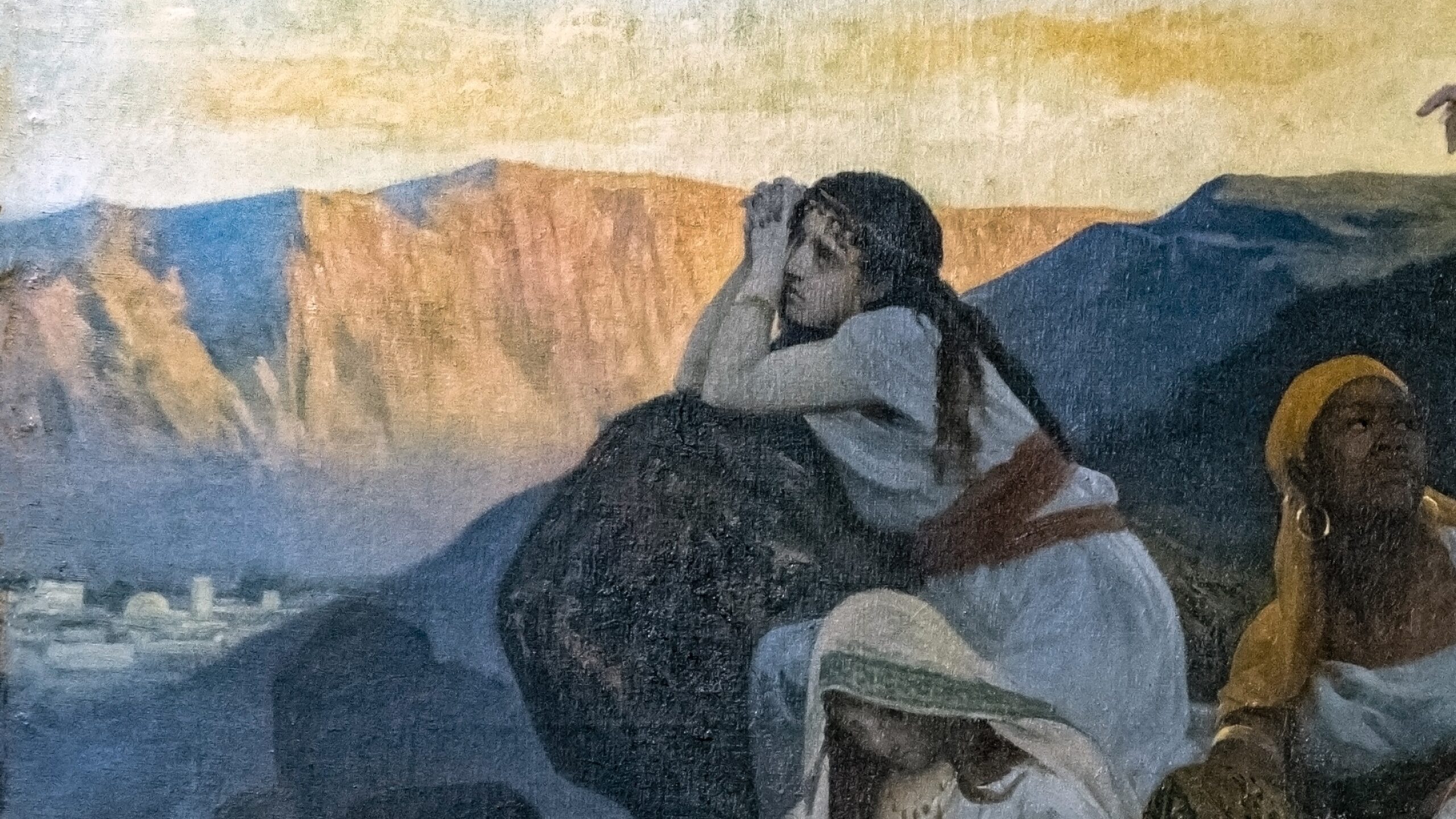
Image credit: Detail of “Jephthah’s Daughter” by Édouard Debat-Ponsan, 1876.