
John 19:1-16a
NL435
1 Then PilateI tookII JesusIII and had him flogged.IV
I “Pilate” = Pilatos. From Latin Pilatus (may mean one who has skill with a javelin); perhaps from pilum (javelin) OR perhaps from pileus (a soft cap made of felt that was brimless and was associated with people who were freedmen). This is Pilate. See https://en.wikipedia.org/wiki/Pontius_Pilate
II “took” = lambano. It does not refer to passive receiving of something, but active acceptance or taking of something whether it is offered or simply nearby. It focuses on individual decision and action.
III “Jesus” = Iesous. From Hebrew Yehoshua (Joshua, the Lord is salvation); {from YHVH (proper name of the God of Israel; the self-existent and eternal one); {from havah (to become) or from hayah (to come to pass, become, be)} + yasha (to deliver, defend, help, preserve, rescue; properly, to be open, wide or free, which implies being safe. So, in a causative sense, this is to free someone)}. This is Jesus or Joshua in Greek – the Lord saves or the Lord is salvation.
IV “flogged” = mastigoo. 7x in NT. From mastix (a whip that had leather straps with metal bits sewn onto them; figurative for great pain, suffering, disease, or plague; a Roman whip used on criminals, the flagellum); probably from massaomai (to chew, gnaw, consume); from masso (to handle, squeeze). This is to flog or whip someone – the victim being strapped to a pole. Used figuratively for being chastised.
2 And the soldiersV woveVI a crownVII of thornsVIII
V “soldiers” = stratiotes. From stratia (army; used figuratively for large organized groups like the angels and the hosts of heaven, which is to say the stars); from the same as strateuo (to wage war, fight, serve as a soldier; used figuratively for spiritual warfare); or from the base of stronnuo (to spread, to spread out like a bed). This is a soldier in a literal or figurative sense.
VI “wove” = pleko. 3x in NT– all in Gospel parallels of soldiers mocking Jesus. This is to twist, braid, or weave together.
VII “crown” = stephanos. 18x in NT. From stepho (to twine, encircle). This is something that surrounds i.e. a crown or garland. Properly, this refers to the wreath or garland that the winner of athletic games would win. It symbolized victory and honor from skill as contrasted with a royal crown, which is diadema in Greek. This is the word used for the crown that the saints in heaven wear in, for example, Revelation 4:4.
VIII “thorns” = akantha. 14x in NT. From akmen (even now, still yet); from the same as akmazo (ripe, to be vigorous); from akme (point, edge); related to ake (a point). This is thorn or thorn bush.
and put it onIX his head,X and they dressed him inXI a purpleXII robe.XIII
IX “put…on” = epitithemi. From epi (on, upon, what is fitting) + tithemi (to put, place, set, fix, establish in a literal or figurative sense; properly, this is placing something in a passive or horizontal position). This is to lay on or place on, whether in a friendly or aggressive way.
X “head” = kephale. This is head or chief. It can be a literal head or, figuratively, a ruler or lord. It can also refer to a corner stone. This is where the word “cephalic” comes from.
XI “dressed…in” = periballo. From peri (about, concerning, all around, encompassing) + ballo (to throw, cast, place, put, drop). This is to thrown around, clothe, array, put on.
XII “purple” = porphurous. 4x in NT. From porphura (purple dye, cloth, or a garment from that cloth; ranged from violet to scarlet to blue; dye made from a snail; symbolized royalty, wealth, or power); perhaps from phuro (to mix something dry with something wet). This is purple, the cloth or the dye – associated with money, power, nobility, and kings.
XIII “robe” = himation. From heima (garment) OR from ennumi (to put on). This is the outer garment, cloak, robe, or mantle. It is worn loosely over a tunic.
3 They kept coming upXIV to him, saying, “Hail,XV KingXVI of the Jews!”XVII and strikingXVIII him on the face.
XIV “coming up” = erchomai. This is to come or go.
XV “hail” = chairo. From char– (to extend favor, lean towards, be inclined to be favorable towards). This is to rejoice, be glad or cheerful; a greeting. This is the root verb that the Greek word for “grace” comes from (charis).
XVI “King” = Basileus. Probably from basis (step, hence foot; a pace); from baino (to walk, to go). This is king, emperor, or sovereign.
XVII “Jews” = Ioudaios. From Ioudas (Judah, Judas); from Hebrew Yehudah (Judah, son of Jacob, his tribal descendants, a name for the southern kingdom. Literally, it means praised); probably from yadah (to throw one’s hands into the air in a gesture of praise); from yad (hand). This is Jewish, a Jew, or Judea.
XVIII “striking” = didomi…rhapisma. Didomi is to give, offer, place, bestow, deliver. This is give in a literal or figurative sense. Rhapisma is 3x in NT. From rhapizo (to hit with a rod or to slap); from a derivation of rhabdos (staff, rod, cudgel; a staff that denotes power, royalty, or authority); from rhepo (to let fall, to rap). This is a hit from a stick or an open-handed slap.
4 Pilate wentXIX out again and saidXX to them, “Look,XXI I am bringingXXII him out to you to let you knowXXIII that I findXXIV no caseXXV against him.”
XIX “went” = exerchomai. Related to “coming up” in v3. From ek (from, from out of) + erchomai (see note XIV above). This is to go out, depart, escape, proceed from, spread news abroad.
XX “said” = lego. This is to speak, say, name, call, command. It is generally to convey verbally.
XXI “look” = idou. From eido (to be aware, see, know, remember, appreciate). This is see! Lo! Behold! Look! Used to express surprise and or draw attention to the statement.
XXII “bringing” = ago. This is lead, bring, carry, guide, drive, go.
XXIII “know” = ginosko. This is to know, recognize, realize, perceive, learn. It is knowledge gained through personal experience.
XXIV “find” = heurisko. This is to find, learn, or obtain. It is to discover something, which generally implies a period of searching for it. This is to find in a literal or figurative sense. This is where the word “heuristic” comes from.
XXV “case” = aitia. From aiteo (to ask, demand, beg, desire). This is a cause or reason. It can also be a legal crime, accusation, guilt, or case.
5 So Jesus cameXXVI out wearingXXVII the crown of thornsXXVIII and the purple robe. Pilate said to them, “BeholdXXIX the man!”XXX
XXVI “came” = exerchomai. Same as “went” in v4. See note XIX above.
XXVII “wearing” = phoreo. 6x in NT. From phero (to bear, bring, lead, make known publicly; to carry in a literal or figurative sense). This is to wear or bear regularly or continually. It can refer to clothing or bearing a burden.
XXVIII “of thorns” = akanthinos. Related to “thorns” in v2. 2x in NT. From akantha (see note VIII above). This is related to thorns or thorny.
XXIX “behold” = idou. Same as “look” in v4. See note XXI above.
XXX “man” = anthropos. Probably from aner (man, male, husband) + ops (eye, face); {from optanomai (to appear, be seen); perhaps from horao (become, seem, appear)}. This is human, humankind. Used for all genders.
6 When the chief priestsXXXI and the policeXXXII sawXXXIII him, they shouted,XXXIV “CrucifyXXXV him! Crucify him!”
Pilate said to them, “Take him yourselves and crucify him; I find no case against him.”
XXXI “chief priests” = archiereus. From archo (to rule, begin, have first rank or have political power) + hiereus (a priest literal or figurative – of any faith); {from hieros (sacred, something sacred, temple, holy, set apart; something consecrated to God or a god)} This is a high or chief priest.
XXXII “police” = huperetes. From huper (by, under, under the authority of another) + eresso (to row). Originally, this was a rower or someone who worked the oars on the lower deck of a boat. It is used figuratively of someone under the authority of another who follows their commands. So this could be servant, attendant, or office. It could also be someone who is a minister of the Gospel.
XXXIII “saw” = horao. Related to “man” in v5. See note XXX above.
XXXIV “shouted” = kraugazo. 9x in NT. From krauge (a very emotional shout or cry generally or clamor against someone else; a cry of alarm, trouble, or grief); from krazo (to cry out, scream, shriek; onomatopoeia for the sound of a raven’s call; figuratively, this is means crying out urgently without intelligible words to express something that is deeply felt). This is to cry, shout, clamor. It is a screaming or shrieking that is often impossible to understand exact words in. It is sound expressing feeling/urgency. Properly, this refers to loud animal sounds.
XXXV “crucify” = stauroo. From stauros (upright stake, cross; literally the horizontal beam of a Roman cross, generally carried by the one convicted to die); from the same as histemi (to stand, cause to stand). This can be to attach someone to a cross or fencing with stakes. In a figurative sense, it could be to destroy, mortify, or subdue passions/selfishness.
7 The Jews answeredXXXVI him, “We haveXXXVII a law,XXXVIII
XXXVI “answered” = apokrinomai. From apo (from, away from) + krino (to judge, decide, think good, condemn, determine, pass judgment, stand trial, sue; judging whether in court or in a private setting; properly, mentally separating or distinguishing an issue – to come to a choice or decision, to judge positively or negatively in seeking what is right or wrong, who is innocent or guilty; can imply trying, condemning, punishing, or avenging). This is to reply or respond, to draw one’s own conclusions, to speak when one is expected to.
XXXVII “have” = echo. This is to have, hold, possess.
XXXVIII “law” = nomos. From nemo (to parcel out). Literally, this is that which is assigned. It can be usage, custom, or law. This word can be used for human or divine law. It can be used specifically for the law of Moses or as a name for the Torah (the first five books of the Bible). Sometimes it is used for scripture as a whole, used of the Gospel, or of any theology. It is also used for the “tradition of the elders,” which would be the oral Torah – the tradition of the laws plus their interpretations as they were passed down over time. We must carefully consider which meaning of “law” is meant when we interpret passages the word is found in.
and according to that law he oughtXXXIX to dieXL because he has claimed to beXLI the SonXLII of God.”XLIII
XXXIX “ought” = opheilo. Perhaps from the base of ophelos (advantage, gain, profit); from ophello (heaped together, accumulate, increase). This is to be indebted morally or legally – having an obligation one must meet. This term came from the legal world, but was then adopted in reference to morality. In the New Testament it is used for humanity’s ethical responsibility.
XL “die” = apothnesko. From apo (from, away from) + thnesko (to die, be dead). This is to die off. It is death with an emphasis on the way that death separates. It can also mean to wither or decay.
XLI “claimed to be” = heautou + poieo. Literally, “he made himself.” Poieo is to make, do, act, construct, abide, or cause.
XLII “Son” = huios. This is son, descendant – a son whether natural born or adopted. It can be used figuratively for other forms of kinship.
XLIII “God” = Theos. From Proto-Indo-European origins, meaning do, put, place. This is God or a god in general.
8 Now when Pilate heardXLIV this,XLV he was moreXLVI afraidXLVII than ever.
XLIV “heard” = akouo. This is hear or listen, but it also means to understand by hearing. This is where the word “acoustics” comes from.
XLV {untranslated} = logos. Related to “said” in v4. From lego (see note XX above). This is word, statement, speech, analogy. It is a word that carries an idea or expresses a thought, a saying. It could refer to a person with a message or reasoning laid out in words. By implication, this could be a topic, line of reasoning, or a motive. It can be used for a divine utterance or as Word – Christ.
XLVI “more” = mallon. This is rather, more than, or better.
XLVII “afraid” = phobeo. From phobos (panic flight, fear, fear being caused, terror, alarm, that which causes fear, reverence, respect); from phebomai (to flee, withdraw, be put to flight). This is also to put to flight, terrify, frighten, dread, reverence, to withdraw or avoid. It is sometimes used in a positive sense to mean the fear of the Lord, echoing Old Testament language. More commonly, it is fear of following God’s path. This is where the word phobia comes from.
9 He enteredXLVIII his headquartersXLIX again and askedL Jesus, “Where areLI you from?” But Jesus gaveLII him no answer.LIII
XLVIII “entered” = eiserchomai. Related to “coming up” in v3 & “went” in v4. From eis (to, into, for, among) + erchomai (see note XIV above). This is to go in in a literal or figurative sense.
XLIX “headquarters” = praitorion. 8x in NT. From Latin praetorium (headquarters, general’s tent, villa, place where the governor lives); from prator (leader, chief, president); from pareeo (to lead, go before). This is praetorium or preatorian guard. It is the place where the governor lives or the place where the praetorian guard of Rome lived. It could also mean courtroom. See https://en.wiktionary.org/wiki/praetorium#Latin
L “asked” = lego. Same as “said” in v4. See note XX above.
LI “are” = eimi. This is to be, exist.
LII “gave” = didomi. Same as “striking” in v3. See note XVIII above.
LIII “answer” = apokrisis. Related to “answered” in v7. 4x in NT. From apokrinomai (see note XXXVI above). This is reply or response.
10 Pilate therefore said to him, “Do you refuse to speak to me? Do you not knowLIV that I have powerLV to releaseLVI you and power to crucify you?”
LIV “know” = eido. Related to “look” in v4. See note XXI above.
LV “power” = exousia. Related to “are” in v9. From exesti (to be permitted or lawful); {from ek (out, out of) + eimi (see note LI above)}. This is power to act or weight. It especially denotes moral authority or influence. It can mean domain, liberty, freedom, capacity, mastery, right, force, or strength.
LVI “release” = apoluo. From apo (from, away from) + luo (to loose, release, untie; figuratively, to break, destroy, or annul; releasing what had been withheld). This is letting go, setting free, or releasing. So, it can be to discharge, dismiss, divorce, pardon, or set at liberty.
11 Jesus answered him, “You would have no power over me unless it had been given you from above;LVII therefore the one who handed me overLVIII to you is guiltyLIX of a greaterLX sin.”LXI
LVII “from above” = anothen. 13x in NT– this is the word used in John 3:3 in the being born “from above”/“again” conversation between Jesus and Nicodemus. From ano (up, above, up to the top, things above, heaven); from ana (up, upwards, again, back, among, anew). This is from above, from the top, again, beginning, from the source. It implies anew.
LVIII “handed…over” = paradidomi. Related to “striking” in v3. See note XVIII above.
LIX “is guilty” = echo. Same as “have” in v7. See note XXXVI above.
LX “greater” = megas. This is big in a literal or figurative sense – great, large, exceeding, abundant, high, mighty, perfect, strong, etc.
LXI “sin” = hamartia. From hamartano (to miss the mark, do wrong, make a mistake, sin); {from a (not) + meros (a part or share)}. Literally, this means not having one’s share or portion – like not receiving inheritance or what was allotted to you. This word means missing the mark so it is used for guilt, fault, and acts of sin.
12 From then on Pilate triedLXII to release him, but the Jews cried out,LXIII “If you release this man, you are no friendLXIV
LXII “tried” = zeteo. This is to seek, search for, desire. It is searching for something by inquiring or investigation. It can be seek in a literal or figurative sense. There is a Hebrew figure of speech “to seek God’s face” so it can also mean to worship God. Alternately, you could seek someone’s life i.e. plot to kill them.
LXIII “cried out” = kraugazo. Same as “shouted” in v6. See note XXXIV above.
LXIV “friend” = philos. This is dear, beloved, a friend, an associate; friendship with personal affection, a trusted confidante; love from personal experience with another person.
of Caesar.LXV EveryoneLXVI who claims to be a king sets himself againstLXVII Caesar.”
LXV “Caesar” = Kaisar. From Latin (Caesar); perhaps from Punic caesai (elephant) OR from Latin a cesiis oculis (because of the blue eyes) OR from Latin a caesarie (because of the hair) OR from Latin a caeso matris utero (born by Caesarean section) OR from Latin caedo (to cut). This is Caesar, at first a last name, then taken as a title by Roman emperors. See https://en.wiktionary.org/wiki/Caesar#Latin
LXVI “everyone” = pas. This is all or every.
LXVII “sets…against” = antilego. Related to “said” in v4 & {untranslated} in v8. 11x in NT. From anti (opposite, instead of, against) + lego (see note XX above). This is literally to speak against – so, to contradict, oppose, resist. It is being argumentative, especially with a hostile bent through opposition. It can indicate attempts to thwart.
13 When Pilate heard these words,LXVIII he brought Jesus outside and satLXIX on the judge’s benchLXX
LXVIII “words” = logos. Same as {untranslated} in v8. See note XLV above.
LXIX “sat” = kathizo. From kathezomai (to sit down, be seated); {from kata (down, against, according to, among) + hezomai (to sit); {from aphedron (a seat, a base)}}. This is to sit, set, appoint, stay, rest.
LXX “judge’s bench” = bema. Related to “king” in v3. 12x in NT. From the same as basis (see note XVI above). This is a place that is raised and has steps such as where a tribunal would meet to mete out justice. It also refers literally to the chair from which such justice would come whether for reward or punishment. This word was borrowed into Jewish religious practice from Byzantine Greek (from the same root) to describe the raised area of the synagogue from which the Torah was proclaimed – the bima. See https://en.wiktionary.org/wiki/%D7%91%D7%99%D7%9E%D7%94#Hebrew
at a placeLXXI calledLXXII The Stone Pavement,LXXIII or in HebrewLXXIV Gabbatha.LXXV
LXXI “place” = topos. This is a place or region. It is a smaller space that can only hold a limited number of people whereas chora is a larger place. Figuratively it could be an opportunity.
LXXII “called” = lego. Same as “said” in v4. See note XX above.
LXXIII “Stone Pavement” = lithostrotos. Related to “soldiers” in v2. 1x in NT. From lithos (stone literal or figurative – stumbling, millstone, cornerstone) + strotos (spread or covered); {from stronnumi (see note V above)}. This is paved with stone or a mosaic. It is the place where the Roman tribunal met.
LXXIV “in Hebrew” = Hebraisti. 7x in NT. From Hebrais (Hebrew language, Aramaic); from Eber (Heber); from Hebrew Eber (the region beyond; Eber, the name of several Israelites including a descendant of Shem); from abar (to pass over, pass through, or pass by; cross over or to alienate; used for transitions). This is Hebrew, perhaps meaning a descendant of Eber. This is in Hebrew or in Aramaic.
LXXV “Gabbatha” = Gabbatha. 1x in NT. From Aramaic gab (back or side); corresponding to Hebrew gab (back, rim, valut, bulwark, top, a prominent or high place). This is Gabbath, which may mean stone pavement like the Greek. It may also mean knoll or higher place.
14 Now it was the day of PreparationLXXVI for the Passover,LXXVII and it was about noon.LXXVIII He said to the Jews, “Here is your King!”
LXXVI “day of Preparation” = paraskeue. 6x in NT. From paraskeuazo (to prepare, get ready); {from para (from beside, by) + skeuos (vessel, tool, container, implement; also vessel in a figurative or literal sense); {from skeuazo (to prepare using a tool)}}. This is preparation or readiness. It can be used specifically to refer to preparing for the Sabbath or a festival.
LXXVII “Passover” = Pascha. From Aramaic corresponding to Hebrew pesach (Passover or the offering for Passover); from pasach (to stop, pass over, skit over, to spare). This is Passover – used for the feast, the lamb of sacrifice, the day, and the festival itself. This is where the term “paschal” comes from as in the “paschal lamb.”
LXXVIII “was about noon” = hora + eimi + hos + hektos. Literally, “the hour was about the sixth.” Hora is a set time or period, an hour, instant, or season. This is where the word “hour” comes from. Eimi is the same as “are” in v9. See note LI above. Hektos is 14x in NT. From hex (six). This is sixth.
15 They cried out, “AwayLXXIX with him! Away with him! Crucify him!”
Pilate asked them, “Shall I crucify your King?”
The chief priests answered, “We have no king but Caesar.” 16 Then he handed him over to them to be crucified. So they tookLXXX Jesus,
LXXIX “away” = airo. This is to lift up in a literal or figurative sense. So, it could mean to lift, carry, or raise. It could also imply lifting something in order to take it away or remove it. Figuratively, this can be used for raising the voice or level of suspense. It can mean sailing off as raising the anchor. It can also correspond to a Hebrew expression for atonement of sin (lift/remove sin).
LXXX “took” = paralambano. Related to “took” in v1. From para (beside, by, in the presence of) + lambano (see note II above). This is to receive, take, acknowledge, associate with. It can also mean to take on an office or to learn.
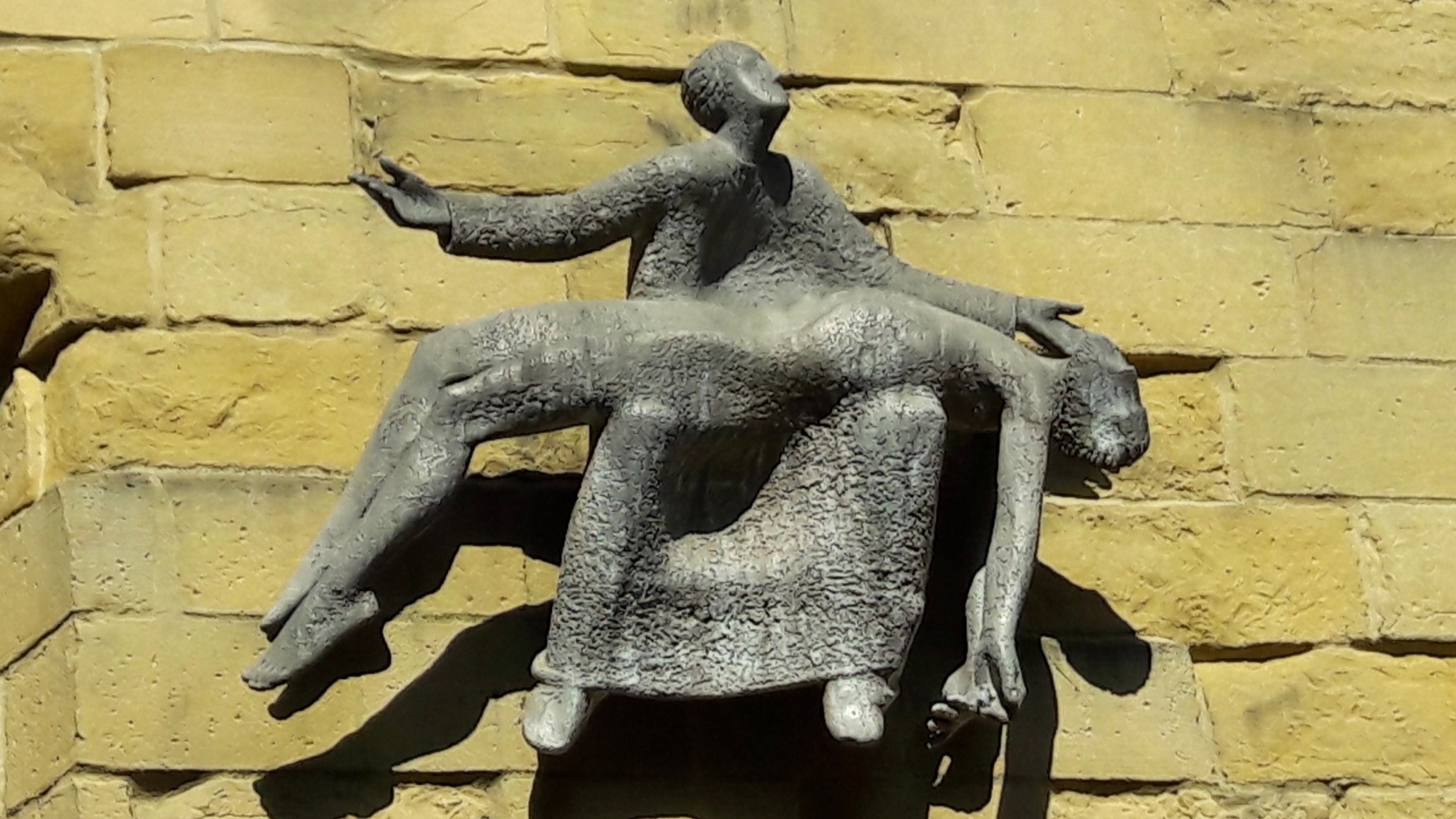
Image credit: “Piedada” of Donostia by Jose Oteiza. Photo by Ksarasola, 2022.
