
2 Samuel 4
1 When Saul’sI sonII Ishbaal heardIII that AbnerIV
I “Saul’s” = Shaul. From shaal (to ask, inquire, beg, borrow, desire, request; can also mean demand). This is Saul or Shaul, meaning “asked of the Lord.”
II “son” = ben. From banah (to build or obtain children). This is son, age, child. It is son in a literal or figurative sense.
III “heard” = shama. This is to hear, call, consent, or consider. It implies listening intelligently, giving attention, and, because of these two factors, obedience and action are often implied.
IV “Abner” = Abner. From ab (father in a literal or figurative sense – grandfather, chief, ancestor) + ner (properly, to glisten; a lamp, light, burner, candle; light literal or figurative). This is Abner, a name meaning “my father is a lamp,” “father of light,” “enlightening.”
had diedV at Hebron,VI his courageVII failed,VIII
V “died” = mut. This is to die in a literal or figurative sense. It can also refer to being a dead body.
VI “Hebron” = Chebron. From cheber (company, society, enchantment, wide); from chabar (to unite, ally, attach, touch; to join in a literal or figurative sense; also, specially, using magic knots or spells to fascinate or connect). This is Hebron, meaning “seat of association” or “league.”
VII “courage” = yad. This is hand, ability, power. Hand in a literal sense, but also what one can do or the means by which one does it.
VIII “failed” = raphah. This is to slacken in a literal or figurative sense. So, it could be to hang, be feeble, fail, drop, be helpless, relax, slink, subside, or wait.
and allIX IsraelX was dismayed.XI
IX “all” = kol. From kalal (to complete). This is all or every.
X “Israel” = Yisrael. From sarah (to persist, exert oneself, contend, persevere, wrestle, prevail) + El (God or god). This is Israel, meaning God strives or one who strives with God; new name for Jacob and for his offspring. This refers to the people and to the land.
XI “dismayed” = bahal. To be afraid or dismayed or amazed. This is deep trembling within. So, figuratively, it refers to being suddenly agitated. This implies moving or acting quickly/anxiously.
2 Saul’s son hadXII twoXIII XIVcaptainsXV of raiding bands;XVI
XII “had” = hayah. This is to be or become, to happen.
XIII “two” = shenayim. From sheni (double, again, another, second); from shanah (to fold, repeat, double, alter, or disguise). This is two, both, second, couple.
XIV {untranslated} = ish. Perhaps from enosh (human, humankind, mortal); from anash (to be weak, sick, or frail). This is man, husband, another, or humankind.
XV “captains” = sar. This is chief, leader, ruler, lord, official, governor, prince, military leader. It refers to someone at the top of a rank or class.
XVI “raiding bands” = gedud. From gadad (to cut, gather, assemble, crowd; also, to gash as pushing in). This is a crowd, but generally used to refer to soldiers. So, it is a band, troop, or company. It can also be a group of robbers.
the nameXVII of the oneXVIII was Baanah,XIX
XVII “name” = shem. May be from sum (to put, place, set). This is name, fame, renown. A name was thought to indicate something essential about a person – something about their individuality. So, this word can also mean honor, authority, or character.
XVIII “one” = echad. Perhaps from achad (to unify, continue on a path; figuratively, to gather one’s thoughts). This is the number one, first, united. It can also be alone, altogether, a certain, a few.
XIX “Baanah” = Baanah. Related to “son” in v1. 9x in OT. Perhaps from anah (to be bowed down; humility or being browbeaten, oppressed, afflicted, or depressed; literal or figurative – depressed in mood or circumstance) OR from ben (see note II above) + anah (to answer, respond, announce, sing, shout, or testify; to pay attention, which implies responding and, by extension, starting to talk; singing, shouting, testifying, etc.). This is Baanah, which means “in affliction” or “son of response” or “son of affliction” or “son of Distress” or “affliction;” see https://www.abarim-publications.com/Meaning/Baana.html
and the name of the otherXX was Rechab.XXI They were sons of Rimmon,XXII
XX “other” = sheni. Related to “two” in v2. See note XIII above.
XXI “Rechab” = Rekab. 13x in OT. From rakab (to ride an animal or in some vehicle; also, bringing on a horse). This is Rechab, which means “rider” or “band of riders” or “driver” or “controller” or “horseman.” See https://www.abarim-publications.com/Meaning/Rechab.html
XXII “Rimmon” = Rimmon. 17x in OT. From the same as rimmon (a pomegranate or a decoration in that shape; can also refer to the pomegranate tree); perhaps from rum (to rise in a literal or figurative sense; to get up or exalt). This is Rimmon, the name of a god in Syria who is called Baal and who is called Ramanu in Assyria. It is also the name of some cities. It may mean “pomegranate” or “apex” or “harvest ready” or “mature mind.” See https://www.abarim-publications.com/Meaning/Rimmon.html & https://en.wikipedia.org/wiki/Rimmon
a BenjaminiteXXIII from Beeroth,XXIV forXXV
XXIII “Benjaminite” = ben + Binyamin. Literally, “sons of Benjamin.” Ben is the same as “son” in v1. See note II above. Binyamin is related to “son” in v1 & “Baanah” in v2. From ben (see note II above) + from yamin (right hand or side; that which is stronger or more agile; the south); {perhaps yamam (to go or choose the right, use the right hand; to be physically fit or firm)}. This is Benjamin, meaning “son of the right hand.” It could refer to Benjamin himself, his offspring, their tribe, or their territory.
XXIV “Beeroth” = Beerothi. 5x in OT. From Beeroth (Beeroth, a place whose name means “wells”); from beer (a well or pit); from baar (to make plain; to dig; can also mean to engrave or figuratively to explain). This is someone from Beeroth – a Beerothite.
XXV {untranslated} = gam. This is also, moreover, again.
BeerothXXVI is considered to belongXXVII to Benjamin.XXVIII 3 (Now the people of BeerothXXIX had fledXXX to GittaimXXXI
XXVI “Beeroth” = Beeroth. Related to “Beeroth” in v2. 5x in OT. See note XXIV above.
XXVII “considered to belong” = chashab. This is properly to braid or interpenetrate. Literally it is to create or to wear. Figuratively, it can mean plotting – generally in a negative sense. More broadly, this can also mean think, consider, or make account of.
XXVIII “Benjamin” = Binyamin. Same as “Benjaminite” in v2. See note XXIII above.
XXIX “people of Beeroth” = Beerothi. Same as “Beeroth” in v2. See note XXIV above.
XXX “fled” = barach. This is to flee, drive away, hurry, to bolt.
XXXI “Gittaim” = Gittayim. 2x in OT. From gath (wine press); perhaps from nagan (to strike a stringed instrument, to pluck or play it). This is Gittaim, meaning “double wine-press.”
and areXXXII there as resident aliensXXXIII to this day.)XXXIV
XXXII “are” = hayah. Same as “had” in v2. See note XII above.
XXXIII “resident aliens” = gur. Properly, this is the act of turning off the road for any reason. So, it means sojourning, becoming a guest. It can mean being fearful since one is outside of home territory. It can also mean dwelling, living, or inhabiting if one has turned off the root to encamp for a longer duration. This word is where the Hebrew “ger” comes from, which is the word translated “stranger” or “resident alien.”
XXXIV “day” = yom. Root may mean being hot. This is the day in a literal or figurative sense. It can also mean birth, age, daylight, continually or other references to time.
4 Saul’s son JonathanXXXV had a son who was crippledXXXVI in his feet.XXXVII
XXXV “Jonathan” = Yehonathan. Related to “had” in v2. From YHVH (proper name of the God of Israel; God, Lord; the self-existent or eternal one); {from havah (to become) or hayah (see note XII above)} + natan (to give, put, set, offer; to give literally or figuratively). This is Jonathan or Jehonathan, meaning “the Lord has given.”
XXXVI “crippled” = nakeh. 3x in OT. From nakah (to hit whether lightly or severely literal or figurative; beat, punish, give wounds, kill, or slaughter). This is stricken in a literal sense. Figuratively, it could be crippled, maimed, contrite, or dejected.
XXXVII “feet” = regel. This is foot, endurance, or journey. It is a foot as the means of walking and so it implies a step or a greater journey. It can be used euphemistically for private parts.
He was fiveXXXVIII yearsXXXIX oldXL whenXLI the newsXLII about Saul and Jonathan
XXXVIII “five” = chamesh. This is five or fifth.
XXXIX “years” = shanah. From shana (to change, alter). This is a year, age, old. It can also mean yearly.
XL “old” = ben. Same as “son” in v1. See note II above.
XLI {untranslated} = hayah. Same as “had” in v2. See note XII above.
XLII “news” = shemuah. Related to “heard” in v1. From shama (see note III above). This is something heard – news, a rumor, fame, announcement.
cameXLIII from Jezreel.XLIV His nurseXLV
XLIII “came” = bo. This is to enter, come in, advance, fulfill, bring offerings, enter to worship, attack. It can also have a sexual connotation.
XLIV “Jezreel” = Yizreel. Related to “Israel” in v1. From zara (to sow or scatter seed; conceive or yield) + El (see note X above). This is Jezreel or Yizreel. It means “God sows” or “God will sow.”
XLV “nurse” = aman. This is to believe, endure, fulfill, confirm, support, be faithful. It is to put one’s trust in, be steadfast. Figuratively, this is to be firm, steadfast, or faithful, trusting, believing, being permanent, morally solid. This is where the word “amen” comes from.
picked him upXLVI and fled,XLVII and in her hasteXLVIII to flee it happenedXLIX
XLVI “picked…up” = nasa. This is to lift in a broad sense, literally and figuratively. So it could be to carry, take, or arise. It could also be bring forth, advance, accept.
XLVII “fled” = nus. This is to flee, vanish away, hide, escape, be displayed.
XLVIII “haste” = chaphaz. 9x in OT. This is hurry or alarm. It is something that begins with a start so it can mean to hurry away or to panic, tremble, fear.
XLIX “happened” = hayah. Same as “had” in v2. See note XII above.
that he fellL and became lame.LI His name was Mephibosheth.LII
L “fell” = naphal. This is to fall, whether by accident, to fall prostrate, or to fall in violent death. Figuratively, it can refer to personal ruin or calamity, a city falling, an attack or a falling away. It can also be a deep sleep or wasting away.
LI “became lame” = pasach. 8x in OT. This is to stop, pass over, skip over, to spare, become lame, hesitate. It is the root of the word for “Passover” in Hebrew.
LII “Mephibosheth” = Mephibosheth. 15x in OT. From paah (to cut in pieces, scatter, blow away) + bosheth (shame as a feeling and a thing that creates shame; humiliation, confusion, or an idol); {from bosh (properly, to be pale, which implies shame, disappointment, or confusion)}. This is Mephibosheth, meaning “dispeller of shame” (a reference to Baal) or “one who destroys shame” or “end of shame.” See https://www.abarim-publications.com/Meaning/Mephibosheth.html
5 Now the sons of Rimmon the Beerothite,LIII Rechab and Baanah, set out,LIV and about the heatLV of the day they came to the houseLVI
LIII “Beerothite” = Beerothi. Same as “Beeroth” in v2. See note XXIV above.
LIV “set out” = halak. This is go, come, walk. It is walk literally and figuratively and includes people and animals. It can be used figuratively for one’s moral life – how we walk according to God’s way or against it. It can also refer to the walk of life as in the course one’s life takes, the choices we make, etc.
LV “heat” = chom. 14x in OT. From chamam (to be warm, heat; to be hot in a literal or figurative sense; to mate). This is hot or warmth.
LVI “house” = bayit. Related to “son” in v1 & “Baanah” and “Benjaminite” in v2. Probably from banah (see note II above). This is house, court, family, palace, temple.
of IshbaalLVII while he was takingLVIII his noondayLIX rest.LX
LVII “Ishbaal” = Ish-bosheth. Related to {untranslated} in v2 and to “Mephibosheth” in v4. 11x in OT. From ish (see note XIV above) + bosheth (shame as a feeling and a thing that creates shame; can also mean humiliation, confusion, or be used specifically for an idol); {from bosh (properly, to be pale, which implies shame, disappointment, or confusion)}. This is Ish-bosheth, which means “man of shame.”
LVIII “taking” = shakab. This is to lie down, lodge. It is lying for sleep, sex, or other reasons.
LIX “noonday” = tsohar. From tsahar (pressing oil, glistening); from yitshar (fresh oil, anointed; oil as that which is burned to make light; used figuratively to talk about anointing). This is a light, window, or midday.
LX “rest” = mishkab. Related to “taking” in v5. From shakab (see note LVIII above). This is a place where one lies down i.e. a bed, couch, or bedchamber. It can also be used in an abstract sense to refer to sleep or euphemistically for sex.
6 They came insideLXI the house as though to takeLXII wheat,LXIII and they struckLXIV him
LXI “inside” = tavek. This is among, middle, in the midst, the center. Perhaps, properly, to sever.
LXII “take” = laqach. This is to take, accept, carry away, receive. It can also have the sense of take a wife or take in marriage.
LXIII “wheat” = chittah. Perhaps from chanat (to spice, ripen, embalm). This is wheat, referring to the plant or its product.
LXIV “struck” = nakah. Related to “crippled” in v4. See note XXXVI above.
in the stomach;LXV then Rechab and his brotherLXVI Baanah escaped.LXVII
LXV “stomach” = chomesh. 4x in OT– all in 2 Samuel. May come from a word that means being stout. This is one-fifth or stomach.
LXVI “brother” = ach. This is brother, kindred, another, other, like. It is literally brother, but it can also be someone who is similar, resembling, or related to.
LXVII “escaped” = malat. This is to be smooth, which implies to escape as slipping away from. It can also be release, rescue, deliver, or preserve. It can be used specifically to meaning giving birth or making sparks.
7 Now they had come into the house while he was lyingLXVIII on his couchLXIX in his bedchamber;LXX
LXVIII “lying” = shakab. Same as “taking” in v5. See note LVIII above.
LXIX “couch” = mittah. From natah (to stretch or spread out, extend, bend). This is a couch or bed that is spread out to sleep on or for eating. It can also refer to a litter or a bier.
LXX “bedchamber” = cheder + mishkab. Cheder is from chadar (to surround or enclose; a room as enclosed; also, by analogy, besieging). This is a chamber or room that is private. Can mean the innermost chamber of a house. Mishkab is the same as “rest” in v5. See note LX above.
they attackedLXXI him, killedLXXII him, and beheadedLXXIII him. Then they tookLXXIV his headLXXV
LXXI “attacked” = nakah. Same as “struck” in v6. See note LXIV above.
LXXII “killed” = mut. Same as “died” in v1. See note V above.
LXXIII “beheaded” = sur + et + rosh. Sur is to turn aside in a literal or figurative sense – to depart, decline, rebel, remove, or withdraw. Rosh may come a word that means to shake. It is the head, captain, or chief. It can also be excellent or the forefront. It can be first in position or in statue or in time (i.e. the beginning).
LXXIV “took” = laqach. Same as “take” in v6. See note LXII above.
LXXV “head” = rosh. Same as “beheaded” in v7. See note LXXIII above.
and traveledLXXVI by wayLXXVII of the ArabahLXXVIII all nightLXXIX long.
LXXVI “traveled” = halak. Same as “set out” in v5. See note LIV above.
LXXVII “way” = derek. From darak (to tread, march, to walk. Can also mean affixing a string to a box since one needs to step on it to bend it in the process; so also an archer). This is a road as a thing that is walked on. Can be used figuratively for the path that one’s life takes or how one chooses to live one’s life.
LXXVIII “Arabah” = Arabah. From the same as arab (desert plateau, Arabia) OR from arab (to become evening); {from ereb (evening) or from arab (to exchange, give or take on pledge, braid, intermix)}. This is a desert valley or plain, wilderness. Also, the name of a place Arabah.
LXXIX “night” = layil. Properly, this refers to light twisting away. It is used for night or midnight. Figuratively, this can mean adversity.
8 They broughtLXXX the head of Ishbaal to DavidLXXXI at Hebron and saidLXXXII to the king,LXXXIII
LXXX “brought” = bo. Same as “came” in v4. See note XLIII above.
LXXXI “David” = David. From the same as dod (beloved, love, uncle); the root may mean to boil, which is used figuratively to describe love. So, this implies someone you love such as a friend, a lover, or a close family member like an uncle. David’s name likely means something like “beloved one.”
LXXXII “said” = amar. This is to speak, say, answer, command, promise, report.
LXXXIII “king” = melek. From malak (to be or become king or queen, to rise to the throne, to be crowned; by implication, to take counsel). This is king or royal.
“HereLXXXIV is the head of Ishbaal son of Saul, your enemyLXXXV who soughtLXXXVI your life;LXXXVII
LXXXIV “here” = hinneh. From hen (lo! Behold! If, though; an expression of surprise). This is to draw attention, show suddenness or surprise, or to emphasize the importance of the coming statement. See! Lo! Behold!
LXXXV “enemy” = oyeb. From ayab (to hate or be hostile to). This is a foe or enemy as one that you are hostile to.
LXXXVI “sought” = baqash. This is to seek, ask, desire, or request. It can be any kind of searching. It can also mean to worship or pray – implies a striving for.
LXXXVII “life” = nephesh. Related to naphash (to refresh or be refreshed). This is soul, self, person, emotion. It is a breathing creature. Can also refer to appetites and desires.
the LordLXXXVIII has avengedLXXXIX my lordXC the king this day on Saul and on his offspring.”XCI
LXXXVIII “Lord” = YHVH. Related to “had” in v2 & “Jonathan” in v4. See note XXXV above.
LXXXIX “avenged” = natan…neqamah. Natan is related to “Jonathan” in v4. See note XXXV above. Neqamah is from naqam (a quarrel or vengeance); from naqam (to avenge, punish, have a grudge, execute). This is vengeance, or revenge – whether the act of vengeance or the drive towards vengeance.
XC “lord” = adon. From a root that means ruling or being sovereign. This is lord, master, or owner.
XCI “offspring” = zera. Related to “Jezreel” in v4. From zara (see note XLIV above). This is seed or sowing. It can, thus, mean a fruit, plant, sowing time, child, offspring, or posterity.
9 David answeredXCII Rechab and his brother Baanah, the sons of Rimmon the Beerothite,XCIII “As the LordXCIV lives,XCV
XCII “answered” = anah. Related to “Baanah” in v2. See note XIX above.
XCIII {untranslated} = amar. Same as “said” in v8. See note LXXXII above.
XCIV “Lord” = YHVH. Same as “Lord” in v8. See note LXXXVIII above.
XCV “lives” = chay. From chayah (to live or keep alive literally or figuratively). This is alive, living, lifetime. It can also be used to describe someone’s age. It can refer to animals, plants, water, or a company or congregation of people. It is life in a very broad sense.
who has redeemedXCVI my lifeXCVII out of everyXCVIII adversity,XCIX
XCVI “redeemed” = padah. This is to sever, which is to say to ransom. To secure someone’s release (by paying their debt to free them from slavery) and thus redeem, rescue, deliver, preserve. Can also be the redemption price.
XCVII “life” = nephesh. Same as “life” in v8. See note LXXXVII above.
XCVIII “every” = kol. Same as “all” in v1. See note IX above.
XCIX “adversity” = tsarah. From tsar (properly, a narrow or constricted place; figuratively, trouble, a pebble, an enemy, anguish, or distress); from tsarar (to bind, restrict, narrow, be cramped, an adversary). This is tightness, distress, affliction, trouble, or adversary.
10 when the one who toldC me,CI ‘See,CII Saul is dead,’ thoughtCIII
C “told” = nagad. This is to declare, make conspicuous, stand in front, manifest, predict, explain.
CI {untranslated} = amar. Same as “said” in v8. See note LXXXII above.
CII “see” = hinneh. Same as “here” in v8. See note LXXXIV above.
CIII “thought” = hayah…ayin. Hayah is the same as “had” in v2. See note XII above. Ayin is eye in a literal or figurative sense so eye, appearance, favor, or a fountain (the eye of the landscape).
he was bringing good news,CIV I seizedCV him and killedCVI him
CIV “bringing good news” = basar. This is being a messenger, to publish, carry, or preach. Properly, this is being fresh, rosy or cheerful as one bearing news.
CV “seized” = achaz. This is to grasp, catch, seize, take and hold in possession. It can also be to be afraid or hold back.
CVI “killed” = harag. This is to strike with deadly intent so it can be kill, destroy, murder, or put to death.
at ZiklagCVII—this was the reward I gaveCVIII him for his news.CIX
CVII “Ziklag” = Tsiqelag. 15x in OT. Perhaps from tsuq (“to smelt copper”) + log (pint). This is Ziklag, a city whose name may mean “a pint of liquid metal,” “winding,” or “outflowing of a fountain.” See https://www.abarim-publications.com/Meaning/Ziklag.html
CVIII “reward…gave” = natan. Same as “avenged” in v8. See note LXXXIX above.
CIX “news” = besorah. Related to “bringing good news” in v10. 6x in OT. From basar (see note CIV above). This is news, reward, or a reward that is granted for favorable news.
11 How much more,CX then, when wickedCXI menCXII have killedCXIII a righteousCXIV man
CX “how much more” = aph. This is also, furthermore, even.
CXI “wicked” = rasha. This is morally wrong so it refers to someone who is actively bad as wicked, criminal, an evil person, offender, condemned, or ungodly.
CXII “men” = ish. Same as {untranslated} in v2. See note XIV above.
CXIII “killed” = harag. Same as “killed” in v10. See note CVI above.
CXIV “righteous” = tsaddiq. From the same as tsedeq (rightness, righteousness, just cause, vindication; that which is right in a natural, moral, or legal sense; abstractly equity; figuratively prosperity). This is just, innocent, righteous, righteous one, or lawful.
on his bedCXV in his own house! And nowCXVI shall I not requireCXVII his bloodCXVIII
CXV “bed” = mishkab. Same as “rest” in v5. See note LX above.
CXVI “now” = attah. Related to “Baanah” in v2 & “answered” in v9. Perhaps from et (a period or season; whenever or continually); probably from anah (see note XIX above). This is now, from now on.
CXVII “require” = baqash. Same as “sought” in v8. See note LXXXVI above.
CXVIII “blood” = dam. Perhaps from damam (to cease, be or become mute, silent, still, cut off, hold peace, be astonished, die). This is blood, bloodshed, bloodguilt, lifeblood, and death. It is used for people and animals. More often blood from a wound or the blood of the innocent. Used figuratively for violence or for wine. Closely tied to life and death.
at your handCXIX and destroyCXX you from the earth?”CXXI
12 So David commandedCXXII the young men,CXXIII
CXIX “hand” = yad. Same as “courage” in v1. See note VII above.
CXX “destroy” = ba’ar. This is to burn, consume, heat, remove. It can also be to consume by a fire or through eating, being brutish or wasting.
CXXI “earth” = erets. Root may mean to be firm. This is earth, ground, field land, or country.
CXXII “commanded” = tsavah. This is to charge, command, order, appoint, or enjoin. This is the root that the Hebrew word for “commandment” comes from (mitsvah).
CXXIII “young men” = naar. May be from na’ar (to shake, toss up and down, tumble around). This is a child or a servant. It is a child in their active years so they could be aged anywhere from infancy to adolescence.
and they killedCXXIV them; they cut offCXXV their hands and feet and hungCXXVI their bodies
beside the poolCXXVII at Hebron. But the head of Ishbaal they tookCXXVIII and buriedCXXIX in the tombCXXX of Abner at Hebron.
CXXVII “pool” = berekah. 17x in OT. From barak (to kneel, bless; blessing God as part of worship and adoration; blessing humans to help them; can be used as a euphemism to say curse God). This is a pool or a pond. Perhaps it refers to camels kneeling to drink or rest.
CXXVIII “took” = laqach. Same as “take” in v6. See note LXII above.
CXXIX “buried” = qabar. This is to bury or inter. It could also refer to the person who does the burying.
CXXX “tomb” = qeber. Related to “buried” in v12. From qabar (see note CXXIX above). This is a place where one is buried such as a grave or tomb.
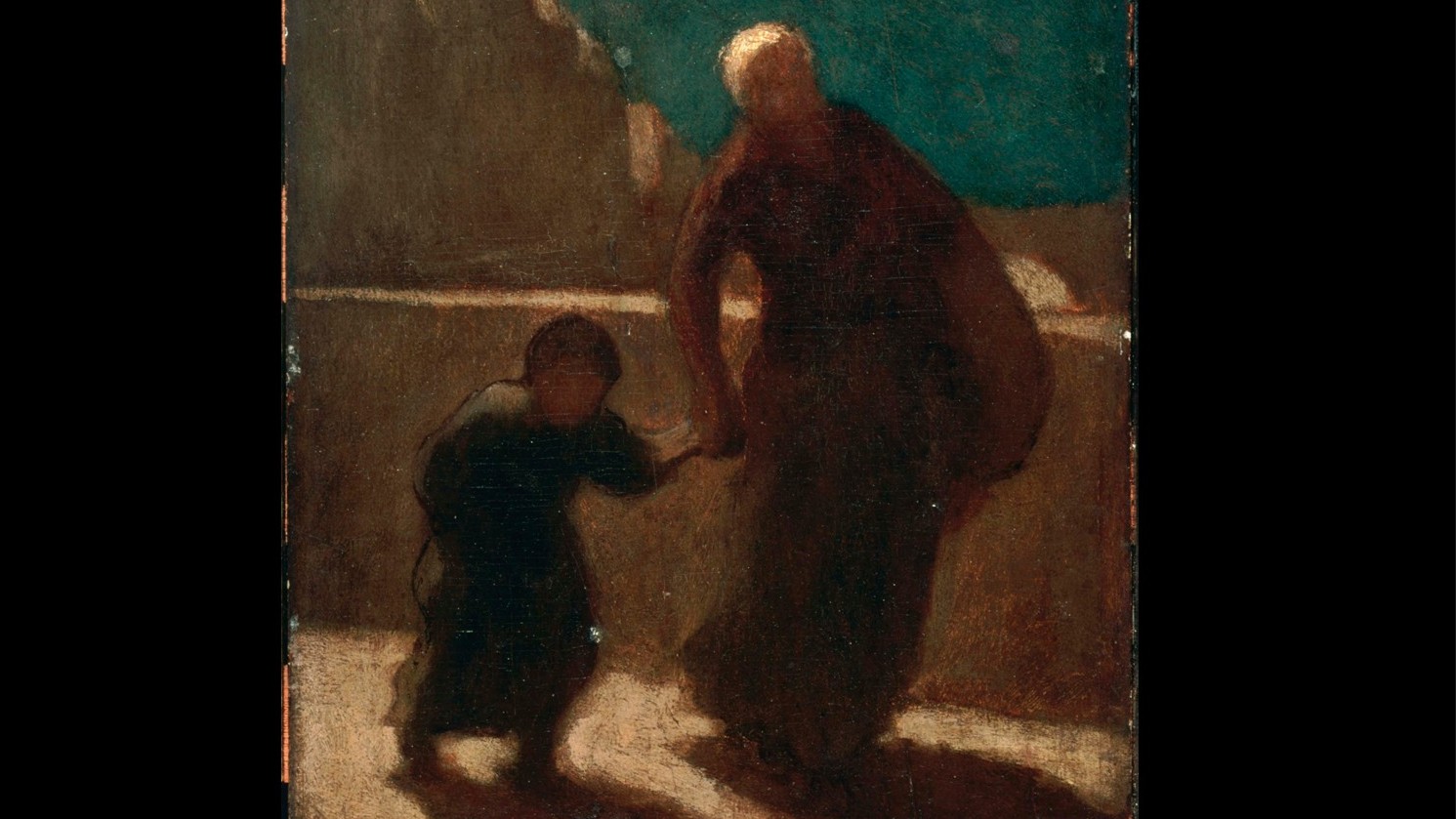
Image credit: “On a Bridge at Night” by Honoré Daumier, around 1845-1848.
