
John 16:7-15
NL
7 Nevertheless, I tellA you the truth:B it is to your advantageC that I go away,D
A “tell” = lego. This is to speak, say, name, call, command. It is generally to convey verbally.
B “truth” = aletheia. From alethes (true, unconcealed; true because it is in concert with fact and reality – attested; literally, what cannot be hidden; truth stands up to test and scrutiny and is undeniable, authentic). {from a (not, without) + lanthano (unnoticed, concealed)}. Truth is literally that which is not or cannot be concealed. This word covers more than the sense of true versus false. It spoke of truth as that which corresponds to reality – reality as opposed to illusion. Thus, it includes, sincerity, straightforwardness, and reality itself.
C “is…advantage” = sumphero. 17x in OT. From sun (with, together with) + phero (to bear, bring, lead, make known publicly; to carry in a literal or figurative sense). This is to collect, bring together, or be profitable to. It is combining things such that there is gain or profit or advantage.
D “go away” = aperchomai. From apo (from, away from) + erchomai (to come or go). This is to depart, follow, or go off in a literal or figurative sense.
for if I do not go away, the AdvocateE will not comeF to you, but if I go,G I will sendH him to you.
E “Advocate” = Parakletos. 5x in OT. From parakaleo (to call to, summon, invite, request, or beg; to exhort or admonish; to encourage, comfort, or console; has legal overtones and is used of one’s advocate in a courtroom); {from para (beside, by, in the presence of) + kaleo (to call by name, invite, to name, bid, summon, call aloud); {related to keleuo (to command, order, direct); from kelomai (to urge on)}}. This is someone who is called for aid or assistance. Properly, it refers to a a legal advocate who is close to the situation and speaks in court. This is advocate, helper, comforter, helper, or intercessor. It is also used as a technical term for the Holy Spirit – the Paraclete.
F “come” = erchomai. Related to “go away” in v7. See note D above.
G “go” = poreuomai. From poros (ford, passageway). This is to go, travel, journey, or die. It refers to transporting things from one place to another and focuses on the personal significance of the destination.
H “send” = pempo. This is to send, put forth, or dispatch. This often refers to a temporary errand. It is sending someone with a focus on the place they departed from. By contrast, another Greek word, hiemi, emphasizes the destination and yet another word, stello, focuses on the motion that goes with the sending.
8 And when he comes, he will prove the worldI wrongJ about sinK
I “world” = kosmos. Perhaps from the base of komizo (to carry, convey, recover); from komeo (to take care of). This is order, the world, the universe, including its inhabitants. Literally, this is something that is ordered so it can refer to all creation. It can also refer to decoration in the sense that something is better ordered and, thus, made more beautiful. This is where “cosmos” and “cosmetics” come from.
J “prove…wrong” = elegcho. 17x in OT. This is to expose, reprove, discipline, convict, or rebuke. It is using convincing evidence to expose a wrong.
K “sin” = hamartia. From hamartano (to miss the mark, do wrong, make a mistake, sin); {from a (not) + meros (a part or share)}. Literally, this means not having one’s share or portion – like not receiving inheritance or what was allotted to you. This word means missing the mark so it is used for guilt, fault, and acts of sin.
and righteousnessL and judgment:M 9 about sin,N because they do not believeO in me;
L “righteousness” = dikaiosune. From dikaios (correct, righteous – implies innocent; this is that which conforms to God’s notion of justice, uprightness); from dike (the principle of justice; that which is right in a way that is very clear; a decision or the execution of that decision; originally, this word was for custom or usage; evolved to include the process of law, judicial hearing, execution of sentence, penalty, and even vengeance; more commonly, it refers to what is right); may be from deiknumi (to show, point out, exhibit; figurative for teach, demonstrate, make known). This is judicial or divine approval of character or action. This is righteousness, justice, justness, divine righteousness.
M “judgment” = krisis. From krino (to judge, decide, think good, condemn, determine, pass judgment, stand trial, sue; judging whether in court or in a private setting; properly, mentally separating or distinguishing an issue – to come to a choice or decision, to judge positively or negatively in seeking what is right or wrong, who is innocent or guilty; can imply trying, condemning, punishing, or avenging). This is a judging or a sentence. It is often used of God’s judgment, but can also be any accusation or condemnation. This is where the word “crisis” comes from.
N {untranslated} = men. This is truly, indeed, even, in fact. Often, it is not translated, but used to emphasize affirmation.
O “believe” = pisteuo. From pistis (faith, faithfulness, belief, trust, confidence; to be persuaded or come to trust); from peitho (to have confidence, urge, be persuaded, agree, assure, believe, have confidence, trust). This is to believe, entrust, have faith it, affirm, have confidence in. This is less to do with a series of beliefs or doctrines that one believes and more to do with faithfulness, loyalty, and fidelity. It is trusting and then acting based on that trust.
10 about righteousness, because I am goingP to the Father,Q and you will seeR me no longer;
P “going” = hupago. From hupo (by, under, under the authority of) + ago (lead, bring, guide, spend, drive, carry). This is to lead under so to depart, go away, or die. It is to lead away under the command of someone else, being given a mission or objective to carry out.
Q “Father” = Pater. This is father in a literal or figurative sense. Could be elder, senior, ancestor, originator, or patriarch.
R “see” = theoreo. From theaomai (to behold, look upon, see, contemplate, visit); from thaomai (to gaze at a spectacle; to look at or contemplate as a spectator; to interpret something in efforts to grasp its significance); from theoros (a spectator or envoy). This is gazing, beholding, experiencing, discerning. It is looking at something to analyze it and concentrate on what it means. This is the root of the word “theatre” in that people concentrate on the action of the play to understand its meaning.
11 about judgment, because the rulerS of this world has been condemned.T
12 “I still haveU many thingsV to sayW to you,
S “ruler” = archon. From archo (to rule, begin, have first rank or have political power). This is ruler, leader, magistrate, official, prince, chief.
T “condemned” = krino. Related to “judgment” in v8. See note M above.
U “have” = echo. This is to have, hold, possess.
V “many things” = polus. This is much, often, plenteous – a large number or a great extent.
W “say” = lego. Same as “tell” in v7. See note A above.
but you cannotX bearY them now.Z
X “cannot” = ou + dunamai. Dunamai is to be able, or something that is possible. It can also be empowered or being powerful. The Greek word for “miracle” (dunamis) comes from this root.
Y “bear” = bastazo. Perhaps from the base of basis (step, hence foot; a pace); from baino (to walk, to go). This is to lift in a literal of figurative sense. It can also mean take up, carry, bear, or remove. Figuratively, it can mean declare, endure, or sustain.
Z “now” = arti. Perhaps from airo (raise, take up, lift, remove). This is now, the present, from now.
13 When the SpiritAA of truth comes, he will guideBB you into allCC the truth,
AA “Spirit” = Pneuma. From pneo (to blow, breathe, breathe hard). This is wind, breath, or ghost. A breeze or a blast or air, a breath. Figuratively used for a spirit, the human soul or part of us that is rational. It is also used supernaturally for angels, demons, God, and the Holy Spirit. This is where pneumonia comes from.
BB “guide” = hodegeo. Related to “going” in v10. 5x in OT. From hodegos (leader or guide; figuratively, a teacher); {from hodos (way, road, path, or journey; can imply progress along a route) + hegeomai (to think, suppose, have an opinion; to lead the way, what comes in front or first, initial thought, high esteem or authority; one who commands in an official capacity); {from ago (see note P above)}. This is to guide or instruct. It is showing someone else the way, whether literally or figuratively.
CC “all” = pas. This is all, every.
for he will not speakDD on his own but will speak whatever he hears,EE and he will declareFF to you the things that are to come.
DD “speak” = laleo. From lalos (talkative). This is to talk, say, or preach.
EE “hears” = akouo. This is hear or listen, but it also means to understand by hearing. This is where the word “acoustics” comes from.
FF “declare” = anaggello. Related to “going” in v10 & “guide” in v13. 14x in OT. From ana (up, again, back, among, by, anew) + aggello (to announce, report) {from aggelos (angel, messenger – supernatural or human envoy of God); probably from ago (see note P above)}. This is returning with word, reporting, declaring, announcing. It is to tell something all the way, which is to say to tell it clearly.
14 He will glorifyGG me because he will takeHH what is mine and declare it to you. 15 All that the Father has isII mine. For this reason I saidJJ that he will take what is mine and declare it to you.
GG “glorify” = doxazo. From doxa (glory, opinion, praise, honor, renown; particularly used as a quality of God or manifestation of God – splendor); from dokeo (to have an opinion, seem, appear, suppose; a personal judgment; to think); from dokos (opinion). This is to render or hold something as glorious, to glorify, honor, magnify, or celebrate. This is ascribing weight to something by recognizing its true value or essence.
HH “take” = lambano. It does not refer to passive receiving of something, but active acceptance or taking of something whether it is offered or simply nearby. It focuses on individual decision and action.
II “is” = eimi. This is to be, exist.
JJ “said” = eiron. This is to speak say, answer, command.
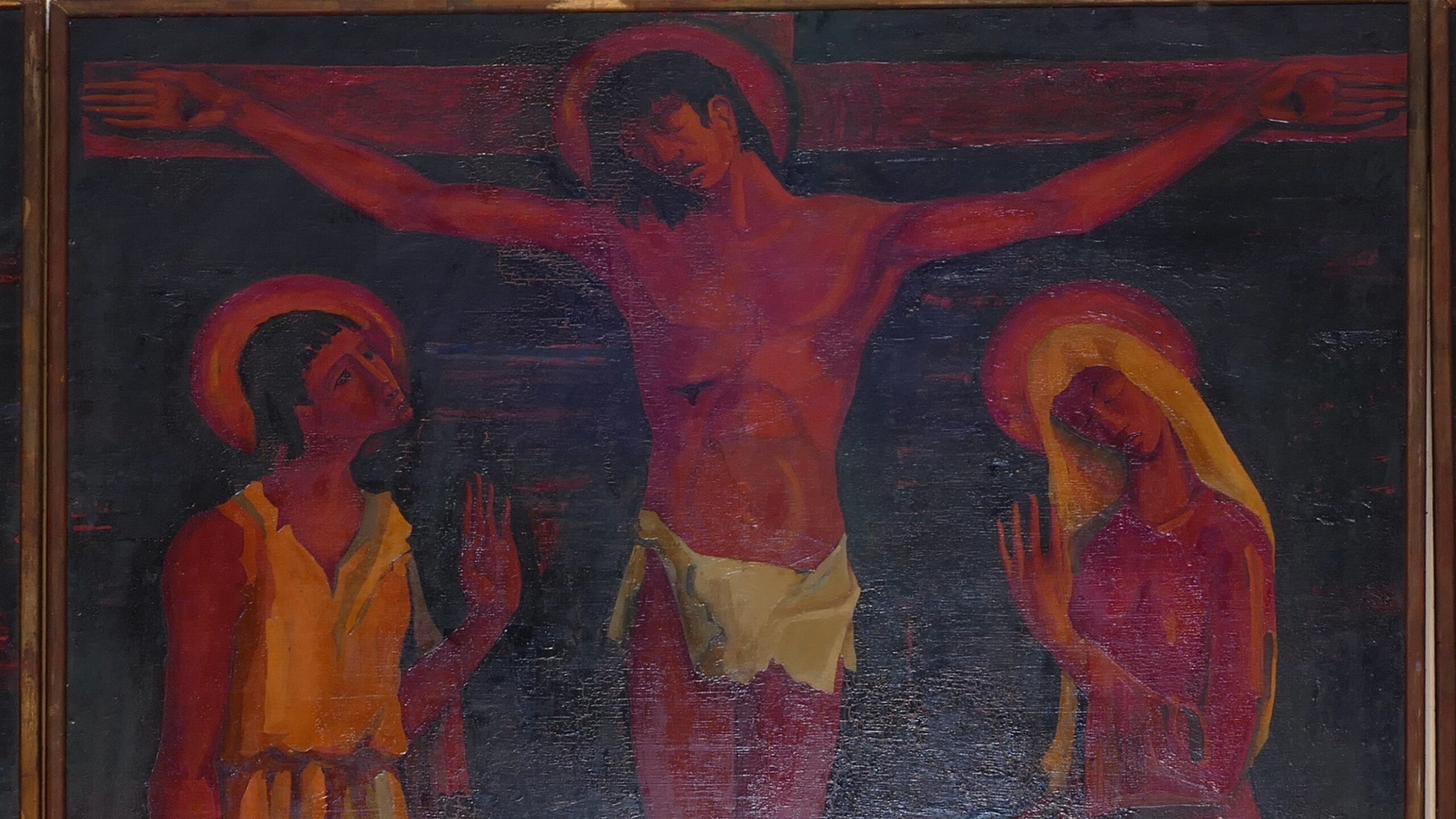
Image credit: Detail of a triptych painting of Jesus Christ (Baptism, Crucifixion, and Ascension) in the interior of St. Augustin Catholic Church in Bischwiller, France. Photo by Ralph Hammann, 2015.
