
John 8:13-20
NL
13 Then the PhariseesA saidB to him, “You are testifyingC on your own behalf;
A “Pharisees” = Pharisaios. From Aramaic peras (to divide, separate) and from Hebrew parash (to make distinct, separate, scatter). This is a Pharisee, a member of a Jewish sect active in the 1st century. Their name meant separate in the sense of wanting to live a life separated from sin. Whereas the Sadducees were part of the priestly line and inherited their religious position and responsibilities, Pharisees were regular people who studied the scriptures and offered guidance to regular folk. Sadducees were often wealthier and willing to sacrifice their identity to rub elbows with Roman society. Pharisees were often more concerned with what it meant to follow God without compromising what made them different as followers of God. Sadducees primarily believed in that which was written down (the first five books of the Bible) and Pharisees believed in the Bible and the traditions of the elders. Pharisees had a very wide range of interpretations and diversity of opinion. Their standard mode of religious engagement was lively debate with one another. To argue religion with another teacher was to recognize that they had something of value to offer.
B “said” = eiron. This is to speak say, answer, command.
C “testifying” = martureo. From martus (a witness whether having heard or seen something; witness literally, judicially, or figuratively; by analogy, a martyr). This is to bear witness, testify, give evidence. It is to testify in a literal or figurative sense.
your testimonyD isE not valid.”F
D “testimony” = marturia. Related to “testifying” in v13. From martureo (see note C above). This is testimony, witness, evidence, record, reputation.
E “is” = eimi. This is to be, exist.
F “valid” = alethes. From a (not) + lanthano (concealed, hidden, unnoticed; to shut one’s eyes to, unwittingly, unawares). This is true, unconcealed; true because it is in concert with fact and reality – attested. Literally, what cannot be hidden; truth stands up to test and scrutiny and is undeniable, authentic.
14 JesusG answered,H, I “Even if I testify on my own behalf,
G “Jesus” = Iesous. From Hebrew Yehoshua (Joshua, the Lord is salvation); {from YHVH (proper name of the God of Israel; the self-existent and eternal one); {from havah (to become) or from hayah (to come to pass, become, be)} + yasha (to deliver, defend, help, preserve, rescue; properly, to be open, wide or free, which implies being safe. So, in a causative sense, this is to free someone)}. This is Jesus or Joshua in Greek – the Lord saves or the Lord is salvation.
H “answered” = apokrinomai. From apo (from, away from) + krino (to judge, decide, think good, condemn, determine, pass judgment, stand trial, sue; judging whether in court or in a private setting; properly, mentally separating or distinguishing an issue – to come to a choice or decision, to judge positively or negatively in seeking what is right or wrong, who is innocent or guilty; can imply trying, condemning, punishing, or avenging). This is to reply or respond, to draw one’s own conclusions, to speak when one is expected to.
I {untranslated} = kai + eiron + autos. Literally “and said to them.” Eiron is the same as “said” in v13. See note B above.
my testimony is valid because I knowJ where I have comeK from and where I am going,L but you do not know where I come from or where I am going.
J “know” = eido. This is to know, consider perceive, appreciate, behold, or remember. It means seeing with one’s eyes, but also figuratively, it means perceiving – seeing that becomes understanding. So, by implication, this means knowing or being aware.
K “come” = erchomai. This is to come or go.
L “gong” = hupago. From hupo (by, under, under the authority of) + ago (lead, bring, guide, spend, drive, carry). This is to lead under so to depart, go away, or die. It is to lead away under the command of someone else, being given a mission or objective to carry out.
15 You judgeM by human standards;N I judge no one. 16 Yet even if I do judge, my judgmentO is valid,P
M “judge” = krino. Related to “answered” in v14. See note H above.
N “human standards” = sarx. Literally, “the flesh.” May be from saroo (to sweep, cleanse by sweeping); from sairo (to brush off). This is flesh, the body, human nature, materiality, kindred. Flesh is not always evil in scripture (as when it refers to Jesus taking on a human body). However, it is generally used in a negative way for actions made selfishly and not through faith. This can mean animal flesh, i.e. meat, or refer to body in contrast to soul/spirit. Flesh can be a way of talking about how things or people are related or talking about human frailty (physical or moral).
O “judgment” = krisis. Related to “answered” in v14 & “judge” in v15. From krino (see note H above). This is a judging or a sentence. It is often used of God’s judgment, but can also be any accusation or condemnation. This is where the word “crisis” comes from.
P “valid” = alethinos. Related to “valid” in v13. From alethes (see note F above). This is literally made of truth – that which is true or real, authentic. Something that is true from its source and has integrity.
for it is not I aloneQ who judge but I and the FatherR who sentS me.
Q “alone” = monos. Perhaps from meno (to stay, abide, wait, endure). This is alone, single, remaining, mere, desolate.
R “Father” = Pater. This is father in a literal or figurative sense. Could be elder, senior, ancestor, originator, or patriarch.
S “sent” = pempo. This is to send, put forth, or dispatch. This often refers to a temporary errand. It is sending someone with a focus on the place they departed from. By contrast, another Greek word, hiemi, emphasizes the destination and yet another word, stello, focuses on the motion that goes with the sending.
17 In your lawT it is writtenU that the testimony of twoV
T “law” = nomos. From nemo (to parcel out). Literally, this is that which is assigned. It can be usage, custom, or law. This word can be used for human or divine law. It can be used specifically for the law of Moses or as a name for the Torah (the first five books of the Bible). Sometimes it is used for scripture as a whole, used of the Gospel, or of any theology. It is also used for the “tradition of the elders,” which would be the oral Torah – the tradition of the laws plus their interpretations as they were passed down over time. We must carefully consider which meaning of “law” is meant when we interpret passages the word is found in.
U “written” = grapho. This is to write or describe. It is where the word “graphic” comes from.
V “two” = duo. This is two or both.
witnessesW is valid.X 18 IY testify on my own behalf, and the Father who sent me testifies on my behalf.”
W “witnesses” = anthropos. Probably from aner (man, male, husband) + ops (eye, face); {from optanomai (to appear, be seen); perhaps from horao (become, seem, appear)}. This is human, humankind. Used for all genders.
X “valid” = alethes. Same as “valid” in v13. See note F above.
Y {untranslated} = eimi. Same as “is” in v13. See note E above.
19 Then they said to him, “Where is your Father?”
Jesus answered, “You know neither me nor my Father. If you knew me, you would know my Father also.” 20 He spokeZ these wordsAA while he was teachingBB
Z “spoke” = laleo. From lalos (talkative). This is to talk, say, or preach.
AA “words” = rhema. From rheo (to speak, command, make, say, speak of); from ereo (to all, say, speak of, tell; denotes ongoing speech). This is word, which implies a matter or thing spoken, a command, report, promise, thing, or business. Often used for narration, commands, or disputes.
BB “teaching” = didasko. From dao (learn). This is to teach, direct, instruct, or impart knowledge. In the New Testament, this is almost always used for teaching scripture.
in the treasuryCC of the temple,DD but no one arrestedEE him, because his hourFF had not yet come.
CC “treasury” = gazophulakion. 5x in NT. From gaza (treasure, treasury, riches) + phulake (guard, watch, keeping guard, imprisonment); {from phulasso (to guard, protect, preserve through vigilance)}. This is a court in the Temple area that had collection boxes for offerings. In Nehemiah, it also refers to a storage space for public records.
DD “temple” = hieros. From hieros (sacred, temple, holy). This is a temple – its structure or courtyards.
EE “arrested” = piazo. 12x in NT. From piezo (to press down or together, to pack) OR related to biazo (to force, use power to seize); {from bia (strength, force, violence) or bios (life, livelihood, goods, wealth)}. This is to take, catch, squeeze, capture from hunting, or arrest. This is the root of “piezoelectricity.”
FF “hour” = hora. This is a set time or period, an hour, instant, or season. This is where the word “hour” comes from.
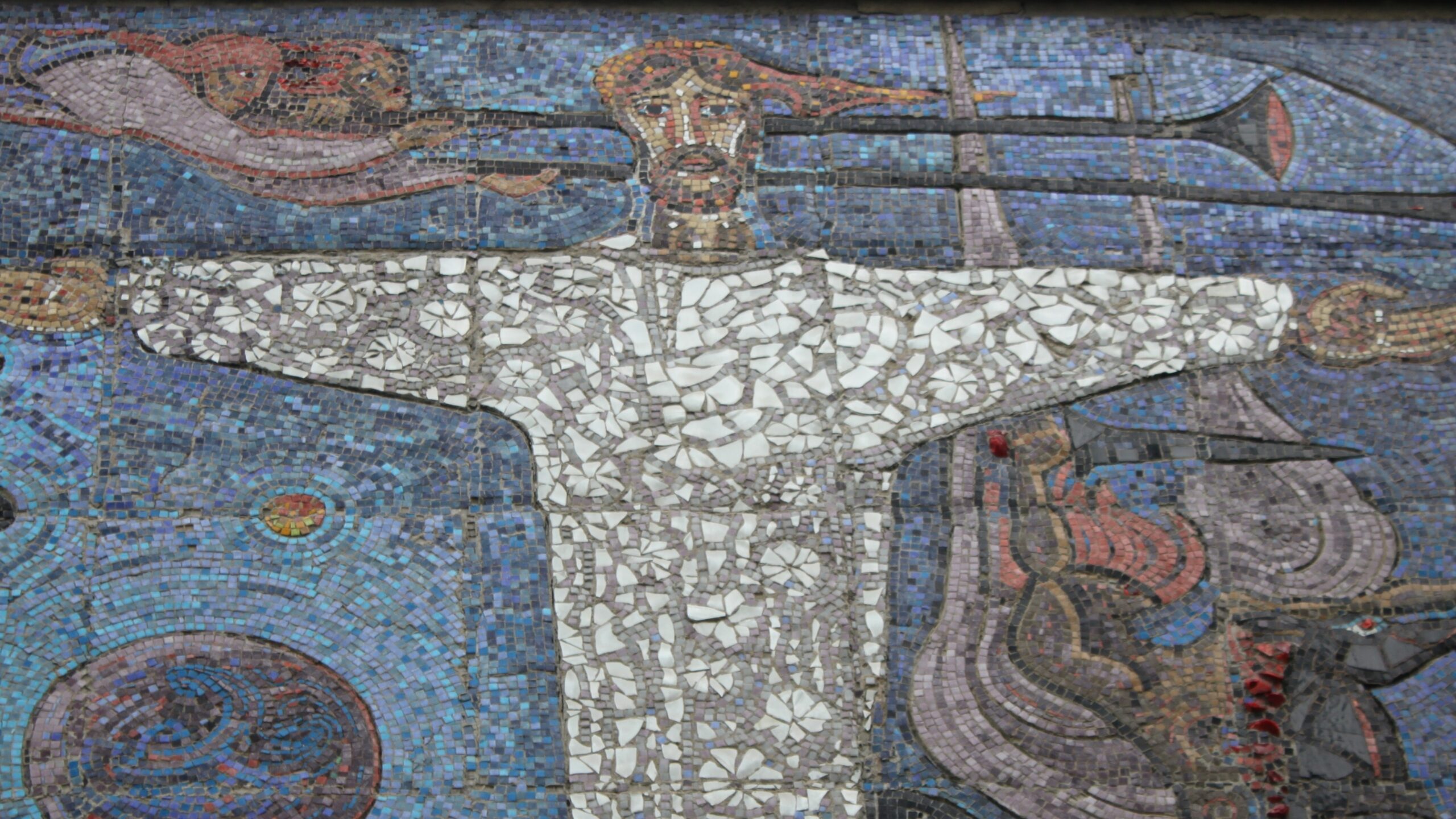
Image credit: Mural at Christ the King Church in Krakow, Poland. Photo by mik Krakow, 2016.
