1 Kings 16
BibleHub
1 The wordI of the LordII cameIII
Notes on verse 1a
I “word” = dabar. From dabar (to speak, declare, discuss). This is speech, a word, a matter, an affair, charge, command, message, promise, purpose, report, request. It is a word, which implies things that are spoken of in a wide sense.
II “Lord” = YHVH. Related to “came” in v1. From havah (to be, become) or hayah (see note III below). This is the name of the God of Israel, the self-existent and eternal one, the tetragrammaton. This pronunciation has been lost to time so “Lord” is generally used in its place.
III “came” = hayah. This is to be or become, to happen.
to JehuIV sonV of HananiVI against Baasha,VII saying,VIII
Notes on verse 1b
IV “Jehu” = Yehu. Related to “came” and “Lord” in v1. From YHVH (see note II above) + hu (third person pronoun – he, she, it). This is Jehu, meaning “the Lord is He.”
V “son” = ben. From banah (to build or obtain children). This is son, age, child. It is son in a literal or figurative sense.
VI “Hanani” = Chanani. 11x in OT. From chanan (beseech, show favor, be gracious; properly, to bend in kindness to someone with less status). This is Hanani or Chanani, meaning “gracious” or “the Lord has been gracious” or “graciously given of the Lord.” See https://www.abarim-publications.com/Meaning/Hanani.html
VII “Baasha” = Baasha. Perhaps from a root that means to stink. This is Baasha, which may mean “offensiveness” or “stinking” or “revolting.” See https://www.abarim-publications.com/Meaning/Baasha.html
VIII “saying” = amar. This is to speak, say, answer, command, promise, report.
2 “SinceIX I exaltedX you out of the dustXI and madeXII you leaderXIII
Notes on verse 2a
IX “since” = yaan. From anah (to answer, respond, announce, sing, shout, or testify; to pay attention, which implies responding and, by extension, starting to talk; singing, shouting, testifying, etc.). This is because, since, for the sake of, giving a reason.
X “exalted” = rum. This is to rise or raise, to be high literally or figuratively. So it can also mean to exalt or extol.
XI “dust” = aphar. May be related to aphar (to throw dust, be dust). This is dust as powdered, perhaps gray colored. It could be ashes, powder, ground, dry earth, clay mud, or rubbish.
XII “made” = natan. This is to give, put, set, offer. It is to give literally or figuratively.
XIII “leader” = nagid. From nagad (this is to declare, make conspicuous, stand in front, manifest, predict, explain). This is a commander or leader as the one who stands at the front, whether in a military, religious, or civic setting. It can also mean honorable or noble in an abstract sense.
over my peopleXIV Israel,XV and you have walkedXVI
Notes on verse 2b
XIV “people” = am. From amam (to darken, hide, associate; creating shadows by huddling together). This is people or nation. It can be used specifically for a tribe, collectively of troops or armies, or figuratively to refer to a flock of animals.
XV “Israel” = Yisrael. From sarah (to persist, exert oneself, contend, persevere, wrestle, prevail) + El (God or god). This is Israel, meaning God strives or one who strives with God; new name for Jacob and for his offspring. This refers to the people and to the land.
XVI “walked” = halak. This is go, come, walk. It is walk literally and figuratively and includes people and animals. It can be used figuratively for one’s moral life – how we walk according to God’s way or against it. It can also refer to the walk of life as in the course one’s life takes, the choices we make, etc.
in the wayXVII of JeroboamXVIII and have caused my people Israel to sin,XIX
Notes on verse 2c
XVII “way” = derek. From darak (to tread, march, to walk. Can also mean affixing a string to a box since one needs to step on it to bend it in the process; so also an archer). This is a road as a thing that is walked on. Can be used figuratively for the path that one’s life takes or how one chooses to live one’s life.
XVIII “Jeroboam” = Yarobam. Related to “people” in v2. From rabab (to be or become much or many, multiply) + am (see note XIV above) OR from rib (properly to toss or grapple; used figuratively to mean wrangling and so for arguments, complaints, or disputes; used in a legal setting for pleading or defending a case) + am (see above). This is Jeroboam, a name meaning “the people increase” or “the people will contend” or “whose people are countless.” See https://www.abarim-publications.com/Meaning/Jeroboam.html
XIX “caused…to sin” = chata. This is properly to miss, and so figuratively it is used for sinning, bearing the blame. It implies a forfeiture or loss of something.
provoking me to angerXX with their sins,XXI 3 thereforeXXII I will consumeXXIII, XXIV Baasha
Notes on verses 2d-3a
XX “provoking…to anger” = kaas. This is to provoke, be angry, grieve, trouble.
XXI “sins” = chatta’ah. Related to “caused…to sin” in v2. From chata (see note XIX above). This is sin itself as well as punishment for sin. It is sometimes used specifically to refer to sin that is habitual.
XXII “therefore” = hen. This is a remark of surprise or excitement: lo! Behold! It can also mean if or though.
XXIII “consume” = ba’ar. This is to burn, consume, heat, remove. It can also be to consume by a fire or through eating, being brutish or wasting.
XXIV {untranslated} = achar. From achar (to remain behind, linger, continue, be behind, or delay; can also imply procrastination). This is after or the last part, following.
andXXV his house,XXVI and I will make your house like the house of Jeroboam son of Nebat.XXVII 4 Anyone belonging to Baasha who diesXXVIII in the cityXXIX
Notes on verses 3b-4a
XXV {untranslated} = achar. Same as {untranslated} in v3. See note XXIV above.
XXVI “house” = bayit. Related to “son” in v1. Probably from banah (see note V above). This is house, court, family, palace, temple.
XXVII “Nebat” = Nebat. From nabat (to behold, look at intently, consider, or scan; to have respect or regard someone favorably). This is Nebat, meaning “regard” or “look” or “aspect.” See https://www.abarim-publications.com/Meaning/Nebat.html
XXVIII “dies” = mut. This is to die in a literal or figurative sense. It can also refer to being a dead body.
XXIX “city” = iyr. From uwr (to awaken or wake oneself up). This can mean excitement in the sense of wakefulness or city. Properly, this is a place that is guarded. Guards kept schedules according to watches. This sense of the word would include cities as well as encampments or posts that were guarded.
the dogsXXX shall eat,XXXI and anyone of his who dies in the fieldXXXII the birdsXXXIII of the airXXXIV shall eat.”
Notes on verse 4b
XXX “dogs” = keleb. This is yelping or attacking. It can also refer to a dog or it can be a term used for a male prostitute.
XXXI “eat” = akal. This is to eat, devour, burn up, or otherwise consume. It can be eating in a literal or figurative sense.
XXXII “field” = sadeh. From the same as shadday (almighty, field, land); from shadad (to devastate, ruin, destroy, oppress, be powerful). Or, it may be from a word that means to spread out. This is field, ground, soil, or land. It can be used to mean wild as in a wild animal.
XXXIII “birds” = oph. From uph (to fly, flee, shine, be weary, be faint). This is a flying creature.
XXXIV “air” = shamayim. Root may mean being lofty. This is sky, the air, or heaven. It is in a dual noun form so this might refer to the part of the sky where the clouds move on the one hand and the part beyond that where the sun, moon, and stars are on the other hand.
5 Now the restXXXV of the actsXXXVI of Baasha, what he did,XXXVII and his power,XXXVIII
Notes on verse 5a
XXXV “rest” = yether. From yathar (to jut over, remain behind, preserve, to excel). This is a remainder or excess. It can imply abundant or superiority. Additionally, it can be cord a free-hanging rope.
XXXVI “acts” = dabar. Same as “word” in v1. See note I above.
XXXVII “did” = asah. This is to make, do, act, appoint, become in many senses.
XXXVIII “power” = geburah. From gabar (to be strong or mighty; to prevail or be insolent). This is force in a literal or figurative sense. So, it could be strength, power, courage, triumph, victory, or mastery.
are they not writtenXXXIX in the BookXL of the AnnalsXLI of the KingsXLII of Israel?
Notes on verse 5b
XXXIX “written” = kathab. This is to inscribe, write, record, or decree.
XL “Book” = sepher. Perhaps from saphar (to tally or record something; to enumerate, recount, number, celebrate, or declare). This can be writing itself or something that is written like a document, book, letter, evidence, bill, scroll, or register.
XLI “Annals” = dabar + yom. Literally, “acts of the days.” Dabar is the same as “word” in v1. See note I above. Yom has a root that may mean being hot. This is the day in a literal or figurative sense. It can also mean birth, age, daylight, continually or other references to time.
XLII “Kings” = melek. From malak (to be or become king or queen, to rise to the throne, to be crowned; by implication, to take counsel). This is king or royal.
6 Baasha sleptXLIII with his ancestorsXLIV and was buriedXLV at Tirzah,XLVI
Notes on verse 6a
XLIII “slept” = shakab. This is to lie down, lodge. It is lying for sleep, sex, or other reasons.
XLIV “ancestors” = ab. This is father, chief, or ancestor. It is father in a literal or figurative sense.
XLV “buried” = qabar. This is to bury or inter. It could also refer to the person who does the burying.
XLVI “Tirzah” = Tirtsah. 18x in OT. From ratsah (to be pleased with, delight, take pleasure in, or accept with favor; to approve or consent regarding something; can be used specifically of satisfying debts or being pardoned). This is Tirzah or Tirtsah, meaning “delight” or “pleasantness” or “pleasure” or “beauty.” See https://www.abarim-publications.com/Meaning/Tirzah.html
and his son ElahXLVII succeededXLVIII him. 7 Moreover,XLIX the word of the Lord came byL the prophetLI Jehu son of Hanani against Baasha and his house,
Notes on verses 6b-7a
XLVII “Elah” = Elah. 16x in OT. From elah (oak or terebinth; or some other kind of tree that is strong); from ayil (terebinth, oak); from the same as ulam (porch, hall); from the same as ul (mighty, strength, body, belly; root may mean to twist and that implies strength and power). This is Elah, a personal and place name that means “terebinth” or “oak.”
XLVIII “succeeded” = malak…tachat. Literally, “reigned…in his place.” Malak is related to “Kings” in v5. See note XLII above. Tachat is underneath, below, the bottom, instead of.
XLIX “moreover” = gam. This is also, moreover, again.
L “by” = yad. This is hand, ability, power. Hand in a literal sense, but also what one can do or the means by which one does it.
LI “prophet” = nabi. This is prophet, prophecy, speaker, or someone inspired.
both because of allLII the evilLIII that he did in the sightLIV of the Lord,
Notes on verse 7b
LII “all” = kol. From kalal (to complete). This is all or every.
LIII “evil” = ra’. From ra’a’ (to be evil, bad, afflict; properly, to spoil – to destroy by breaking into pieces; figuratively, to cause something to be worthless; this is bad in a physical, social, or moral sense; that which displeases, to do harm or mischief, to punish or vex). This is bad, disagreeable, that which causes pain, misery, something having little or no value, something that is ethically bad, wicked, injury, calamity. This refers to anything that is not what it ought to be – a natural disaster, a disfigurement, an injury, a sin.
LIV “sight” = ayin. This is eye in a literal or figurative sense so eye, appearance, favor, or a fountain (the eye of the landscape).
provoking him to anger with the workLV of his hands,LVI in beingLVII like the house of Jeroboam, and also because he destroyedLVIII it.
Notes on verse 7c
LV “work” = maaseh. From asah (to do, make, accomplish, become). This is a work – any action whether positive or negative. It can also be a transaction, construction, activity, property, or something that is produced.
LVI “hands” = yad. Same as “by” in v7. See note L above.
LVII “being” = hayah. Same as “came” in v1. See note III above.
LVIII “destroyed” = nakah. This is to hit whether lightly or severely. It can be used in a literal or figurative sense. So, this could be beat, punish, give wounds, kill, or slaughter.
8 In the twentyLIX-sixthLX yearLXI, LXII of King AsaLXIII of Judah,LXIV Elah son of Baasha began to reignLXV over Israel in Tirzah; he reigned two years.
Notes on verse 8
LIX “twenty” = esrim. From the same as eser (ten, tenth). This is twenty or twentieth.
LX “sixth” = shesh. This is six. Figuratively, it can be a surplus since it is one more than the number of fingers on the hand.
LXI “year” = shanah. From shana (to change, alter). This is a year, age, old. It can also mean yearly.
LXII {untranslated} = shanah. Same as “year” in v8. See note LXI above.
LXIII “Asa” = Asa. Related to Aramaic asaya (physician, healer); from Akkadian a’sum (Azu); from Sumerian Azu (physician, healer). This is Asa, which may mean “healer.” See https://en.wiktionary.org/wiki/Asa
LXIV “Judah” = Yehudah. Probably from yadah (to throw one’s hands into the air in a gesture of praise); from yad (hand). This is Judah, meaning “praised.”
LXV “began to reign” = malak. Same as “succeeded” in v6. See note XLVIII above.
9 But his servantLXVI Zimri,LXVII commanderLXVIII
Notes on verse 9a
LXVI “servant” = ebed. From abad (to work, serve, compel; any kind of work; used causatively, can mean to enslave or keep in bondage). This is a servant, slave, or bondservant.
LXVII “Zimri” = Zimri. Related to “came” and “Lord” and “Jehu” in v1. 15x in OT. From zamar (making music; used specially of music to worship God; music with singing, singing praise, singing psalms); {may be from zamar (to trim or prune); perhaps related to zemer (a sheep or antelope)} OR from zamar (see above) + Yah (the shortened form of the name of the God of Israel; God, Lord); {from YHVH (see note II above)}. This is Zimri, meaning “musical” or “my musician” or “song of the Lord” or “my gardener” or “mountain sheep.” See https://www.abarim-publications.com/Meaning/Zimri.html
LXVIII “commander” = sar. This is chief, leader, ruler, lord, official, governor, prince, military leader. It refers to someone at the top of a rank or class.
of halfLXIX his chariots,LXX conspiredLXXI against him. When he was at Tirzah drinkingLXXII himself drunkLXXIII
Notes on verse 9b
LXIX “half” = machatsith. 16x in OT. From chatsah (to halve, divide, reach, participate). This is half or middle.
LXX “chariots” = rekeb. From rakab (to ride an animal or in some vehicle; also, bringing on a horse). This is a vehicle, wagon, or chariot. It can be cavalry or an individual rider.
LXXI “conspired” = qashar. This is to tie or bind. It can also refer to joining together as a league or in love. In a negative sense, it can mean to conspire.
LXXII “drinking” = shathah. This is to drink literally or figuratively. It could also be a drinker.
LXXIII “drunk” = shikkor. 13x in OT. From shakar (to be filled with drink, merry, tipsy; satiated in a positive sense or drunken in a negative sense; also figuratively influence). This is being in an intoxicated state or being a habitual drunkard.
in the house of Arza,LXXIV who was in charge of the palaceLXXV at Tirzah, 10 Zimri came inLXXVI and struck him downLXXVII and killedLXXVIII him, in the twenty-seventhLXXIX year of King Asa of Judah, and succeeded him.
Notes on verses 9c-10
LXXIV “Arza” = Artsa. 1x in OT. From erets (root may mean to be firm; earth, ground, field, land, country). This is Arza, meaning “earth” or “earthiness” or “toward the land.”
LXXV “palace” = bayit. Same as “house” in v3. See note XXVI above.
LXXVI “came in” = bo. This is to enter, come in, advance, fulfill, bring offerings, enter to worship, attack. It can also have a sexual connotation.
LXXVII “struck…down” = nakah. Same as “destroyed” in v7. See note LVIII above.
LXXVIII “killed” = mut. Same as “dies” in v4. See note XXVIII above.
LXXIX “seventh” = sheba. This is seven or by sevenfold. It can also be used to imply a week or an indefinite number. Symbolically, this is the number of fullness, sacredness, perfection.
11 LXXXWhen he began to reign, as soon as he had seatedLXXXI himself on his throne,LXXXII he killedLXXXIII all the house of Baasha;
Notes on verse 11a
LXXX {untranslated} = hayah. Same as “came” in v1. See note III above.
LXXXI “seated” = yashab. This is to sit and so to remain and so to dwell. It is sitting for any reason – as a judge, in order to ambush, or just sitting quietly. Causatively, this can mean settling or marrying. This can also mean continue, endure, or establish.
LXXXII “throne” = kisse. From the same as kese (full moon); perhaps from kasah (to cover, conceal, overwhelm; to cover as clothes do or to hide a secret). This is throne – a seat that is covered or has a canopy. Thus, it is a seat that conveys authority.
LXXXIII “killed” = nakah. Same as “destroyed” in v7. See note LVIII above.
he did not leaveLXXXIV him a single maleLXXXV of his kindredLXXXVI or his friends.LXXXVII
Notes on verse 11b
LXXXIV “leave” = shaar. Properly, this is swelling up i.e. being left over, a remnant, remaining, being redundant.
LXXXV “male” = shathan + qir. Literally, “who urinates against a wall.” Shathan is 6x in OT. This is to urinate. Qir is perhaps from qur (to dig, destroy, wall up). This is a wall, ceiling, surface, mason, or town.
LXXXVI “kindred” = gaal. This is to redeem someone or something according to kinship laws. So, it could be acting on a relative’s behalf to buy back their property, to marry one’s brother’s widow, etc. This could be more briefly translated as to redeem, acts as kinsman, or purchase. As a noun, it could be deliverer or avenger.
LXXXVII “friends” = rea. From raah (to associate with). This is the same as neighbor in Leviticus 19:18 “love your neighbor as yourself.” This is friend, companion, fellow, neighbor. It is someone with whom you associate, whether more or less close.
12 Thus Zimri destroyedLXXXVIII all the house of Baasha, according to the word of the Lord, which he had spokenLXXXIX against Baasha byXC the prophet Jehu, 13 because of all the sins of Baasha and the sins of his son Elah that they committedXCI and that they caused Israel to commit, provoking the Lord GodXCII of Israel to anger with their idols.XCIII 14 Now the rest of the acts of Elah and all that he did, are they not written in the Book of the AnnalsXCIV of the Kings of Israel?
Notes on verses 12-14
LXXXVIII “destroyed” = shamad. This is to demolish, destroy, perish, overthrow, pluck down.
LXXXIX “spoken” = dabar. Related to “word” in v1. See note I above.
XC “by” = yad. Same as “by” in v7. See note L above.
XCI “committed” = chata. Same as “caused….to sin” in v2. See note XIX above.
XCII “God” = Elohim. Related to “Israel” in v2. See note XV above.
XCIII “idols” = hebel. This is emptiness, vapor, breath. It can refer to something that is fleeting or futile, worthless or a delusion. Something that is passing and so does not satisfy. This is related to the root for the name “Abel.”
XCIV “Annals” = dabar + yom. Literally, “acts of the days.” See note XLI above.
15 In the twenty-seventh yearXCV of King Asa of Judah, Zimri reigned seven daysXCVI in Tirzah. Now the troopsXCVII were encampedXCVIII against Gibbethon,XCIX
Notes on verse 15a
XCV {untranslated} = shanah. Same as “year” in v8. See note LXI above.
XCVI “days” = yom. Same as “Annals” in v5. See note XLI above.
XCVII “troops” = am. Same as “people” in v2. See note XIV above.
XCVIII “encamped” = chanah. This is decline, bending down, or living in tents. It can be camping to create a home or camping as a part of battle.
XCIX “Gibbethon” = Gibbethon. 6x in OT. From the same as gab (root may mean to curve or hollow; a back because it is rounded, the brow of the eye, rim, a vault, higher place, or shrine) OR from gibah (hill or little hill); {from the same as Geba (Geba or Gibeah; hillock); from the same as gabia (cup, bowl, flower; root might mean being convex)}.This is Gibbethon, meaning “mound” or “hilly spot” or “lofty place.” See https://www.abarim-publications.com/Meaning/Gibbethon.html
which belonged to the Philistines,C 16 and the troops who were encamped heardCI it said, “Zimri has conspired, andCII he has killedCIII the king”;
Notes on verses 15b-16a
C “Philistines” = Pelishti. From Pelesheth (Philistia); from palash (to mourn, wallow, maybe roll in). This is Philistines. Their name may mean “griever” or “burrower” or “weakener.” See https://www.abarim-publications.com/Meaning/Philistine.html.
CI “heard” = shama. This is to hear, call, consent, or consider. It implies listening intelligently, giving attention, and, because of these two factors, obedience and action are often implied.
CII {untranslated} = gam. Same as “moreover” in v7. See note XLIX above.
CIII “killed” = nakah. Same as “destroyed” in v7. See note LVIII above.
therefore all Israel made Omri,CIV the commander of the army,CV kingCVI over Israel that day in the camp.CVII
Notes on verse 16b
CIV “Omri” = Omri. Related to “came” and “Lord” and “Jehu” in v1 & “Zimri” in v9. 18x in OT. From amar () OR from amar (to bind sheaves, heap; discipline as piling on blows) + Yah (see note LXVII above). This is Omri, meaning “heaping” or “gripping” or “bound by the Lord” See https://www.abarim-publications.com/Meaning/Omri.html
CV “army” = tsaba. From tsaba (to wage war, serve, assemble, fight, perform, muster, wait on). This is a large group of persons (used figuratively for a group of things). It implies a campaign literally as with army, war, warfare, battle, company, soldiers. Can also be used figuratively for hardship or for worship.
CVI “made…king” = malak. Same as “succeeded” in v6. See note XLVIII above.
CVII “camp” = machaneh. Related to “encamped” in v15. From chanah (see note XCVIII above). This is an encampment, whether of people traveling together or soldiers. So, it can be a camp band, or company as well as an army of soldiers. Also can be used of other groups like animals, angels or stars.
17 So Omri went upCVIII from Gibbethon and all Israel with him, and they besiegedCIX Tirzah. 18 CXWhen Zimri sawCXI that the city was taken,CXII
Notes on verses 17-18a
CVIII “went up” = alah. This is to go up, approach, ascend, be high, be a priority; to arise in a literal or figurative sense.
CIX “besieged” = tsur. This is to confine, assault, bind up, be an adversary.
CX {untranslated} = hayah. Same as “came” in v1. See note III above.
CXI “saw” = raah. This is to see in a literal or figurative sense so stare, advise, think, view.
CXII “taken” = lakad. This is to capture, seize, or imprison. It is to catch something in a snare or net or trap. It can also mean to occupy of select something by casting lots.
he wentCXIII into the citadelCXIV of the king’s house; he burned downCXV the king’s house over himself with fireCXVI and died— 19 because of the sins that he committed, doing evil in the sight of the Lord, walking in the way of Jeroboam, and for the sin that he committed,CXVII causing Israel to sin.
Notes on verses 18b-19
CXIII “went” = bo. Same as “came in” in v10. See note LXXVI above.
CXIV “citadel” = armon. Root might mean to be high in elevation. So, this is any kind of fortified building like a citadel, castle, tower, or palace.
CXV “burned down” = saraph. This is to burn or kindle. This is the root that “seraphim” comes from.
CXVI “fire” = esh. This is fire, burning, flaming, hot. It is fire in a literal or figurative sense.
CXVII “committed” = asah. Same as “did” in v5. See note XXXVII above.
20 Now the rest of the acts of Zimri and the conspiracyCXVIII that he made,CXIX are they not written in the Book of the AnnalsCXX of the Kings of Israel?
21 ThenCXXI the people of Israel were dividedCXXII into two parts:CXXIII
Notes on verses 20-21a
CXVIII “conspiracy” = qesher. Related to “conspired” in v9. 16x in OT. From qashar (see note LXXI above). This is conspiracy, treason, or alliance.
CXIX “made” = qashar. Same as “conspiracy” in v9. See note LXXI above.
CXX “Annals” = dabar + yom. Literally, “acts of the days.” See note XLI above.
CXXI “then” = az. This is beginning, now, from, since.
CXXII “divided” = chalaq. This is to be smooth in a figurative sense. So, it can refer to the stones that were part of casting lots – hence, apportion, share, distribute. Figuratively, it can also mean to flatter. It can also be to deal or divide.
CXXIII “two parts” = chatsi. Related to “half” in v9. From chatsah (see note LXIX above). This is half, middle, midnight, midst.
halfCXXIV of the people followedCXXV TibniCXXVI
Notes on verse 21b
CXXIV “half” = chatsi. Same as “two parts” in v21. See note CXXIII above.
CXXV “followed” = hayah + achar. Literally, “were behind.” Hayah is the same as “came” in v1. See note III above. Achar is the same as {untranslated} in v3. See note XXIV above.
CXXVI “Tibni” = Tibni. Related to “son” in v1 & “house” in v3 and related to “came” and “Lord” and “Jehu” in v1 & “Zimri” in v9 & “Omri” in v16. 3x in OT. From teben (material like straw or stubble – refuse used as fodder); {probably from banah (see note V above)} – perhaps + Yah (see note LXVII above). This is Tibni, meaning “strawy” or “chaff” or “my building” or “building of the Lord” or “intelligence of the Lord.” See https://www.abarim-publications.com/Meaning/Tibni.html
son of GinathCXXVII to make him king, and halfCXXVIII followedCXXIX Omri. 22 But the people who followedCXXX Omri overcameCXXXI the people who followedCXXXII Tibni son of Ginath, so Tibni died, and Omri became king.CXXXIII
Notes on verses 21c-22
CXXVII “Ginath” = Ginat. 2x in OT. Perhaps from ganan (to surround, cover, defend, protect). This is Ginath, which may mean “protection” or “enclosure.” See https://www.abarim-publications.com/Meaning/Ginath.html
CXXVIII “half” = chatsi. Same as “two parts” in v21. See note CXXIII above.
CXXIX “followed” = achar. Same as {untranslated} in v3. See note XXIV above.
CXXX “followed” = achar. Same as {untranslated} in v3. See note XXIV above.
CXXXI “overcame” = chazaq. This is to strengthen, seize, be courageous, repair, bind, heal, conquer, harden.
CXXXII “followed” = achar. Same as {untranslated} in v3. See note XXIV above.
CXXXIII “became king” = malak. Same as “succeeded” in v6. See note XLVIII above.
23 In the thirtyCXXXIV-firstCXXXV yearCXXXVI of King Asa of Judah, Omri began to reign over Israel; he reigned for twelveCXXXVII years, sixCXXXVIII, CXXXIX of them in Tirzah.
Notes on verse 23
CXXXIV “thirty” = sheloshim. From the same as shalosh (three, fork, triad). This is thirty or thirtieth.
CXXXV “first” = echad. Perhaps from achad (to unify, continue on a path; figuratively, to gather one’s thoughts). This is the number one, first, united. It can also be alone, altogether, a certain, a few.
CXXXVI {untranslated} = shanah. Same as “year” in v8. See note LXI above.
CXXXVII “twelve” = shenayim + asar. Shenayim is from sheni (double, again, another, second); from shanah (to fold, repeat, double, alter, or disguise). This is two, both, second, couple. Asar is from the same as eser (ten). This is -teen or -teenth.
CXXXVIII “six” = shesh. Same as “sixth” in v8. See note LX above.
CXXXIX {untranslated} = shanah. Same as “year” in v8. See note LXI above.
24 He boughtCXL the hillCXLI of SamariaCXLII from ShemerCXLIII
Notes on verse 24a
CXL “bought” = qanah. This is to acquire, create, purchase, own. Its root may mean to smith or to produce.
CXLI “hill” = har. From harar (hill or mountain). This is mountain, hill, hilly region.
CXLII “Samaria” = Shomron. From shamar (to keep, watch, or preserve; to guard something or to protect it as a thorny hedge protects something). This is Samaria, meaning watch station.
CXLIII “Shemer” = Shemer. Related to “Samaria” in v24. 5x in OT. From shemer (something preserved so it is the dregs or settling parts of wine); from shamar (see note CXLII above). This is Shemer, meaning “guard” or “custody” or “dregs.” See https://www.abarim-publications.com/Meaning/Shemer.html
for two talentsCXLIV of silver;CXLV he fortifiedCXLVI the hill and calledCXLVII the city that he builtCXLVIII Samaria,
Notes on verse 24b
CXLIV “talents” = kikkar. From karar (to dance or whirl). This is round so it can refer to a circle, a circular region, a weight used for measurement, money, a loaf of bread that is round, a cover, a plain, or a valley in the Jordan.
CXLV “silver” = keseph. From kasaph (to long for, be greedy; to become pale). This is silver or money.
CXLVI “fortified” = banah. Related to “son” in v1 & “house” in v3 & “Tibni” in v21. See note V above.
CXLVII “called” = qara. This is to call or call out – to call someone by name. Also used more broadly for calling forth.
CXLVIII “built” = banah. Same as “fortified” in v24. See note CXLVI above.
after the nameCXLIX of Shemer, the ownerCL of the hill.
25 Omri did what was evil in the sight of the Lord; he did more evilCLI than all who were beforeCLII him. 26 For he walked in all the way of Jeroboam son of Nebat and in the sins that he caused Israel to commit, provoking the Lord, the God of Israel, to anger by their idols.
Notes on verses 24c-26
CXLIX “name” = shem. May be from sim (to put, place, set). This is name, fame, renown. A name was thought to indicate something essential about a person – something about their individuality. So, this word can also mean honor, authority, or character.
CL “owner” = adon. From a root that means ruling or being sovereign. This is lord, master, or owner.
CLI “did…evil” = ra’a’. Related to “evil” in v7. See note LIII above.
CLII “before” = paneh. From panah (to turn, face, appear). This is face in a literal or figurative sense. It could be face, presence, anger, respect. It can also be used of God to indicate divine favor or presence.
27 Now the rest of the acts of Omri that he did and the power that he showed,CLIII are they not written in the Book of the AnnalsCLIV of the Kings of Israel? 28 Omri slept with his ancestors and was buried in Samaria; his son AhabCLV succeededCLVI him.
Notes on verses 27-28
CLIII “showed” = asah. Same as “did” in v5. See note XXXVII above.
CLIV “Annals” = dabar + yom. Literally, “acts of the days.” See note XLI above.
CLV “Ahab” = Achab. From ach (brother, kindred, another, other, like) + ab (father, ancestor, grandfather; father in a literal or figurative sense). This is Ahab, a name meaning “father’s brother” or “father’s friend.”
CLVI “succeeded” = malak…tachat. Same as “succeeded” in v6. See note XLVIII above.
29 In the thirty-eighthCLVII yearCLVIII of King Asa of Judah, Ahab son of Omri began to reign over Israel; Ahab son of Omri reigned over Israel in Samaria twenty-twoCLIX years. 30 Ahab son of Omri did evilCLX in the sight of the Lord more than all who were beforeCLXI him.
Notes on verses 29-30
CLVII “eighth” = shemoneh. Perhaps from shamen (to shine, which implies being oily, growing fat); from shaman (to grow fat, shine, be oily). This is eight or eighth. It can refer to abundance as being more than 7, the number of sacred fullness.
CLVIII {untranslated} = shanah. Same as “year” in v8. See note LXI above.
CLIX “two” = shenayim. Same as “twelve” in v23. See note CXXXVII above.
CLX “evil” = ra’. Same as “evil” in v7. See note LIII above.
CLXI “before” = paneh. Same as “before” in v25. See note CLII above.
31 AndCLXII as if it had been a light thingCLXIII for him to walk in the sins of Jeroboam son of Nebat, he tookCLXIV as his wifeCLXV JezebelCLXVI
Notes on verse 31a
CLXII {untranslated} = hayah. Same as “came” in v1. See note III above.
CLXIII “light thing” = qalal. This is to be little, insignificant, swift. It can also mean to bring down in esteem, create contempt, curse.
CLXIV “took” = laqach. This is to take, accept, carry away, receive. It can also have the sense of take a wife or take in marriage.
CLXV “wife” = ishshah. From ish (man); perhaps from enosh (human, humankind, mortal); from anash (to be weak, sick, or frail). This is woman, wife, or female.
CLXVI “Jezebel” = Izebel. Perhaps from iy (not, island); {probably related to ay (where, how, whether); perhaps from ayin (where)} + Zebul (Zebul; a name meaning “dwelling”); {from zebul (height, dwelling, elevation, place); from zabal (to dwell, inclose, reside)}. This is Jezebel, a name which may mean “not honored by cohabitation” or “un-husbanded” or “without cohabitation” or “unmarried” or “chaste.” See https://www.abarim-publications.com/Meaning/Jezebel.html
daughterCLXVII of King EthbaalCLXVIII of the SidoniansCLXIX
Notes on verse 31b
CLXVII “daughter” = bat. Related to “son” in v1 & “house” in v3 & “Tibni” in v21 & “fortified” in v24. From ben (see note V above). This is daughter in a literal or figurative sense.
CLXVIII “Ethbaal” = Etbaal. 1x in OT. From et (with, among, beside, concerning, near); {from anah (to meet, happen, approach)} + Baal (Baal, literally “lord,” a Phoenician god); {from the same as ba’al (lord, owner, ally, or archer); from ba’al (to marry, have dominion, be master)}. This is Ethbaal, meaning “with Baal” or “with the Lord.” See https://www.abarim-publications.com/Meaning/Ethbaal.html
CLXIX “Sidonians” = Tsidoni. 16x in OT. From Tsidon (Sidon – a city in Phoenicia); from Phoenician tsydon (Sidon; probably meaning fishery or fishing town). This is Sidonian or Zidonian. See https://en.wiktionary.org/wiki/Sidon & https://en.wikipedia.org/wiki/Sidon
and wentCLXX and servedCLXXI BaalCLXXII and worshipedCLXXIII him. 32 He erectedCLXXIV an altarCLXXV for Baal in the house of Baal that he built in Samaria.
Notes on verses 31c-32
CLXX “went” = halak. Same as “walked” in v2. See note XVI above.
CLXXI “served” = abad. Related to “servant” in v9. See note LXVI above.
CLXXII “Baal” = Baal. Related to “Ethbaal” in v31. See note CLXVIII above.
CLXXIII “worshiped” = shachah. This is to bow down, make a humble entreaty, to do homage to royalty or to God.
CLXXIV “erected” = qum. To arise, stand, accomplish, establish, abide. This is rising as in rising against, getting up after being sick or asleep, arising from one state to another, becoming powerful, or rising for action. It can also be standing in a figurative sense.
CLXXV “altar” = mizbeach. From zabach (to kill, slay, offer; slaughtering an animal to offer as a sacrifice). This is an altar.
33 Ahab also madeCLXXVI a sacred pole.CLXXVII Ahab did moreCLXXVIII to provoke the anger of the Lord, the God of Israel, than had all the kings of Israel who were beforeCLXXIX him.
34 In his days HielCLXXX of BethelCLXXXI built Jericho;CLXXXII
Notes on verse 34a
CLXXX “Hiel” = Chiel. Related to “Israel” in v2 & “God” in v13. 1x in OT. From chay (alive, living, lifetime; age; animals, plants, water, or a company or congregation of people – life in a very broad sense); {from chayah (to live or keep alive literally or figuratively)} + El (see note XV above) OR from ach (see note CLV above) + El (see above). This is Hiel, meaning “living of God” or “God lives” or “brother of God.” See https://www.abarim-publications.com/Meaning/Hiel.html
CLXXXI “of bethel” = Beth Haeli. Related to “son” in v1 & “house” in v3 & “Tibni” in v21 & “fortified” in v24 & “daughter” in v31 and related to “Israel” in v2 & “God” in v13 & “Hiel” in v34. 1x in OT. From Bethel (Bethel, literally “house of God”); {from bayit (see note XXVI above) + El (see note XV above)}. This is Bethelite – someone from Bethel.
CLXXXII “Jericho” = Yericho. From yareach (moon); {from the same as yerach (month)} OR from ruach (smell, breathe, perceive, anticipate, accept, enjoy). This is Jericho meaning either “moon city” or “fragrant place.”
he laid its foundationCLXXXIII at the cost of AbiramCLXXXIV his firstbornCLXXXV
Notes on verse 34b
CLXXXIII “laid…foundation” = yasad. This is to establish, appoint, instruct. It is to set in a literal or figurative sense. Also means to sit down together and so to consult or take counsel.
CLXXXIV “Abiram” = Abiram. Related to “ancestors” in v6 & “Ahab” in v28 and related to “exalted” in v2. 11x in OT. From ab (see note CLV above) + rum (see note X above). This is Abiram, meaning “exalted father” or “father of height” or “lofty.” See https://www.abarim-publications.com/Meaning/Abiram.html
CLXXXV “firstborn” = bekor. From bakar (to bear fruit, be firstborn, firstling, that which opens the womb, give the birthright to). This is firstborn or chief.
and set upCLXXXVI its gatesCLXXXVII at the cost of his youngestCLXXXVIII son Segub,CLXXXIX
Notes on verse 34c
CLXXXVI “set up” = natsab. This is to station, appoint, establish, take a stand.
CLXXXVII “gates” = delet. From dalah (to draw, lift up; properly, to dangle; draw water; figuratively, to deliver). This is something that swings like a door, gate, leaf, lid, or other opening.
CLXXXVIII “youngest” = tsair. From tsaar (to be brought low, small, little one; figuratively, be insignificant or ignoble). This is little, young, least, younger, few in number, low in value.
CLXXXIX “Segub” = Segub. 3x in OT. From sagab (raise, lifted, high, secure on high, excellent, strong; literal and figurative). This is Segub, meaning “aloft” or “exalted.”
according to the word of the Lord that he spoke byCXC JoshuaCXCI son of Nun.CXCII
Notes on verse 34d
CXC “by” = yad. Same as “by” in v7. See note L above.
CXCI “Joshua” = Yehoshua. Related to “came” and “Lord” and “Jehu” in v1 & “Zimri” in v9 & “Omri” in v16 & “Tibni” in v21. From YHVH (see note II above) + yasha (to deliver, defend, help, preserve, rescue; properly, to be open, wide or free, which implies being safe. So, in a causative sense, this is to free someone). This is Joshua, Jeshua, or Yehoshua, which means “the Lord is salvation.”
CXCII “Nun” = Nun. From nun (to propagate, continue, resprout, be perpetual). This is Nun or Non, meaning “perpetuity.”
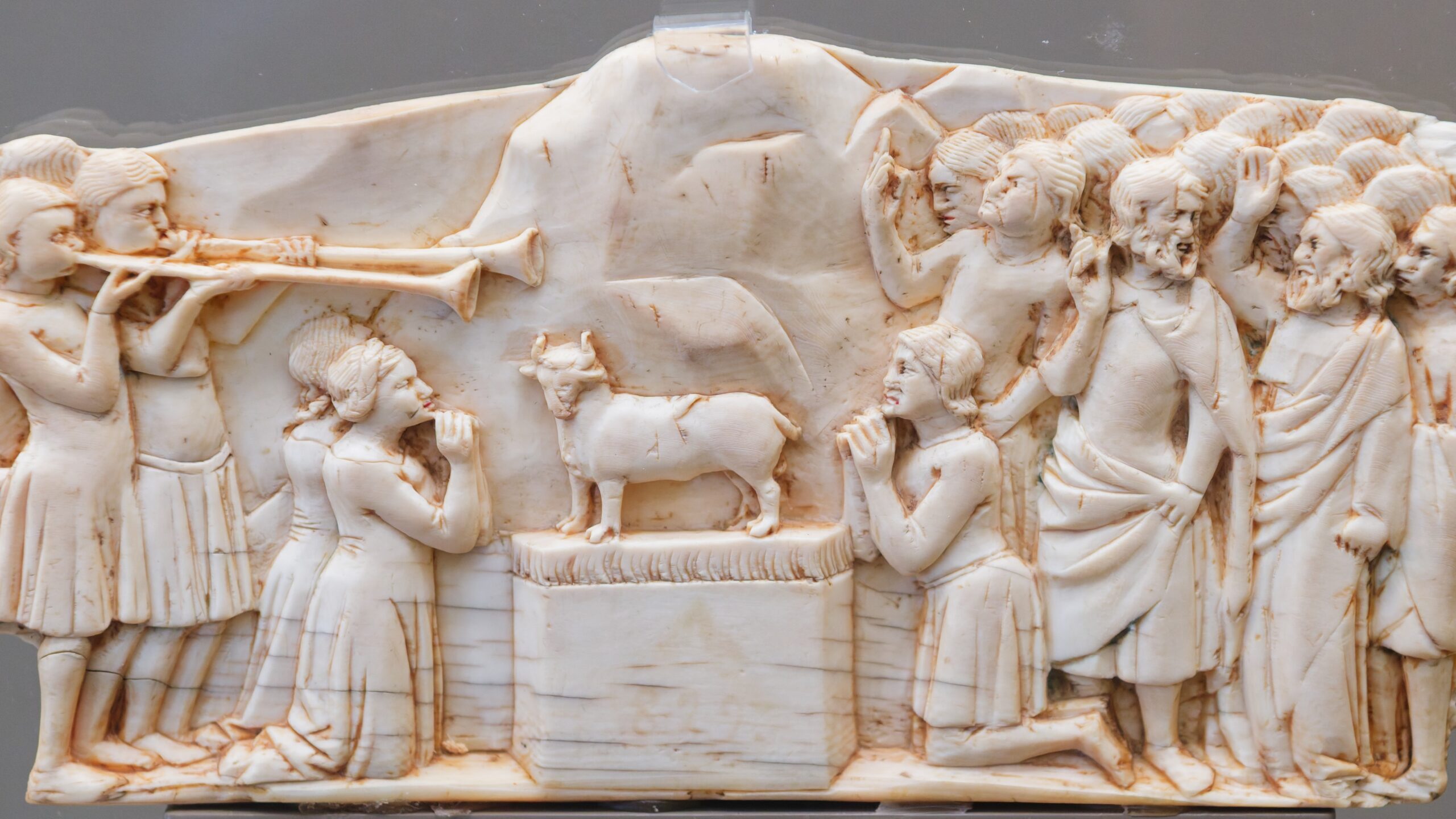
Image credit: “Adoration of the Golden Calf” from the workshop of Baldassare degli Embriachi, c. late 14th-early 15th century. Photo by Marie-Lan Taÿ Pamart, 2026.