1 Kings 19
BibleHub
1 AhabI toldII JezebelIII
Notes on verse 1a
I “Ahab” = Achab. From ach (brother, kindred, another, other, like) + ab (father, ancestor, grandfather; father in a literal or figurative sense). This is Ahab, a name meaning “father’s brother” or “father’s friend.”
II “told” = nagad. This is to declare, make conspicuous, stand in front, manifest, predict, explain.
III “Jezebel” = Izebel. Perhaps from iy (not, island); {probably related to ay (where, how, whether); perhaps from ayin (where)} + Zebul (Zebul; a name meaning “dwelling”); {from zebul (height, dwelling, elevation, place); from zabal (to dwell, inclose, reside)}. This is Jezebel, a name which may mean “not honored by cohabitation” or “un-husbanded” or “without cohabitation” or “unmarried” or “chaste.” See https://www.abarim-publications.com/Meaning/Jezebel.html
allIV that ElijahV had doneVI and how he had killedVII all the prophetsVIII with the sword.IX
Notes on verse 1b
IV “all” = kol. From kalal (to complete). This is all or every.
V “Elijah” = Eliyyah. From El (God, god) + Yah (the shortened form of the name of the God of Israel; God, Lord); {from YHVH (proper name of the God of Israel; God, Lord; the self-existent or eternal one); from havah (to become) or hayah (to be, become, happen)}. This is Elijah, meaning “The Lord is God.”
VI “done” = asah. This is to make, do, act, appoint, become in many senses.
VII “killed” = harag. This is to strike with deadly intent so it can be kill, destroy, murder, or put to death.
VIII “prophets” = nabi. This is prophet, prophecy, speaker, or someone inspired.
IX “sword” = chereb. From charab (to attack, slay). This is any sharp instrument like a sword, dagger, axe, or mattock.
2 Then Jezebel sentX a messengerXI to Elijah, saying,XII “SoXIII may the godsXIV do to me
Notes on verse 2a
X “sent” = shalach. This is to send out, away, send for, forsake. It can also mean to divorce or set a slave free.
XI “messenger” = malak. This is a messenger, an angel, or a deputy of some kind. Can be used for human messengers literally or for prophets, priests, or teachers as messengers of God. Also used for supernatural messengers i.e. angels.
XII “saying” = amar. This is to speak, say, answer, command, promise, report.
XIII “so” = koh. Perhaps from ki (that, for when, certainly) + hu (he, she, it). This is like this, thus, here, now.
XIV “gods” = elohim. Related to “Elijah” in v1. See note V above.
and moreXV also,XVI if I do not makeXVII your lifeXVIII like the life of oneXIX of them
Notes on verse 2b
XV “more” = yasaph. This is to add, increase, continue, exceed.
XVI “also” = koh. Same as “so” in v2. See note XIII above.
XVII “make” = sim. This is to put or place in a literal or figurative sense. It can be appoint, care, change, make, and may other things.
XVIII “life” = nephesh. Related to naphash (to refresh or be refreshed). This is soul, self, person, emotion. It is a breathing creature. Can also refer to appetites and desires.
XIX “one” = echad. Perhaps from achad (to unify, continue on a path; figuratively, to gather one’s thoughts). This is the number one, first, united. It can also be alone, altogether, a certain, a few.
by this timeXX tomorrow.”XXI 3 Then he was afraid;XXII he got upXXIII
Notes on verses 2c-3a
XX “time” = et. Probably from anah (to answer, sing, announce); from ad (forever, all, old); from adah (to pass on, advance, decorate oneself). This is a period or season. It can also mean whenever or continually.
XXI “tomorrow” = machar. Perhaps from achar (to be behind, delay, be late, procrastinate, continue). This is tomorrow or later. It is some kind of deferred time, so it could also mean indefinitely or refer to the time to come.
XXII “was afraid” = raah. This is to see in a literal or figurative sense so stare, advise, think, view.
XXIII “got up” = qum. To arise, stand, accomplish, establish, abide. This is rising as in rising against, getting up after being sick or asleep, arising from one state to another, becoming powerful, or rising for action. It can also be standing in a figurative sense.
and fledXXIV for his life and cameXXV to Beer-sheba,XXVI
Notes on verse 3b
XXIV “fled” = halak. This is go, come, walk. It is walk literally and figuratively and includes people and animals. It can be used figuratively for one’s moral life – how we walk according to God’s way or against it. It can also refer to the walk of life as in the course one’s life takes, the choices we make, etc.
XXV “came” = bo. This is to enter, come in, advance, fulfill, bring offerings, enter to worship, attack. It can also have a sexual connotation.
XXVI “Beer-sheba” = Beerah shaba. From beer (a well or pit); {from baar (to make plain; to dig; can also mean to engrave or figuratively to explain)} + perhaps from shaba (to swear, curse, vow, make a covenant; properly, to be complete; this is to seven oneself – as in affirming something so strongly it is as though it were said seven times) {perhaps from sheba (seven – the number of perfection/sacred fullness)}. This is Beersheba – meaning either “well of seven” or “well of an oath.”
which belongs to Judah;XXVII he leftXXVIII his servantXXIX there.
Notes on verse 3c
XXVII “Judah” = Yehudah. Probably from yadah (to throw one’s hands into the air in a gesture of praise); from yad (hand). This is Judah, meaning “praised.”
XXVIII “left” = yanach. Perhaps from the same as nuach (to rest, calm, camp, free, place, remain, satisfy, settle, station, or wait; implies settling down in a literal or figurative sense). This is to lay down, let alone, pacify, cast down, or deposit. It can also mean to allow something or someone to stay.
XXIX “servant” = naar. May be from na’ar (to shake, toss up and down, tumble around). This is a child or a servant. It is a child in their active years so they could be aged anywhere from infancy to adolescence.
4 But he himself wentXXX a day’sXXXI journeyXXXII into the wildernessXXXIII
Notes on verse 4a
XXX “went” = halak. Same as “fled” in v3. See note XXIV above.
XXXI “day’s” = yom. Root may mean being hot. This is the day in a literal or figurative sense. It can also mean birth, age, daylight, continually or other references to time.
XXXII “journey” = derek. From darak (to tread, march, to walk. Can also mean affixing a string to a box since one needs to step on it to bend it in the process; so also an archer). This is a road as a thing that is walked on. Can be used figuratively for the path that one’s life takes or how one chooses to live one’s life.
XXXIII “wilderness” = midbar. From dabar (to speak, command, declare). This is mouth or speech. It can also be desert or wilderness. Additionally, it can be used for a pasture to which one drives cattle.
and came and sat downXXXIV underXXXV a solitaryXXXVI broom tree.XXXVII
Notes on verse 4b
XXXIV “sat down” = yashab. This is to sit and so to remain and so to dwell. It is sitting for any reason – as a judge, in order to ambush, or just sitting quietly. Causatively, this can mean settling or marrying. This can also mean continue, endure, or establish.
XXXV “under” = tachat. This is underneath, below, the bottom, instead of.
XXXVI “solitary” = echad. Same as “one” in v2. See note XIX above.
XXXVII “broom tree” = rethem. 4x in OT. From ratham (to attach, yoke, bind). This is a broom plant or tree, or a juniper. It is perhaps retama raetam.
He askedXXXVIII that heXXXIX might die,XL, XLI “It is enough;XLII
Notes on verse 4c
XXXVIII “asked” = shaal. This is to ask, inquire, beg, borrow, desire, request. It can also mean to demand.
XXXIX “he” = nephesh. Same as “life” in v2. See note XVIII above.
XL “die” = mut. This is to die in a literal or figurative sense. It can also refer to being a dead body.
XLI {untranslated} = amar. Same as “saying” in v2. See note XII above.
XLII “enough” = rab. From rabab (increasing in any aspect whether quantity, authority, size, quality, greatness, etc.). This is abundance, many, elder, exceedingly, great. It refers to abundance of amount, rank, or status.
now,XLIII O Lord,XLIV take awayXLV my life, for I am no betterXLVI than my ancestors.”XLVII
Notes on verse 4d
XLIII “now” = attah. Related to “time” in v2. Perhaps from et (see note XX above). This is now, from now on.
XLIV “Lord” = YHVH. Related to “Elijah” in v1. See note V above.
XLV “take away” = laqach. This is to take, accept, carry away, receive. It can also have the sense of take a wife or take in marriage.
XLVI “better” = tob. From tob (to be pleasing, to be good). This is good, beautiful, pleasant, agreeable, bountiful, at ease. This word is used for goodness as a concept, a good thing, a good person. This can refer to prosperity and welfare as well as joy, kindness, sweetness, and graciousness. So, this is ethically good, but also enjoyably good.
XLVII “ancestors” = ab. Related to “Ahab” in v1. See note I above.
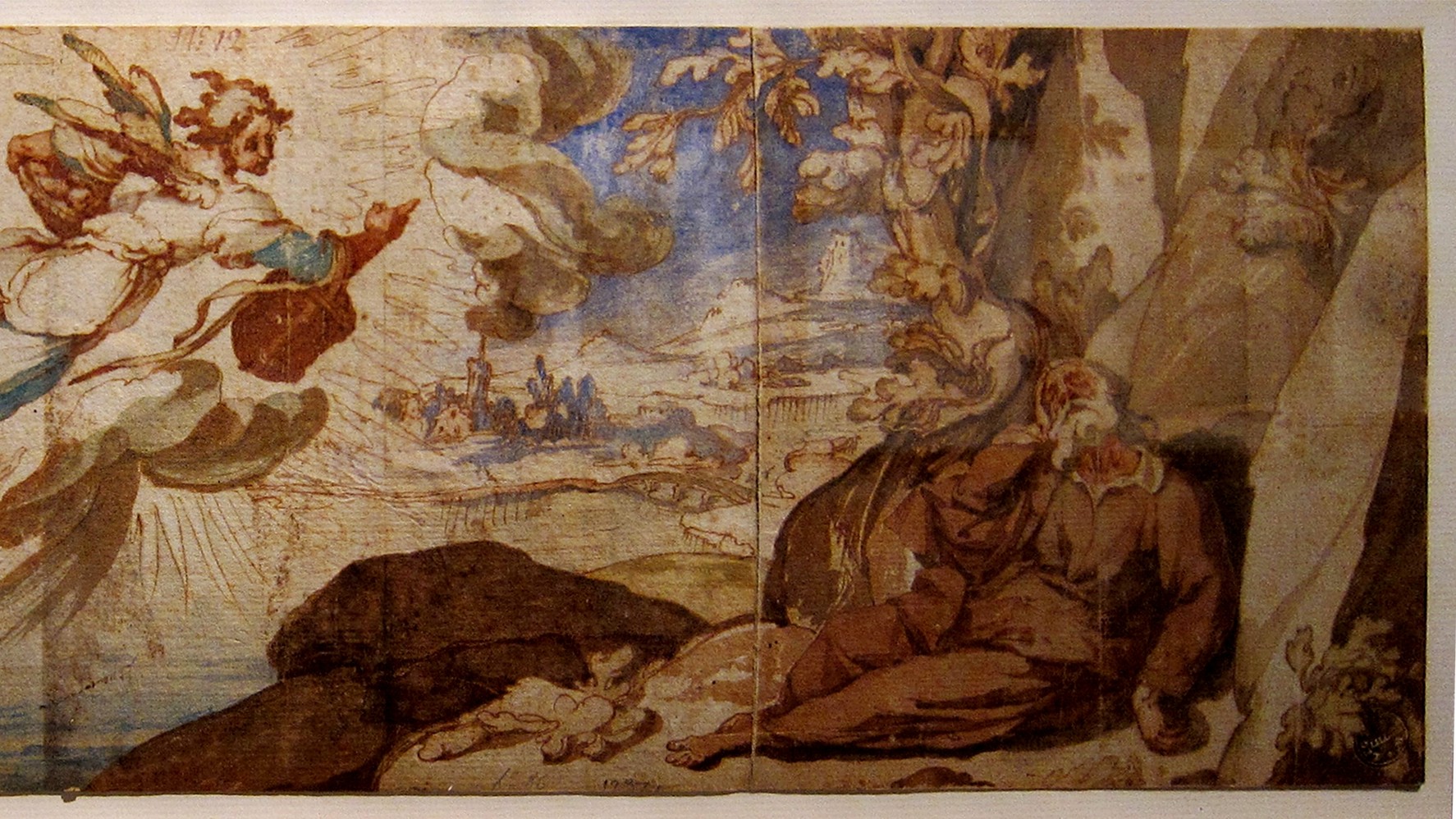
5 Then he lay downXLVIII under theXLIX broom tree and fell asleep.L SuddenlyLI an angelLII
Notes on verse 5a
XLVIII “lay down” = shakab. This is to lie down, lodge. It is lying for sleep, sex, or other reasons.
XLIX “the” = echad. Same as “one” in v2. See note XIX above.
L “fell asleep” = yashen. This is to be languid or go slack. By implication it can mean to sleep, become old or stale, or die.
LI “suddenly” = hinneh. From hen (lo! Behold! If, though; an expression of surprise). This is to draw attention, show suddenness or surprise, or to emphasize the importance of the coming statement. See! Lo! Behold!
LII “angel” = malak. Same as “messenger” in v2. See note XI above.
touchedLIII him and said to him, “Get up and eat.”LIV
6 He looked,LV and thereLVI at his headLVII was a cakeLVIII
Notes on verses 5b-6a
LIII “touched” = naga. This is touch, reach, arrive, come near, strike. This is touching for any reason including sexual or violent.
LIV “eat” = akal. This is to eat, devour, burn up, or otherwise consume. It can be eating in a literal or figurative sense.
LV “looked” = nabat. This is to behold, look at intently, consider, or scan. It can mean to have respect or regard someone favorably.
LVI “there” = hinneh. Same as “suddenly” in v5. See note LI above.
LVII “head” = meraashoth. 8x in OT. From rosh (head, captain, or chief; excellent or the forefront; first in position or in statue or in time). This is a place for one’s place so it could be a pillow, head rest, or other head piece.
LVIII “cake” = uggah. 7x in OT. Perhaps from ug (to gyrate, bake; baking a round cake). This is a bread cake that is round, cooked on the hearth.
baked on hot stonesLIX and a jarLX of water.LXI He ate and drankLXII and lay down again.LXIII
Notes on verse 6b
LIX “hot stones” = retseph. 1x in OT. Related to ritspah (coal, hot stone, pavement). This is a coal of a hot stone that one used in cooking.
LX “jar” = tsappachath. 7x in OT. This is jar, cruse, or saucer.
LXI “water” = mayim. This is water, waters, or waterway in a general sense. Figuratively, it can also mean juice, urine, or semen.
LXII “drank” = shathah. This is to drink literally or figuratively. It could also be a drinker.
LXIII “again” = shub. To turn back, return, turn away – literally or figuratively. Doesn’t necessarily imply going back to where you started from. This is also the root verb for the Hebrew word for repentance “teshubah.”
7 The angel of the Lord cameLXIV a secondLXV time, touched him, and said, “Get up and eat, or the journey will be too muchLXVI for you.” 8 He got up and ate and drank; then he went in the strengthLXVII of that foodLXVIII
Notes on verses 7-8a
LXIV “came” = shub. Same as “again” in v6. See note LXIII above.
LXV “second” = sheni. From shanah (to fold, repeat, double, alter, or disguise). This is double, again, another, second.
LXVI “too much” = rab. Same as “enough” in v4. See note XLII above.
LXVII “strength” = koach. Root may mean to be firm. This is power, strength, force. It can be literal or figurative, positive or negative. It can also mean capacity or means – what something produces. Additionally, it could refer to some kind of small reptile.
LXVIII “food” = akilah. Related to “eat” in v5. 1x in OT. From akal (see note LIV above). This is something that can be eaten – a meal or food.
fortyLXIX days and forty nightsLXX to HorebLXXI the mountLXXII of God.LXXIII
Notes on verse 8b
LXIX “forty” = arbaim. From the same as arba (four); from raba (to make square or be four-sided); perhaps from raba (to lie down flat; can be to lie for mating). This is forty.
LXX “nights” = layil. Properly, this refers to light twisting away. It is used for night or midnight. Figuratively, this can mean adversity.
LXXI “Horeb” = Choreb. 17x in OT. From chareb (to devastate, desolate, or be waste). Horeb means waste or desolate.
LXXII “mount” = har. From harar (hill or mountain). This is mountain, hill, hilly region.
LXXIII “God” = Elohim. Same as “gods” in v2. See note XIV above.
9 At that place he cameLXXIV to a caveLXXV and spent the nightLXXVI there.
ThenLXXVII the wordLXXVIII of the Lord came to him, saying, “What are you doing here, Elijah?”
Notes on verse 9
LXXIV “came” = bo. Same as “came” in v3. See note XXV above.
LXXV “cave” = mearah. Perhaps from ur (to be made naked, exposed, or bare). This is a cave, cavern, den, or hole.
LXXVI “spent the night” = lun. This is to stop – usually to lodge for the night. It can imply dwelling, enduring, or staying permanently. Figuratively, it can mean being obstinate, particularly with one’s words – to complain.
LXXVII {untranslated} = hinneh. Same as “suddenly” in v5. See note LI above.
LXXVIII “word” = dabar. Related to “wilderness” in v4. From dabar (see note XXXIII above). This is speech, a word, a matter, an affair, charge, command, message, promise, purpose, report, request. It is a word, which implies things that are spoken of in a wide sense.
10 He answered,LXXIX “I have been very zealousLXXX for the Lord,LXXXI the God of hosts,LXXXII
Notes on verse 10a
LXXIX “answered” = amar. Same as “saying” in v2. See note XII above.
LXXX “been very zealous” = qanah + qanah. From qinah (zeal, jealousy). This is to be zealous or to provoke to jealousy. The word is repeated twice – the first time as an Infinitive Absolute. The Infinitive Absolute serves to emphasize the sentiment of the word. It is rather like Foghorn Leghorn’s speech pattern, “I said, I said.”
LXXXI “Lord” = YHVH. Related to “Elijah” in v1 & “Lord” in v4. From the same as YHVH (see note V above). This is a secondary spelling of the Lord, the name of the God of Israel. It has the same meaning.
LXXXII “hosts” = tsaba. From tsaba (to wage war, serve, assemble, fight, perform, muster, wait on). This is a large group of persons (used figuratively for a group of things). It implies a campaign literally as with army, war, warfare, battle, company, soldiers. Can also be used figuratively for hardship or for worship.
for the IsraelitesLXXXIII have forsakenLXXXIV your covenant,LXXXV
Notes on verse 10b
LXXXIII “Israelites” = ben + Yisrael. Literally, “children of Israel.” Ben is from banah (to build or obtain children). This is son, age, child. It is son in a literal or figurative sense. Yisrael is related to “Elijah” in v1 & “gods” in v2. From sarah (to persist, exert oneself, contend, persevere, wrestle, prevail) + El (see note V above). This is Israel, meaning God strives or one who strives with God; new name for Jacob and for his offspring. This refers to the people and to the land.
LXXXIV “forsaken” = azab. To loosen, relinquish, permit, forsake, fail, leave destitute.
LXXXV “covenant” = berit. Perhaps from barah (to eat, choose, make clear); perhaps from bar (grain, wheat); from barar (to select, purify, cleanse, test, brighten, polish). This is a compact, covenant, alliance, treaty, or league.
thrown downLXXXVI your altars,LXXXVII and killed your prophets with the sword. I aloneLXXXVIII am left,LXXXIX and they are seekingXC my life, to take it away.”
Notes on verse 10c
LXXXVI “thrown down” = haras. This is to break down, throw down, ruin, overthrow, or destroy. It is breaking down in pieces.
LXXXVII “altars” = mizbeach. From zabach (to kill, slay, offer; slaughtering an animal to offer as a sacrifice). This is an altar.
LXXXVIII “alone” = bad. From badad (to divide or be separated; alone, solitary, lonely, isolated, straggler). This is apart, alone, separation, body part, tree branch, except. It can also be a city’s chief.
LXXXIX “am left” = yathar. This is to jut over, remain behind, preserve, to excel. It can be to leave or to be in abundance.
XC “seeking” = baqash. This is to seek, ask, desire, or request. It can be any kind of searching. It can also mean to worship or pray – implies a striving for.
11 He said, “Go outXCI and standXCII on the mountainXCIII beforeXCIV the Lord,XCV
Notes on verse 11a
XCI “go out” = yatsa. This is to go or come out, bring forth, appear. It is to go out in a literal or figurative sense.
XCII “stand” = amad. This is to stand up in a literal or figurative sense. So it can be establish, continue, endure, take a stand, act, be a servant, stand still, remain, stand against an enemy.
XCIII “mountain” = har. Same as “mount” in v8. See note LXXII above.
XCIV “before” = paneh. From panah (to turn, face, appear). This is face in a literal or figurative sense. It could be face, presence, anger, respect. It can also be used of God to indicate divine favor or presence.
XCV “Lord” = YHVH. Same as “Lord” in v4. See note XLIV above.
forXCVI the LordXCVII is about to pass by.”XCVIII Now there was a greatXCIX wind,C
Notes on verse 11b
XCVI {untranslated} = hinneh. Same as “suddenly” in v5. See note LI above.
XCVII “Lord” = YHVH. Same as “Lord” in v4. See note XLIV above.
XCVIII “pass by” = abar. This is to pass over or cross over. It is used for transitions, whether literal or figurative. It can also mean to escape, alienate, or fail. This is the root verb from which “Hebrew” is drawn.
XCIX “great” = gadol. From gadal (to grow up, become great, become wealthy – to advance. The root meaning may be to twist in the sense of the process of growing). This is great, high, bigger, noble, old, marvelous. It can also refer to someone who is powerful or distinguished.
C “wind” = ruach. From ruach (smell, breathe, perceive, anticipate, accept, enjoy). This is breath, wind, air, cool, spirit. This is wind, which resembles the breath and so this can be used figuratively for life itself or being frail/mortal/impermanent. It can refer to the air of the sky or the spirit.
so strongCI that it was splittingCII mountains and breaking rocksCIII in piecesCIV
Notes on verse 11c
CI “strong” = chazaq. From chazaq (to strengthen, seize, be courageous, repair, bind, heal, conquer, harden). This is strong, hard, powerful, loud, bold, violent, impudent. It is usually strong in a negative sense.
CII “splitting” = paraq. 10x in OT. This is to tear apart, break off, drag away, or crunch. Figuratively, it can mean to deliver.
CIII “rocks” = sela. Root may mean being lofty. This is a rock, cliff, crag, mountain. It could be used figuratively for obstinance or to show God as a refuge. It can also more generally mean fortress or stronghold.
CIV “breaking…in pieces” = shabar. This is break, collapse, destroy, break in pieces, tear. It is bursting in a literal or figurative sense.
beforeCV the Lord,CVI but the LordCVII was not in the wind, and afterCVIII the wind an earthquake,CIX but the LordCX was not in the earthquake,
Notes on verse 11d
CV “before” = paneh. Same as “before” in v11. See note XCIV above.
CVI “Lord” = YHVH. Same as “Lord” in v4. See note XLIV above.
CVII “Lord” = YHVH. Same as “Lord” in v4. See note XLIV above.
CVIII “after” = achar. Related to “tomorrow” in v2. From achar (see note XXI above). This is after or the last part, following.
CIX “earthquake” = raash. 17x in OT. From raash (to quake, shake, tremble, shake from fear; leap like a locust). This is quaking, shaking, rattling, or rumbling. It can also be commotion, tumult, earthquake, or confused sounds.
CX “Lord” = YHVH. Same as “Lord” in v4. See note XLIV above.
12 and after the earthquake a fire,CXI but the LordCXII was not in the fire, and after the fire a soundCXIII of sheerCXIV silence.CXV
Notes on verse 12
CXI “fire” = esh. This is fire, burning, flaming, hot. It is fire in a literal or figurative sense.
CXII “Lord” = YHVH. Same as “Lord” in v4. See note XLIV above.
CXIII “sound” = qol. This is a sound, used often for human voices. Also used when God speaks or angels, animals or instruments. It can be a cry or a noise, thunder or earthquakes and so on.
CXIV “sheer” = daq. 15x in OT. From daqaq (to crush, crumble, make dust, be very small). This is thin, crushed, small, very little.
CXV “silence” = demamah. 3x in OT. From damam (to cease, be or become mute, silent, still, cut off, hold peace, be astonished, or die). This is silence, calm, quiet, whisper, or blowing.
13 CXVIWhen Elijah heardCXVII it, he wrappedCXVIII his faceCXIX in his mantleCXX
Notes on verse 13a
CXVI {untranslated} = hayah. Related to “Elijah” in v1 & “Lord” in v4 & “Lord” in v10. See note V above.
CXVII “heard” = shama. This is to hear, call, consent, or consider. It implies listening intelligently, giving attention, and, because of these two factors, obedience and action are often implied.
CXVIII “wrapped” = lut. 3x in OT. This is to wrap or envelop.
CXIX “face” = paneh. Same as “before” in v11. See note XCIV above.
CXX “mantle” = addereth. 12x in OT– this is the word used for the mantle that passes from Elijah to Elisha. From addir (majestic, excellent, mighty, powerful, or noble); from adar (wide, glorious, honorable, great, magnificent). This is something ample – glory, splendid, goodly. It could also refer to a cloak, robe, or garment.
and went out and stood at the entranceCXXI of the cave. ThenCXXII there came a voiceCXXIII to him that said, “What are you doing here, Elijah?”
14 He answered, “I have been very zealousCXXIV for the Lord,CXXV the God of hosts, for the Israelites have forsaken your covenant, thrown down your altars, and killed your prophets with the sword. I alone am left, and they are seeking my life, to take it away.”
Notes on verses 13b-14
CXXI “entrance” = petach. From patach (to open wide in a literal or figurative sense, loosen, plow, carve). This is opening, door, gate, entrance.
CXXII {untranslated} = hinneh. Same as “suddenly” in v5. See note LI above.
CXXIII “voice” = qol. Same as “sound” in v12. See note CXIII above.
CXXIV “been very zealous” = qanah + qanah. Same as “been very zealous” in v10. See note LXXX above. The word is repeated twice – the first time as an Infinitive Absolute. The Infinitive Absolute serves to emphasize the sentiment of the word. It is rather like Foghorn Leghorn’s speech pattern, “I said, I said.”
CXXV “Lord” = YHVH. Same as “Lord” in v4. See note XLIV above.
15 Then the LordCXXVI said to him, “Go,CXXVII returnCXXVIII on your wayCXXIX to the wilderness of Damascus;CXXX when you arrive,CXXXI
Notes on verse 15a
CXXVI “Lord” = YHVH. Same as “Lord” in v4. See note XLIV above.
CXXVII “go” = halak. Same as “fled” in v3. See note XXIV above.
CXXVIII “return” = shub. Same as “again” in v6. See note LXIII above.
CXXIX “way” = derek. Same as “journey” in v4. See note XXXII above.
CXXX “Damascus” = Dammaseq. From Old Aramaic dammasq (Damascus); perhaps related to d-r (dwelling) OR in Syriac darsuq (“a well-watered land”). This is Damascus. See https://en.wikipedia.org/wiki/Damascus.
CXXXI “arrive” = bo. Same as “came” in v3. See note XXV above.
you shall anointCXXXII HazaelCXXXIII as kingCXXXIV over Aram.CXXXV
Notes on verse 15b
CXXXII “anoint” = mashach. This is smear, paint, spread, or paint. It can also be to rub with oil or, otherwise stated, to anoint. This implies a consecration. This root verb is where the word “messiah” comes from.
CXXXIII “Hazael” = Chazael. Related to “Elijah” in v1 & “gods” in v2 & “Israelites” in v10. From chazah (to gaze at – to see or behold; perceiving as a mental process or looking at something with pleasure; seeing a vision) + El (see note V above). This is Hazael or Chazael, meaning “God sees.”
CXXXIV “king” = melek. From malak (to be or become king or queen, to rise to the throne, to be crowned; by implication, to take counsel). This is king or royal.
CXXXV “Aram” = Aram. Perhaps from ‘armon (any fortified building – castle, citadel, palace) OR from rum (to be high, rise, exalt self, extol, be haughty; to rise literally or figuratively). This is Aram, Syria, Mesopotamia – meaning elevated or citadel. See https://www.abarim-publications.com/Meaning/Aram.html#.XqfDX8hKhPY
16 Also you shall anoint JehuCXXXVI sonCXXXVII of NimshiCXXXVIII as king over Israel, and you shall anoint ElishaCXXXIX
Notes on verse 16a
CXXXVI “Jehu” = Yehu. Related to “Elijah” in v1 & “Lord” in v4 & {untranslated} in v13. From YHVH (see note V above) + hu (third person pronoun – he, she, it). This is Jehu or Yehu, a name meaning “the Lord is He.”
CXXXVII “son” = ben. Same as “Israelites” in v10. See note LXXXIII above.
CXXXVIII “Nimshi” = Nimshi. 5x in OT. Perhaps from mashah (to pull out in a literal or figurative sense, to draw out). This is Nimshi, perhaps meaning “extricated.”
CXXXIX “Elisha” = Elisha. Related to “Elijah” in v1 & “gods” in v2 & “Israelites” in v10 & “Hazael” in v15. From Elishua (Elishua, meaning “God is salvation”); {from El (see note V above) + yasha (to deliver, defend, help, preserve, rescue; properly, to be open, wide or free, which implies being safe. So, in a causative sense, this is to free someone)}. This is Elisha, meaning “God is salvation.”
son of ShaphatCXL of Abel-meholahCXLI as prophet in your place.CXLII
Notes on verse 16b
CXL “Shaphat” = Shaphat. 8x in OT. From shaphat (to judge, defend, pronounce judgment, condemn, govern). This is Shaphat, meaning “he has judged” or “judge.”
CXLI “Abel-meholah” = Abel mecholah. 3x in OT. From abel (meadow, plain – grassy) + mecholah (dancing, a company); {from machol (round dance); from chul (whirling around so dancing as in a circle or writhing in pain; used particularly for the pain of childbirth or from writhing due to fear; can also be falling in pain or waiting)} or {from machashabah (thought, scheme, imagination, purpose, or a plan either good or evil); from chashab (literally to weave; figuratively to think or plot something malicious)}. This is Abel-meholah or Abel Mecholah, meaning “meadow of dancing.”
CXLII “in your place” = tachat. Same as “under” in v4. See note XXXV above.
17 CXLIIIWhoever escapesCXLIV from the sword of Hazael, Jehu shall kill,CXLV and whoever escapes from the sword of Jehu, Elisha shall kill.CXLVI 18 Yet I will leaveCXLVII sevenCXLVIII thousandCXLIX in Israel,
Notes on verses 17-18a
CXLIII {untranslated} = hayah. Same as {untranslated} in v13. See note CXVI above.
CXLIV “escapes” = malat. This is to be smooth, which implies to escape as slipping away from. It can also be release, rescue, deliver, or preserve. It can be used specifically to meaning giving birth or making sparks.
CXLV “kill” = mut. Same as “die” in v4. See note XL above.
CXLVI “kill” = mut. Same as “die” in v4. See note XL above.
CXLVII “leave” = shaar. Properly, this is swelling up i.e. being left over, a remnant, remaining, being redundant.
CXLVIII “seven” = sheba. Related to “Beer-sheba” in v3. See note XXVI above.
CXLIX “thousand” = eleph. Perhaps from the same as eleph (herd, cattle); from alaph (to learn, speak, associate with). This is thousand.
all the kneesCL that have not bowedCLI to Baal,CLII and everyCLIII
Notes on verse 18b
CL “knees” = berek. From barak (to kneel, bless; blessing God as part of worship and adoration; blessing humans to help them; can be used as a euphemism to say curse God). This is the knee.
CLI “bowed” = kara. This is to bow, crouch, kneel down, subdue. It is to bend the knee in many senses. It can also mean to smite, a woman crouching in childbirth, or bowing to worship God.
CLII “Baal” = Baal. From the same as ba’al (lord, owner, ally, or archer); from ba’al (to marry, have dominion, be master). This is Baal, literally “lord,” a Phoenician god.
CLIII “every” = kol. Same as “all” in v1. See note IV above.
mouthCLIV that has not kissedCLV him.”
19 So he set outCLVI from there and foundCLVII Elisha son of Shaphat, who was plowing.CLVIII
Notes on verses 18c-19a
CLIV “mouth” = peh. This is mouth in a literal or figurative sense. So, more literally, it can be beak or jaws. More figuratively, it refers to speech, commands, or promises.
CLV “kissed” = nashaq. This is to kiss in a literal or figurative sense. It can mean to touch, rule, or equip with weapons.
CLVI “set out” = halak. Same as “fled” in v3. See note XXIV above.
CLVII “found” = matsa. This is to find, catch or acquire. It can also mean to come forth or appear. Figuratively, this can mean to meet or be together with.
CLVIII “plowing” = charash. This is to scratch, which implies etching or plowing. It can mean to manufacture regardless of materials used. Figuratively, it can be to devise or conceal. It can also have a sense of secrecy. Hence, being silent or left alone. It can also be speechless.
There were twelveCLIX yokeCLX of oxen aheadCLXI of him, and he was with the twelfth. Elijah passed by him and threwCLXII his mantle over him.
Notes on verse 19b
CLIX “twelve” = shenayim + asar. Shenayim is related to “second” in v7. From sheni (see note LXV above). This is two, both, second, couple. Asar is from the same as eser (ten). This is -teen or -teenth.
CLX “yoke” = tsemed. 15x in OT. From tsamad (to bind, attach, frame, serve, or contrive). This is a pair, together, yoke, team. It can also be used for an acre because it would take a team of cattle a whole day to plow it.
CLXI “ahead” = paneh. Same as “before” in v11. See note XCIV above.
CLXII “threw” = shalak. This is to throw, fling, or hurl. It can also be to throw away in a literal or figurative sense.
20 He leftCLXIII the oxen,CLXIV ranCLXV after Elijah, and said, “Let me kissCLXVI my fatherCLXVII
Notes on verse 20a
CLXIII “left” = azab. Same as “forsaken” in v10. See note LXXXIV above.
CLXIV “oxen” = baqar. From baqar (to plow, break forth; figuratively, to inquire, inspect, consider). This is cattle – an animal used for plowing.
CLXV “ran” = ruts. This is to run or rush, divide quickly, bring swiftly. It can also refer to a footman or guard.
CLXVI {untranslated} = na. This particle is used for requests or for urging. It can be we pray, now, I ask you, oh. This is the same “na” in “hosanna.”
CLXVII “father” = ab. Same as “ancestors” in v4. See note XLVII above.
and my mother,CLXVIII and then I will followCLXIX you.”
Then Elijah said to him, “GoCLXX back again,CLXXI for what have I done to you?” 21 He returned fromCLXXII following him, took the yoke of oxen, and slaughteredCLXXIII them;
Notes on verses 20b-21a
CLXVIII “mother” = em. This is a mother as binding a family together or a breeding female animal. It could be mother in a literal or figurative sense.
CLXIX “follow” = halak + achar. Halak is the same as “fled” in v3. See note XXIV above. Achar is the same as “after” in v11. See note CVIII above.
CLXX “go” = halak. Same as “fled” in v3. See note XXIV above.
CLXXI “back again” = shub. Same as “again” in v6. See note LXIII above.
CLXXII “from” = achar. Same as “after” in v11. See note CVIII above.
CLXXIII “slaughtered” = zabach. Related to “altars” in v10. See note LXXXVII above.
using the equipmentCLXXIV from the oxen, he boiledCLXXV their fleshCLXXVI
Notes on verse 21b
CLXXIV “equipment” = keli. From kalah (to end, be finished, complete, prepare, consume, spent, or completely destroyed). This is something that was prepared – any implement, utensil, article, vessel, weapon, or instrument. Also includes jewels, weapons, bags, carriages, and furniture.
CLXXV “boiled” = bashal. This is to boil up, roast, or bake. It can also mean ripen, produce, or seethe.
CLXXVI “flesh” = basar. From basar (being a messenger, publish, carry preach; properly, this is being fresh, rosy or cheerful as one bearing news). This is flesh, the body, fat, skin, self, nakedness, humankind, or kin. It can also refer to private parts.
and gaveCLXXVII it to the people,CLXXVIII and they ate. Then he set outCLXXIX and followed Elijah and became his servant.CLXXX
Notes on verse 21c
CLXXVII “gave” = natan. This is to give, put, set, offer. It is to give literally or figuratively.
CLXXVIII “people” = am. From amam (to darken, hide, associate; creating shadows by huddling together). This is people or nation. It can be used specifically for a tribe, collectively of troops or armies, or figuratively to refer to a flock of animals.
CLXXIX “set out” = qum. Same as “got up” in v3. See note XXIII above.
CLXXX “became…servant” = sharath. This is ministering, serving, or waiting on. It can refer to one offering service as a worshipper or one serving as a servant.
Image credit: “The Prophet Elijah Visited by an Angel” by Andrea Boscoli at the Palais des Beaux-Arts in Lille, c. 1608. Posted by Velvet, 2013.