2 Samuel 24
BibleHub
1 AgainI the angerII of the LordIII was kindledIV
Notes on verse 1a
I “again” = yasaph. This is to add, increase, continue, exceed.
II “anger” = aph. From anaph (to be angry; properly, breathing hard as a signifier of being enraged). This properly refers to the nose or nostril and by extension the face. It can specifically refer to anger or wrath as one breathes hard and nostrils flare in times of great anger.
III “Lord” = YHVH. From havah (to be, become) or hayah (to come to pass, become, be). This is the name of the God of Israel, the self-existent and eternal one, the tetragrammaton. This pronunciation has been lost to time so “Lord” is generally used in its place.
IV “kindled” = charah. Perhaps related to charar (to be hot, burn, glow, melt, be scorched; figuratively, to incite passion, be angry). This is to be displeased, burn with anger, glow, become warn. Figuratively it is a blaze of anger, zeal, or jealousy.
against Israel,V and he incitedVI DavidVII against them,
Notes on verse 1b
V “Israel” = Yisrael. From sarah (to persist, exert oneself, contend, persevere, wrestle, prevail) +El (God or god). This is Israel, meaning God strives or one who strives with God; new name for Jacob and for his offspring. This refers to the people and to the land.
VI “incited” = suth. 18x in OT. Perhaps from shayith (a thorn-bush or thorn; some kind of wild growth); perhaps from shith (to place, set, bring, appoint, consider, bring, array or look). This is to incite, induce, persuade, provoke, mislead, remove. It could be from the root in the sense of being pricked or agitated. It can imply being seduced.
VII “David” = David. From the same as dod (beloved, love, uncle); the root may mean to boil, which is used figuratively to describe love. So, this implies someone you love such as a friend, a lover, or a close family member like an uncle. David’s name likely means something like “beloved one.”
saying,VIII “Go,IX countX the people of Israel and Judah.”XI
Notes on verse 1c
VIII “saying” = amar. This is to speak, say, answer, command, promise, report.
IX “go” = halak. This is go, come, walk. It is walk literally and figuratively and includes people and animals. It can be used figuratively for one’s moral life – how we walk according to God’s way or against it. It can also refer to the walk of life as in the course one’s life takes, the choices we make, etc.
X “count” = manah. To weigh out, reckon, count, number, set, tell. By implication, it is allotting or providing something officially.
XI “Judah” = Yehudah. Probably from yadah (to throw one’s hands into the air in a gesture of praise); from yad (hand). This is Judah, meaning “praised.”
2 So the kingXII said to JoabXIII and the commandersXIV of the armyXV who were with him,
Notes on verse 2a
XII “king” = melek. From malak (to be or become king or queen, to rise to the throne, to be crowned; by implication, to take counsel). This is king or royal.
XIII “Joab” = Yoab. Related to “Lord” in v1. From YHVH (see note III above) + ab (father, ancestor, grandfather; father in a literal or figurative sense). This is Joab or Yoab, meaning “the Lord is father.”
XIV “commanders” = sar. This is chief, leader, ruler, lord, official, governor, prince, military leader. It refers to someone at the top of a rank or class.
XV “army” = chayil. From chul (to be firm, strong, prosperous; to endure). This is strength, wealth, ability, activity. It can refer to soldier or a company of soldiers as well as goods. It is a force of people, means, or goods. It can speak of valor, virtue, or strength.
“GoXVI throughXVII allXVIII the tribesXIX of Israel,
Notes on verse 2b
XVI “go” = shut. 13x in OT. This is to rove around, push forth, go back and forth. It can also refer to a rower as one who travels around.
XVII {untranslated} = na. This particle is used for requests or for urging. It can be we pray, now, I ask you, oh. This is the same “na” in “hosanna.”
XVIII “all” = kol. From kalal (to complete). This is all or every.
XIX “tribes” = shebet. This is a rod, staff, club, scepter, dart, or tribe. Literally a stick that can be used for punishing, writing, fighting, walking, ruling; thus, used figuratively for a clan.
from DanXX to Beer-sheba,XXI and take a censusXXII
Notes on verse 2c
XX “Dan” = Dan. From din (to judge, defend, dispute, govern, quarrel, plead). This is Dan or a Danite. It means “judge” and can refer to Dan, his tribe, or the lands of the tribe.
XXI “Beer-sheba” = Beerah shaba. beerah shaba. From beer (a well or pit); {from baar (to make plain; to dig; can also mean to engrave or figuratively to explain)} + perhaps from shaba (to swear, curse, vow, make a covenant; properly, to be complete; this is to seven oneself – as in affirming something so strongly it is as though it were said seven times) {perhaps from sheba (seven – the number of perfection/sacred fullness)}. This is Beersheba – meaning either “well of seven” or “well of an oath.”
XXII “take a census” = paqad. This is to attend to or visit – can be used for a friendly or violent encounter. So, it can be to oversee, care for, avenge, or charge.
of the people,XXIII so that I may knowXXIV how manyXXV, XXVI there are.”
Notes on verse 2d
XXIII “people” = am. From amam (to darken, hide, associate; creating shadows by huddling together). This is people or nation. It can be used specifically for a tribe, collectively of troops or armies, or figuratively to refer to a flock of animals.
XXIV “know” = yada. This is to know, acknowledge, advise, answer, be aware, be acquainted with. Properly, this is to figure something out by seeing. It includes ideas of observation, recognition, and care about something. It can be used causatively for instruction, designation, and punishment.
XXV “how many” = mispar. From the same as sepher (writing itself or something that is written like a document, book, letter, evidence, bill, scroll, or register); from saphar (to tally or record something; to enumerate, recount, number, celebrate, or declare). This is a number, whether definite or symbolic – could be innumerable, few, abundance. It can also be a tally or account – or a narration.
XXVI {untranslated} = am. Same as “people” in v2. See note XXIII above.
3 But Joab said to the king, “May the Lord your GodXXVII increaseXXVIII the number of the people a hundredfoldXXIX while the eyesXXX of my lordXXXI the king
Notes on verse 3a
XXVII “God” = Elohim. Related to “Israel” in v1. See note V above.
XXVIII “increase” = yasaph. Same as “again” in v1. See note I above.
XXIX “hundredfold” = meah + paam. Meah is hundred or some number times one hundred (i.e. hundredfold or the base of two hundred, three hundred, etc.). Paam is from paam (to move, trouble; to tap in a regular rhythm; to agitate). This is a beat, stroke, footstep, or occurrence.
XXX “eyes” = ayin. This is eye in a literal or figurative sense so eye, appearance, favor, or a fountain (the eye of the landscape).
XXXI “lord” = adon. From a root that means ruling or being sovereign. This is lord, master, or owner.
can still seeXXXII it! But why does my lordXXXIII the king want to doXXXIV this?”XXXV
Notes on verse 3b
XXXII “see” = raah. This is to see in a literal or figurative sense so stare, advise, think, view.
XXXIII “lord” = adon. Same as “lord” in v3. See note XXXI above.
XXXIV “want to do” = chaphets. Properly, this means inclined towards or bending to. Figuratively, it means to desire, delight in, or be pleased with.
XXXV {untranslated} = dabar. From dabar (to speak, declare, discuss). This is speech, a word, a matter, an affair, charge, command, message, promise, purpose, report, request. It is a word, which implies things that are spoken of in a wide sense.
4 But the king’s wordXXXVI prevailedXXXVII against Joab and the commanders of the army. So Joab and the commanders of the army went outXXXVIII from the presenceXXXIX of the king to take a census of the people of Israel.
Notes on verse 4
XXXVI “word” = dabar. Same as {untranslated} in v3. See note XXXV above.
XXXVII “prevailed” = chazaq. This is to strengthen, seize, be courageous, repair, bind, heal, conquer, harden.
XXXVIII “went out” = yatsa. This is to go or come out, bring forth, appear. It is to go out in a literal or figurative sense.
XXXIX “presence” = paneh. From panah (to turn, face, appear). This is face in a literal or figurative sense. It could be face, presence, anger, respect. It can also be used of God to indicate divine favor or presence.
5 They crossedXL the JordanXLI and beganXLII
Notes on verse 5a
XL “crossed” = abar. This is to pass over or cross over. It is used for transitions, whether literal or figurative. It can also mean to escape, alienate, or fail. This is the root verb from which “Hebrew” is drawn.
XLI “Jordan” = Yarden. From yarad (to go down, descend; going down in a literal or figurative sense; going to the shore or a boundary, bringing down an enemy). This is the Jordan River, meaning “descending.”
XLII “began” = chanah. This is decline, bending down, or living in tents. It can be camping to create a home or camping as a part of battle.
from AroerXLIII, XLIV and from the cityXLV
Notes on verse 5b
XLIII “Aroer” = Aroer. 16x in OT. From the same as aroer (shrub or tree; may be a juniper); from arar (to strip, make bare, destroy). This is Aroer, a city whose name means “accumulation” or “stripped” or “heath.” See https://www.abarim-publications.com/Meaning/Aroer.html
XLIV {untranslated} = yamin. May be from yamam (to go or choose the right, use the right hand; to be physically fit or firm). This can mean right hand, right side, or south. Since most people are right-handed, the metaphorical usage of this word presumes that the right hand is stronger and more agile. Thus, it is the instrument of power and action.
XLV “city” = iyr. From uwr (to awaken or wake oneself up). This can mean excitement in the sense of wakefulness or city. Properly, this is a place that is guarded. Guards kept schedules according to watches. This sense of the word would include cities as well as encampments or posts that were guarded.
that is in the middleXLVI of the valley,XLVII toward GadXLVIII and on to Jazer.XLIX
Notes on verse 5c
XLVI “middle” = tavek. This is among, middle, in the midst, the center. Perhaps, properly, to sever.
XLVII “valley” = nachal. From nachal (to take as heritage, inherit, or distribute). This is a river or stream. It could be a wadi or arroyo – sometimes a narrow valley with no water at all, but in strong rains or when winter snow melts, it swells or floods with water.
XLVIII “Gad” = Gad. Perhaps from gad (fortune, troop; Gad, the name of a god of Babylon); from gad (fortunate, a troop); from gud (to invade, overcome, attack). This is Gad, one of Jacob’s children, his tribe and the land they settled. It means “fortune” or “fortunate.”
XLIX “Jazer” = Yazer. 13x in OT. From azar (to help, protect, support, ally; properly, to surround so as to provide aid). This is Jazer or Yazer, meaning “helpful,” “he shall help,” or “whom the Lord helps.” See https://www.abarim-publications.com/Meaning/Jazer.html
6 Then they cameL to GileadLI and to Kadesh in the landLII of the Hittites,LIII
Notes on verse 6a
L “came” = bo. This is to enter, come in, advance, fulfill, bring offerings, enter to worship, attack. It can also have a sexual connotation.
LI “Gilead” = Gilad. From gala (to lay bare, quarrel, expose) OR from gal’ed (heap of testimony); {from gal (wave, billow, rock pile; something rolled; a spring of water); {from galal (to roll, roll away, wallow, commit, remove; rolling in a literal or figurative sense)} + ed (witness, testimony, recorder); from ud (to admonish, repeat, duplicate, testify, restore, record, relieve)}}. This is Gilead, meaning “perpetual fountain” or “heap of testimony.” See https://www.abarim-publications.com/Meaning/Gilead.html#.Xw_EFShKhPY.
LII “land” = erets. Root may mean to be firm. This is earth, ground, field land, or country.
LIII “Hittites” = Tachtim Chodshi. 1x in OT. From tachti (beneath, the depths, foot of a mountain, a pit, the womb); {from tachat (underneath, below, the bottom, instead of)} + chodesh (a new moon; monthly); {from chadash (to renew, repair)}. This is Tahtim-hodshi, which may mean “under the new moon” or “lower ones monthly.” See https://www.abarim-publications.com/Meaning/Tahtim-hodshi.html
and they came to Dan,LIV and from Dan they went aroundLV to SidonLVI
Notes on verse 6b
LIV “Dan” = Dan Yaan. Related to “Dan” in v2. 1x in OT. From Dan (see note XX above) + perhaps yaan (because, since, for the sake of, giving a reason.); {from anah (to answer, respond, announce, sing, shout, or testify; to pay attention, which implies responding and, by extension, starting to talk; singing, shouting, testifying, etc.)}. This is Dan-jaan, meaning “judge of purpose.”
LV “around” = sabib. From sabab (turning around, going around; to surround, cast, walk, fetch; to revolve or border in a literal or figurative sense). This is a circuit or a circle. It could refer to an environment, one’s neighbors, or a circular path round about.
LVI “Sidon” = Tsidon. From Phoenician tsydon (Sidon; probably meaning fishery or fishing town). This is Sidon – a city in Phoenicia. See https://en.wiktionary.org/wiki/Sidon & https://en.wikipedia.org/wiki/Sidon
7 and came to the fortressLVII of TyreLVIII and to all the cities of the HivitesLIX
Notes on verse 7a
LVII “fortress” = mibtsar. From batsar (to enclose, wall up, or make something inaccessible, impenetrable, isolated to fortify, something mighty, to gather grapes). This is fortification, castle, besiege, or defender.
LVIII “Tyre” = Tsor.“ From Phoenician “𐤑𐤓 (ṣr /Ṣur/, “rock”)”” OR from the same as tsor (flint, stone, knife, edge); from the same as tsar (pebble, flint) or tsur (to confine, cramp, or bind in a literal or figurative sense; to besiege, assault, or distress). This is Tyre, the Phoenician city. Its name may mean “rock.” See https://en.wiktionary.org/wiki/Tyre
LIX “Hivites” = Chivvi. Probably from the same as chavyah (life-giving, which implies the place where one lives like a village or place where one camps); probably from the same as Chavvah (Eve, life-giver); from chavah (show, tell, live, declare). This is Hivite, perhaps meaning villagers or tent villagers.
and Canaanites,LX and they went out to the NegebLXI of Judah at Beer-sheba. 8 So when they had goneLXII through all the land,
Notes on verses 7b-8a
LX “Canaanites” = Knaaniy. From Kanaan (Canaan, his descendants, and the land where they settled; perhaps meaning lowlands, describing their land or subjugated in reference to being conquered by Egypt); from kana (to be humble, subdue; properly, bend the knee). This is Canaanite, which in some instances would imply a peddler or sometimes used in place of Ishmaelite. See https://en.wikipedia.org/wiki/Canaan
LXI “Negeb” = Negeb. Root may mean to be parched. The Negeb is the south country – sometimes used to refer to Egypt. This is a land that suffers from a lot of drought.
LXII “gone” = shut. Same as “go” in v2. See note XVI above.
they came back to JerusalemLXIII at the endLXIV of nineLXV monthsLXVI
Notes on verse 8b
LXIII “Jerusalem” = Yerushalaim. From yarah (to throw, shoot, be stunned; to flow as water so figuratively to instruct or teach) +shalam (to make amends, to be complete or sound). This is Jerusalem, dwelling of peace.
LXIV “end” = qatseh. From qatsah (to cut off, cut short; figuratively, to destroy). This is end, brink, border, edge, frontier. It can refer to that which is within set boundaries.
LXV “nine” = tesha. Perhaps from sha’ah (to gaze at, gaze around, regard – to look to, especially for help; to consider or be compassionate; to look at in amazement or while confounded). This is nine, perhaps as looking to the next number associated with fullness (10).
LXVI “months” = chodesh. Related to “Hittites” in v6. See note LIII above.
and twentyLXVII days.LXVIII 9 Joab reportedLXIX to the king the numberLXX of those who had been recorded:LXXI
Notes on verses 8c-9a
LXVII “twenty” = esrim. From the same as eser (ten, tenth). This is twenty or twentieth.
LXVIII “days” = yom. Root may mean being hot. This is the day in a literal or figurative sense. It can also mean birth, age, daylight, continually or other references to time.
LXIX “reported” = natan. This is to give, put, set, offer. It is to give literally or figuratively.
LXX “number” = mispar. Same as “how many” in v2. See note XXV above.
LXXI “recorded” = miphqad. Related to “take a census” in v2. 4x in OT. From paqad (see note XXII above). This is muster, numbering, census, appointed location.
in Israel there wereLXXII eightLXXIII hundredLXXIV thousandLXXV soldiersLXXVI
Notes on verse 9b
LXXII “were” = hayah. Related to “Lord” in v1 & “Joab” in v2. See note III above.
LXXIII “eight” = shemoneh. Perhaps from shamen (to shine, which implies being oily, growing fat); from shaman (to grow fat, shine, be oily). This is eight or eighth. It can refer to abundance as being more than 7, the number of sacred fullness.
LXXIV “hundred” = meah. Same as “hundredfold” in v3. See note XXIX above.
LXXV “thousand” = eleph. Perhaps from the same as eleph (herd, cattle); from alaph (to learn, speak, associate with). This is thousand.
LXXVI “soldiers” = ish + chayil. Literally, “valiant man.” Ish is perhaps from enosh (human, humankind, mortal); from anash (to be weak, sick, or frail). This is man, husband, another, or humankind. Chayil is the same as “army” in v2. See note XV above.
able to drawLXXVII the sword,LXXVIII and thoseLXXIX of Judah were fiveLXXX hundred thousand.LXXXI
Notes on verse 9c
LXXVII “draw” = shalaph. This is to draw out, pluck off, grow up.
LXXVIII “sword” = chereb. From charab (to attack, slay). This is any sharp instrument like a sword, dagger, axe, or mattock.
LXXIX “those” = ish. Same as “soldiers” in v9. See note LXXVI above.
LXXX “five” = chamesh. This is five, fifth.
LXXXI {untranslated} = ish. Same as “soldiers” in v9. See note LXXVI above.
10 But afterward, David was strickenLXXXII to the heartLXXXIII becauseLXXXIV he had numberedLXXXV the people.
Notes on verse 10a
LXXXII “stricken” = nakah. This is to hit whether lightly or severely. It can be used in a literal or figurative sense. So, this could be beat, punish, give wounds, kill, or slaughter.
LXXXIII “heart” = leb. From the same as lebab (the heart, courage, one’s inner self, the mind, the will; only used in a figurative sense in the Bible); may be related to labab (to encourage; properly, to be encased as with fat; used in a good sense, this means to transport someone with love; used in a bad sense, it can mean to dull one’s senses).. This is inner self, mind, will, feelings, the center.
LXXXIV “because” = achar + ken. Achar is from achar (to remain behind, linger, continue, be behind, or delay; can also imply procrastination). This is after or the last part, following. Ken is perhaps from kun (properly, in a perpendicular position; literally, to establish, fix, fasten, prepare; figuratively, it is certainty, to be firm, faithfulness, render sure or prosperous). This is to set upright. Generally used figuratively to mean thus, so, afterwards, rightly so.
LXXXV “numbered” = saphar. Related to “how many” in v2. See note XXV above.
David said to the Lord,LXXXVI “I have sinnedLXXXVII greatlyLXXXVIII in what I have done.LXXXIX
Notes on verse 10b
LXXXVI “Lord” = YHVH. Same as “Lord” in v1. See note III above.
LXXXVII “sinned” = chata. This is properly to miss, and so figuratively it is used for sinning, bearing the blame. It implies a forfeiture or loss of something.
LXXXVIII “greatly” = meod. Perhaps from the same as uwd (firebrand, a poker). This is very, greatly, exceedingly. It can also mean vehemence, force, abundance.
LXXXIX “done” = asah. This is to make, do, act, appoint, become in many senses.
But now,XC O Lord,XCI I prayXCII you, take awayXCIII
Notes on verse 10c
XC “now” = attah. Related to “Dan” in v6. Perhaps from et (a period or season; whenever or continually); probably from anah (see note LIV above). This is now, from now on.
XCI “Lord” = YHVH. Same as “Lord” in v1. See note III above.
XCII “pray” = na. Same as {untranslated} in v2. See note XVII above.
XCIII “take away” = abar. Same as “crossed” in v5. See note XL above.
the guiltXCIV of your servant,XCV for I have done veryXCVI foolishly.”XCVII
Notes on verse 10d
XCIV “guilt” = avon. Perhaps related to avah (to bend, twist, be amiss). This is sin, mischief, guilt, fault, punishment for iniquity, or moral evil.
XCV “servant” = ebed. From abad (to work, serve, compel; any kind of work; used causatively, can mean to enslave or keep in bondage). This is a servant, slave, or bondservant.
XCVI “very” = meod. Same as “greatly” in v10. See note LXXXVIII above.
XCVII “done…foolishly” = sakal. 8x in OT. Perhaps from kasal (being or becoming stupid or foolish; properly, being fat and so figuratively silly or foolish). This is being or acting foolishly, whether intentionally or unintentionally.
11 When David roseXCVIII in the morning,XCIX the word of the LordC cameCI to the prophetCII Gad, David’s seer,CIII saying,
Notes on verse 11
XCVIII “rose” = qum. To arise, stand, accomplish, establish, abide. This is rising as in rising against, getting up after being sick or asleep, arising from one state to another, becoming powerful, or rising for action. It can also be standing in a figurative sense.
XCIX “morning” = boqer. From baqar (to seek, plow, break forth, admire, care for). This refers to the break of day. So it is dawn, early, morning, or morrow.
C “Lord” = YHVH. Same as “Lord” in v1. See note III above.
CI “came” = hayah. Same as “were” in v9. See note LXXII above.
CII “prophet” = nabi. This is prophet, prophecy, speaker, or someone inspired.
CIII “seer” = chozeh. From chazah (to gaze at – to see or behold; perceiving as a mental process or looking at something with pleasure; seeing a vision). This is seer, prophet, or agreement. It is one who behold a vision or an agreement that the parties see approvingly.
12 “GoCIV and sayCV to David: ThusCVI saysCVII the Lord:CVIII
Notes on verse 12a
CIV “go” = halak. Same as “go” in v1. See note IX above.
CV “say” = dabar. Related to {untranslated} in v3. See note XXXV above.
CVI “thus” = koh. Perhaps from ki (that, for when, certainly) + hu (he, she, it). This is like this, thus, here, now.
CVII “says” = amar. Same as “saying” in v1. See note VIII above.
CVIII “Lord” = YHVH. Same as “Lord” in v1. See note III above.
ThreeCIX things I offerCX you; chooseCXI oneCXII of them, and I will do it to you.”
Notes on verse 12b
CIX “three” = shalosh. This is three, fork, three times.
CX “offer” = natal. 4x in OT. This is to lift, lay, take up, or impose.
CXI “choose” = bachar. This is to choose, appoint, try, excellent.
CXII “one” = echad. Perhaps from achad (to unify, continue on a path; figuratively, to gather one’s thoughts). This is the number one, first, united. It can also be alone, altogether, a certain, a few.
13 So Gad cameCXIII to David and toldCXIV him; he askedCXV him, “Shall sevenCXVI yearsCXVII of famineCXVIII comeCXIX to you on your land?
Notes on verse 13a
CXIII “came” = bo. Same as “came” in v6. See note L above.
CXIV “told” = nagad. This is to declare, make conspicuous, stand in front, manifest, predict, explain.
CXV “asked” = amar. Same as “saying” in v1. See note VIII above.
CXVI “seven” = sheba. Related to “Beer-sheba” in v2. See note XXI above.
CXVII “years” = shanah. From shana (to change, alter). This is a year, age, old. It can also mean yearly.
CXVIII “famine” = raab. From raab (to be hungry). This is hunger, death, or hunger from famine.
CXIX “come” = bo. Same as “came” in v6. See note L above.
Or will you fleeCXX three months beforeCXXI your foesCXXII while they pursueCXXIII you? Or shall there be three days’ pestilenceCXXIV in your land?
Notes on verse 13b
CXX “flee” = nus. This is to flee, vanish away, hide, escape, be displayed.
CXXI “before” = paneh. Same as “presence” in v4. See note XXXIX above.
CXXII “foes” = tsar. From tsarar (to bind, restrict, narrow, be cramped, an adversary). Properly, this is a narrow or constricted place. Figuratively, it can be trouble, a pebble, an enemy, anguish, or distress.
CXXIII “pursue” = radaph. This is to chase after, pursue, hunt, or persecute. It is running after someone or something, generally with hostile motives.
CXXIV “pestilence” = deber. Related to {untranslated} in v3 & “say” in v12. From dabar (see note XXXV above). This is plague or thorns.
Now considerCXXV and decideCXXVI what answerCXXVII I shall returnCXXVIII to the one who sentCXXIX me.”
Notes on verse 13c
CXXV “consider” = yada. Same as “know” in v2. See note XXIV above.
CXXVI “decide” = raah. Same as “see” in v3. See note XXXII above.
CXXVII “answer” = dabar. Same as {untranslated} in v3. See note XXXV above.
CXXVIII “return” = shub. To turn back, return, turn away – literally or figuratively. Doesn’t necessarily imply going back to where you started from. This is also the root verb for the Hebrew word for repentance “teshubah.”
CXXIX “sent” = shalach. This is to send out, away, send for, forsake. It can also mean to divorce or set a slave free.
14 Then David saidCXXX to Gad, “I am in greatCXXXI distress;CXXXII let us fallCXXXIII, CXXXIV
Notes on verse 14a
CXXX “said” = amar. Same as “saying” in v1. See note VIII above.
CXXXI “great” = meod. Same as “greatly” in v10. See note LXXXVIII above.
CXXXII “distress” = tsar. Same as “foes” in v13. See note CXXII above.
CXXXIII “fall” = naphal. This is to fall, whether by accident, to fall prostrate, or to fall in violent death. Figuratively, it can refer to personal ruin or calamity, a city falling, an attack or a falling away. It can also be a deep sleep or wasting away.
CXXXIV {untranslated} = na. Same as {untranslated} in v2. See note XVII above.
into the handCXXXV of the Lord,CXXXVI for his mercyCXXXVII is great,CXXXVIII but let me not fall into humanCXXXIX hands.”
Notes on verse 14b
CXXXV “hand” = yad. This is hand, ability, power. Hand in a literal sense, but also what one can do or the means by which one does it.
CXXXVI “Lord” = YHVH. Same as “Lord” in v1. See note III above.
CXXXVII “mercy” = racham. From the same as rechem (womb); from racham (to love, have compassion, have mercy); from racham (compassion, tender love, womb, compassion; the womb as that which cherishes the fetus). This is compassion, mercy, or tender love.
CXXXVIII “great” = rab. From rabab (increasing in any aspect whether quantity, authority, size, quality, greatness, etc.). This is abundance, many, elder, exceedingly, great. It refers to abundance of amount, rank, or status.
CXXXIX “human” = adam. Perhaps from adam (to be red, make ruddy); related to adamah (ground, dirt, earth). This is man, humankind, also Adam’s name. It refers to a human individual or humanity.
15 So the LordCXL sentCXLI a pestilence on Israel from that morning until the appointedCXLII time,CXLIII
Notes on verse 15a
CXL “Lord” = YHVH. Same as “Lord” in v1. See note III above.
CXLI “sent” = natan. Same as “reported” in v9. See note LXIX above.
CXLII “appointed” = moed. From yaad (to appoint, assemble or gather selves, agree). This is a meeting, assembly, fixed time. It can be used for a festival or feast. It can also refer to a meeting place.
CXLIII “time” = et. Related to “Dan” in v6 & “now” in v10. Probably from anah (see note LIV above). This is a period or season. It can also mean whenever or continually.
and seventyCXLIV thousand of the peopleCXLV died,CXLVI from DanCXLVII to Beer-sheba.
Notes on verse 15b
CXLIV “seventy” = shibim. Related to “Beer-sheba” in v2 & “seven” in v13. From sheba (see note XXI above). This is seventy.
CXLV “people” = ish. Same as “soldiers” in v9. See note LXXVI above.
CXLVI “died” = mut. This is to die in a literal or figurative sense. It can also refer to being a dead body.
CXLVII “Dan” = Dan. Same as “Dan” in v2. See note XX above.
16 But when the angelCXLVIII stretched outCXLIX his hand toward Jerusalem to destroyCL it,
Notes on verse 16a
CXLVIII “angel” = malak. This is a messenger, an angel, or a deputy of some kind. Can be used for human messengers literally or for prophets, priests, or teachers as messengers of God. Also used for supernatural messengers i.e. angels.
CXLIX “stretched out” = shalach. Same as “sent” in v13. See note CXXIX above.
CL “destroy” = shachat. This is to slaughter, slay, or beat. It can be slaying for a sacrifice or in a massacre.
the LordCLI relentedCLII concerning the evilCLIII
Notes on verse 16b
CLI “Lord” = YHVH. Same as “Lord” in v1. See note III above.
CLII “relented” = nacham. Properly, this is a strong breath or a sigh. This can be to be sorry, to pity, console. Comfort, or repent. But, one can also comfort oneself with less righteous thoughts, so this can also mean to avenge oneself.
CLIII “evil” = ra’. From ra’a’ (to be evil, bad, afflict; properly, to spoil – to destroy by breaking into pieces; figuratively, to cause something to be worthless; this is bad in a physical, social, or moral sense; that which displeases, to do harm or mischief, to punish or vex). This is bad, disagreeable, that which causes pain, misery, something having little or no value, something that is ethically bad, wicked, injury, calamity. This refers to anything that is not what it ought to be – a natural disaster, a disfigurement, an injury, a sin.
and said to the angel who was bringing destructionCLIV among the people,CLV “It is enough;CLVI now stayCLVII your hand.” The angel of the LordCLVIII was standingCLIX
Notes on verse 16c
CLIV “bringing destruction” = shachat. Same as “destroy” in v16. See note CL above.
CLV “people” = am. Same as “people” in v2. See note XXIII above.
CLVI “enough” = rab. Same as “great” in v14. See note CXXXVIII above.
CLVII “stay” = raphah. This is to slacken in a literal or figurative sense. So, it could be to hang, be feeble, fail, drop, be helpless, relax, slink, subside, or wait.
CLVIII “Lord” = YHVH. Same as “Lord” in v1. See note III above.
CLIX “standing” = hayah. Same as “were” in v9. See note LXXII above.
by the threshing floorCLX of AraunahCLXI the Jebusite.CLXII David looked up and saw the angel of the Lord standing between earth and heaven and in his hand a drawn sword stretched out over Jerusalem. Then David and the elders, clothed in sackcloth, fell on their faces.
Notes on verse 16d
CLX “threshing floor” = goren. Root may mean to smooth. It is a threshing floor, barn, or open areas more generally.
CLXI “Araunah” = Aravnah. 9x in OT – all in 2 Samuel 24. Perhaps from Ornan (Ornan; “strong”); {from oren (fir, cedar, ash – a tough or strong tree); perhaps from the same as Aran (Aran, “stridulous,” “wild goat,” or “ark”); {perhaps from ranan (a cry of joy or a joyful song; properly, emitting a shrill sound, especially one of joy)} OR from aran (to be agile, joyful)}. This is Araunah, which may mean “strong” or “stridulous” or “wild goat” or “ark.”
CLXII “Jebusite” = Yebusi. From yebus (threshing place; one of the former names of Jerusalem); from bus (to trample down, tread in a literal or figurative sense; to loathe, pollute, squirm). This is Jebusite, meaning treaders or threshers.
17 When David saw the angel who was destroyingCLXIII the people,CLXIV he saidCLXV to the Lord,CLXVI, CLXVII
Notes on verse 17a
CLXIII “destroying” = nakah. Same as “stricken” in v10. See note LXXXII above.
CLXIV “people” = am. Same as “people” in v2. See note XXIII above.
CLXV “said” = amar. Same as “saying” in v1. See note VIII above.
CLXVI “Lord” = YHVH. Same as “Lord” in v1. See note III above.
CLXVII {untranslated} = amar. Same as “saying” in v1. See note VIII above.
“I aloneCLXVIII have sinned, and I, the shepherd, have done evil,CLXIX but these sheep,CLXX what have they done? Let your hand, I pray, be against me and against my father’sCLXXI house.”CLXXII
Notes on verse 17b
CLXVIII “alone” = hinneh. From hen (lo! Behold! If, though; an expression of surprise). This is to draw attention, show suddenness or surprise, or to emphasize the importance of the coming statement. See! Lo! Behold!
CLXIX “done evil” = avah. Related to “guilt” in v10. 17x in OT. See note XCIV above.
CLXX “sheep” = tson. This is a flock of sheep and goats.
CLXXI “father’s” = ab. Related to “Joab” in v2. See note XIII above.
CLXXII “house” = bayit. Probably from banah (to build, make, set up, obtain children; to build literally or figuratively). This is house, court, family, palace, temple.
18 That day Gad cameCLXXIII to David and saidCLXXIV to him, “Go upCLXXV and erectCLXXVI an altarCLXXVII to the LordCLXXVIII on the threshing floor of Araunah the Jebusite.”
Notes on verse 18
CLXXIII “came” = bo. Same as “came” in v6. See note L above.
CLXXIV “said” = amar. Same as “saying” in v1. See note VIII above.
CLXXV “go up” = alah. This is to go up, approach, ascend, be high, be a priority; to arise in a literal or figurative sense.
CLXXVI “erect” = qum. Same as “rose” in v11. See note XCVIII above.
CLXXVII “altar” = mizbeach. From zabach (to kill, slay, offer; slaughtering an animal to offer as a sacrifice). This is an altar.
CLXXVIII “Lord” = YHVH. Same as “Lord” in v1. See note III above.
19 Following Gad’s instructions,CLXXIX David went up,CLXXX as the LordCLXXXI had commanded.CLXXXII 20 When Araunah looked down,CLXXXIII he saw the king and his servants comingCLXXXIV toward him,
Notes on verses 19-20a
CLXXIX “instructions” = dabar. Same as {untranslated} in v3. See note XXXV above.
CLXXX “went up” = alah. Same as “go up” in v18. See note CLXXV above.
CLXXXI “Lord” = YHVH. Same as “Lord” in v1. See note III above.
CLXXXII “commanded” = tsavah. This is to charge, command, order, appoint, or enjoin. This is the root that the Hebrew word for “commandment” comes from (mitsvah).
CLXXXIII “looked down” = shaqaph. This is to look down or look out. Properly, it is looking by leaning out a window. It can be peeping or gazing.
CLXXXIV “coming” = abar. Same as “crossed” in v5. See note XL above.
and Araunah went out and prostratedCLXXXV himself before the king with his faceCLXXXVI to the ground.CLXXXVII
21 Araunah said,CLXXXVIII “WhyCLXXXIX has my lordCXC the king comeCXCI to his servant?”
Notes on verses 20b-21a
CLXXXV “prostrated” = shachah. This is to bow down, make a humble entreaty, to do homage to royalty or to God.
CLXXXVI “face” = aph. Same as “anger” in v1. See note II above.
CLXXXVII “ground” = erets. Same as “land” in v6. See note LII above.
CLXXXVIII “said” = amar. Same as “saying” in v1. See note VIII above.
CLXXXIX “why” = maddua. Related to “know” in v2. From mah (what, how long) + yada (see note XXIV above). This is why or how.
CXC “lord” = adon. Same as “lord” in v3. See note XXXI above.
CXCI “come” = bo. Same as “came” in v6. See note L above.
David said,CXCII “To buyCXCIII the threshing floor from you in order to buildCXCIV an altar to the Lord,CXCV so that the plagueCXCVI may be avertedCXCVII from the people.”CXCVIII
Notes on verse 21b
CXCII “said” = amar. Same as “saying” in v1. See note VIII above.
CXCIII “buy” = qanah. This is to acquire, create, purchase, own. Its root may mean to smith or to produce.
CXCIV “build” = banah. Related to “house” in v17. See note CLXXII above.
CXCV “Lord” = YHVH. Same as “Lord” in v1. See note III above.
CXCVI “plague” = maggephah. From nagaph (to strike, beat, hurt, stumble, defeat, inflict disease). This is a blow, calamity, plague, or defeat.
CXCVII “averted” = atsar. To inclose, restrain, keep, hold back, or prevail. It can also mean to maintain, rule, or gather together.
CXCVIII “people” = am. Same as “people” in v2. See note XXIII above.
22 Then Araunah saidCXCIX to David, “Let my lordCC the king takeCCI and offer upCCII
Notes on verse 22a
CXCIX “said” = amar. Same as “saying” in v1. See note VIII above.
CC “lord” = adon. Same as “lord” in v3. See note XXXI above.
CCI “take” = laqach. This is to take, accept, carry away, receive. It can also have the sense of take a wife or take in marriage.
CCII “offer up” = alah. Same as “go up” in v18. See note CLXXV above.
what seems goodCCIII to him;CCIV hereCCV are the oxenCCVI
Notes on verse 22b
CCIII “good” = tob. From tob (to be pleasing, to be good). This is good, beautiful, pleasant, agreeable, bountiful, at ease. This word is used for goodness as a concept, a good thing, a good person. This can refer to prosperity and welfare as well as joy, kindness, sweetness, and graciousness. So, this is ethically good, but also enjoyably good.
CCIV “him” = ayin. Same as “eyes” in v3. See note XXX above.
CCV “here” = raah. Same as “see” in v3. See note XXXII above.
CCVI “oxen” = baqar. Related to “morning” in v11. From baqar (see note XCIX above). This is cattle – an animal used for plowing.
for the burnt offeringCCVII and the threshing sledgesCCVIII and the yokesCCIX of the oxen
Notes on verse 22c
CCVII “burnt offering” = olah. Related to “go up” in v18. From alah (see note CLXXV above). This is a step, stairs, or some kind of ascent. It is also used for whole burnt offerings, being the offering in which the whole thing is burned and rises as smoke. Burnt offerings were the least common of the offerings: most were eaten, shared with the priest and the one bringing the offering.
CCVIII “threshing sledges” = morag. 3x in OT. May come from am root – to triturate. This is a tool used for threshing.
CCIX “yokes” = keli. From kalah (to end, be finished, complete, prepare, consume, spent, or completely destroyed). This is something that was prepared – any implement, utensil, article, vessel, weapon, or instrument. Also includes jewels, weapons, bags, carriages, and furniture.
for the wood.CCX 23 All this, O king, Araunah givesCCXI to the king.”
And Araunah saidCCXII to the king, “May the LordCCXIII your God respond favorablyCCXIV to you.”
Notes on verses 22d-23
CCX “wood” = ets. Perhaps from atsah (to shut, fasten, firm up, to close one’s eyes). This is tree or other things related to trees like wood, sticks, or stalks. It can also refer to wood products like a plank or staff or gallows. Additionally, this can refer to a carpenter.
CCXI “gives” = natan. Same as “reported” in v9. See note LXIX above.
CCXII “said” = amar. Same as “saying” in v1. See note VIII above.
CCXIII “Lord” = YHVH. Same as “Lord” in v1. See note III above.
CCXIV “respond favorably” = ratsah. This is to be pleased with, delight, take pleasure in, or accept with favor. It can mean to approve or consent regarding something. It can also be used specifically of satisfying debts or being pardoned.
24 But the king saidCCXV to Araunah, “No, but I will buyCCXVI them from you for a price;CCXVII
Notes on verse 24a
CCXV “said” = amar. Same as “saying” in v1. See note VIII above.
CCXVI “buy” = qanah + qanah. Same as “buy” in v21. See note above. CXCIII above. The word is repeated twice – the first time as an Infinitive Absolute. The Infinitive Absolute serves to emphasize the sentiment of the word. It is rather like Foghorn Leghorn’s speech pattern, “I said, I said.”
CCXVII “price” = mechir. Related to “because” in v10. 15x in OT. From the same as machar (tomorrow or later; deferred time; indefinitely or the time to come); perhaps from achar (see note LXXXIV above) OR the root may mean to buy. This is price, payment, wage, sale, cost, or worth.
I will not offerCCXVIII burnt offerings to the LordCCXIX my God that cost me nothing.”CCXX
So David bought the threshing floor and the oxen for fiftyCCXXI shekelsCCXXII of silver.CCXXIII
Notes on verse 24b
CCXVIII “offer” = alah. Same as “go up” in v18. See note CLXXV above.
CCXIX “Lord” = YHVH. Same as “Lord” in v1. See note III above.
CCXX “cost…nothing” = chinnam. From chen (grace, favor, kindness, beauty, precious); from chanan (beseech, show favor, be gracious; properly, to bend in kindness to someone with less status). This is out of favor, so it can mean without cost, without payment, nothing, vain, or useless.
CCXXI “fifty” = chamishshim. Related to “five” in v9. From chamesh (see note LXXX above). This is fifty.
CCXXII “shekels” = sheqel. From shaqal (to weigh, spend, trade). This is shekel or sheqel. It is a unit of weight, generally used in trade.
CCXXIII “silver” = keseph. From kasaph (to long for, be greedy; to become pale). This is silver or money.
25 David built there an altar to the LordCCXXIV and offeredCCXXV burnt offerings and offerings of well-being.CCXXVI So the LordCCXXVII answered his supplicationCCXXVIII for the land, and the plague was averted from Israel.
Notes on verse 25
CCXXIV “Lord” = YHVH. Same as “Lord” in v1. See note III above.
CCXXV “offered” = alah. Same as “go up” in v18. See note CLXXV above.
CCXXVI “offerings of well-being” = shelem. Related to “Jerusalem” in v8. From shalam (see note LXIII above). This is a peace offering or a sacrifice of well-being. It was a voluntary offering given when one celebrated thanksgiving, alliance, or friendship.
CCXXVII “Lord” = YHVH. Same as “Lord” in v1. See note III above.
CCXXVIII “answered…supplication” = athar. This is to pray or entreat. It could mean burning incense as one does as part of worship or to intercede. It could also mean listening to or being moved by prayer.
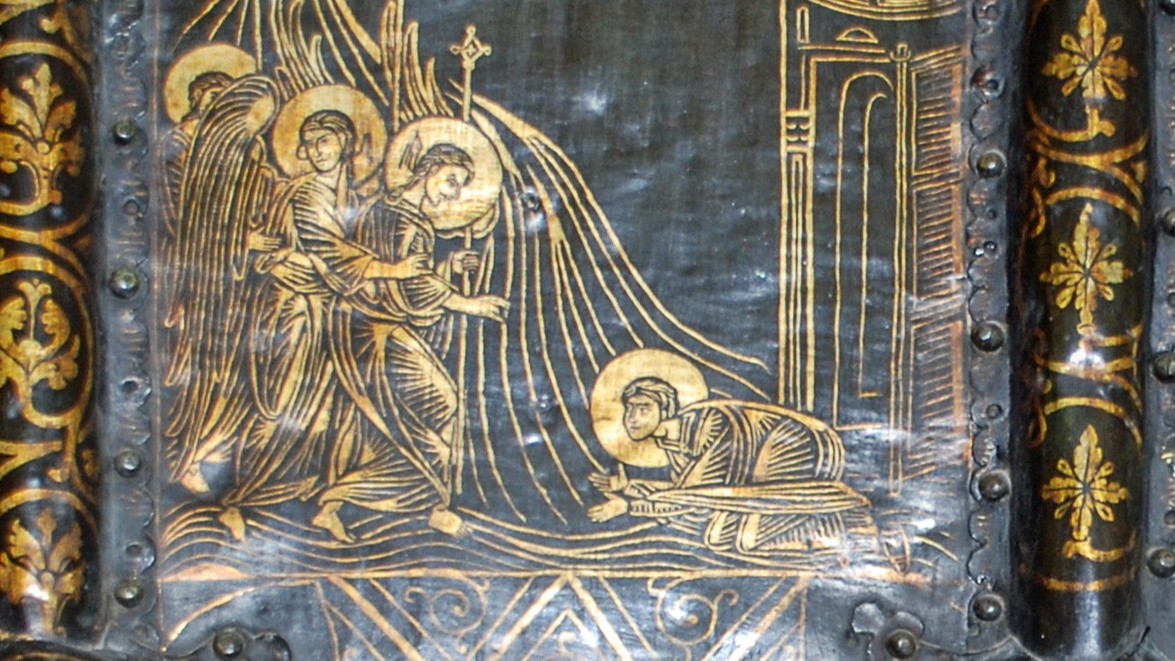
Image credit: Detail from “King David before the Battle” from the South Gates of Cathedral of the Nativity of the Theotokos in Suzdal, Russia. Photo by Shakko, 2024.