
Psalm 147
1 PraiseI the Lord!II
How goodIII it is to sing praisesIV to our God,V
I “praise” = halal. This is to be clear – it originally referred to a sound, then a color. It was to shine and then make a show or boast then to rave. In a causative sense it came to mean celebrate, give glory, sing praise, or be worth of praise. Because of the celebratory nature of the word, it could also mean to give in marriage. This is where Hallelujah comes from.
II “Lord” = Yah. From YHVH (proper name of the God of Israel; God, Lord; the self-existent or eternal one); from havah (to become) or hayah (to be, become, happen)}. This is Lord or God – a shortened form of God’s most holy name.
III “good” = tob. From tob (to be pleasing, to be good). This is good, beautiful, pleasant, agreeable, bountiful, at ease. This word is used for goodness as a concept, a good thing, a good person. This can refer to prosperity and welfare as well as joy, kindness, sweetness, and graciousness. So, this is ethically good, but also enjoyably good.
IV “sing praises” = zamar. Perhaps from zamar (to trim or prune). This is making music. It is used specially of music to worship God. So, music with singing, singing praise, or singing psalms.
V “God” = Elohim.
for he is gracious,VI and a song of praiseVII is fitting.VIII
VI “gracious” = na’iym. 13x in OT. From na’em (to be pleasant or lovely; to surpass in beauty; to be delightful in a literal or figurative sense). This is sweet, lovely, or delightful.
VII “song of praise” = tehillah. Related to “praise” in v1. From halal (see note I above). This is praise or a song of praise. It is to offer God a hymn, to boast in God. This shares a root with “hallelujah.”
VIII “fitting” = naveh. 10x in OT. From naah (to be at home and so pleasant, beautiful) or naveh (home, place where shepherd or sheep live; at hme implies a lovely place or a place of satisfaction); from navah (home, beautify, praise). This is beautiful, becoming, fitting, worthy of praise.
2 The LordIX builds upX Jerusalem;XI
IX “Lord” = YHVH. Related to “Lord” in v1. See note II above.
X “builds up” = banah. This is to build, make, set up, restore, repair, or obtain children. It is to build literally or figuratively.
XI “Jerusalem” = Yerushalaim. From yarah (to throw, shoot, be stunned; to flow as water so figuratively to instruct or teach) +shalam (to make amends, to be complete or sound). This is Jerusalem, dwelling of peace.
he gathersXII the outcastsXIII of Israel.XIV
XII “gathers” = kanas. 11x in OT. This is to gather, assemble, enfold.
XIII “outcasts” = dachah. 11x in OT. This is to push down, drive, thrust, totter, trip, or chase. It can also mean to overthrow or refer to an outcast as one has been pushed down/overthrown.
XIV “Israel” = Yisrael. Related to “God” in v1. From sarah (to persist, exert oneself, contend, persevere, wrestle, prevail) +El (see note V above). This is Israel, meaning God strives or one who strives with God; new name for Jacob and for his offspring. This refers to the people and to the land.
3 He healsXV the brokenheartedXVI
and binds upXVII their wounds.XVIII
XV “heals” = rapha. Properly, this is to repair by stitching – figuratively this means to heal or cure. It can also mean to make whole.
XVI “brokenhearted” = shabar + leb. Shabar is break, collapse, destroy, break in pieces, tear. It is bursting in a literal or figurative sense. Leb is from the same as lebab (the heart, courage, one’s inner self, the mind, the will; only used in a figurative sense in the Bible); may be related to labab (to encourage; properly, to be encased as with fat; used in a good sense, this means to transport someone with love; used in a bad sense, it can mean to dull one’s senses).. This is inner self, mind, will, feelings, the center.
XVII “binds up” = chabash. This is to wrap tightly or bind, to bandage, or heal. It can be to saddle an animal or wrap a turban. Figuratively, it can mean to stop or to govern.
XVIII “wounds” = atstebeth. 5x in OT. From atsab (to hurt, grieve, displease; to carve, make, worry). This is an injury, sorrow, trouble. It can also refer to an idol.
4 He determinesXIX the numberXX of the stars;XXI
XIX “determines” = manah. To weigh out, reckon, count, number, set, tell. By implication, it is allotting or providing something officially.
XX “number” = mispar. From the same as sepher (writing itself or something that is written like a document, book, letter, evidence, bill, scroll, or register); from saphar (to tally or record something; to enumerate, recount, number, celebrate, or declare). This is a number, whether definite or symbolic – could be innumerable, few, abundance. It can also be a tally or account – or a narration.
XXI “stars” = kokab. Perhaps from the same as kavah (to prick, blister, burn, scorch). This is a star as shining, stargaze. Figuratively, can mean prince.
he givesXXII to allXXIII of them their names.XXIV
XXII “gives” = qara. This is to call or call out – to call someone by name. Also used more broadly for calling forth.
XXIII “all” = kol. From kalal (to complete). This is all or every.
XXIV “names” = shem. May be from sim (to put, place, set). This is name, fame, renown. A name was thought to indicate something essential about a person – something about their individuality. So, this word can also mean honor, authority, or character.
5 GreatXXV is our LordXXVI and abundantXXVII in power;XXVIII
XXV “great” = gadol. From gadal (to grow up, become great, become wealthy – to advance. The root meaning may be to twist in the sense of the process of growing). This is great, high, bigger, noble, old, marvelous. It can also refer to someone who is powerful or distinguished.
XXVI “Lord” = adon. From a root that means ruling or being sovereign. This is lord, master, or owner.
XXVII “abundant” = rab. From rabab (increasing in any aspect whether quantity, authority, size, quality, greatness, etc.). This is abundance, many, elder, exceedingly, great. It refers to abundance of amount, rank, or status.
XXVIII “power” = koach. Root may mean to be firm. This is power, strength, force. It can be literal or figurative, positive or negative. It can also mean capacity or means – what something produces. Additionally, it could refer to some kind of small reptile.
his understandingXXIX is beyondXXX measure.XXXI
XXIX “understanding” = tebunah. From bin (to discern, consider, attend to; distinguishing things in one’s mind or, more generally, to understand). This is understanding, discernment, discretion, intelligence, skill, fruit, an argument.
XXX “beyond” = ayin. Perhaps from a word that means to be nothing. This means nothing, none, non-existent. It can also simply mean not or are not.
XXXI “measure” = mispar. Same as “number” in v4. See note XX above.
6 The LordXXXII lifts upXXXIII the downtrodden;XXXIV
he castsXXXV the wickedXXXVI to the ground.XXXVII
XXXII “Lord” = YHVH. Same as “Lord” in v2. See note IX above.
XXXIII “lifts up” = ud. This is to repeat, return, do again. This implies testifying something since that is a repetition. It can also mean to charge, admonish, protest, relieve, restore, or lift up.
XXXIV “downtrodden” = anav. From anah (to be bowed down; can refer to a sense of humility or to a sense of being browbeaten, oppressed, afflicted, or depressed; literal or figurative – depressed in mood or circumstance). This is poor, needy, afflicted as well as humble or meek.
XXXV “casts” = shephel. This is to place low, humble, sink, humiliate.
XXXVI “wicked” = rasha. This is morally wrong so it refers to someone who is actively bad as wicked, criminal, an evil person, offender, condemned, or ungodly.
XXXVII “ground” = erets. Root may mean to be firm. This is earth, ground, field land, or country.
7 SingXXXVIII to the LordXXXIX with thanksgiving;XL
make melodyXLI to our God on the lyre.XLII
XXXVIII “sing” = anah. This is answer, respond, announce, sing, shout, or testify. It means to pay attention, which implies responding and, by extension, starting to talk. Used in a specific sense for singing, shouting, testifying, etc.
XXXIX “Lord” = YHVH. Same as “Lord” in v2. See note IX above.
XL “thanksgiving” = todah. From yadah (to throw one’s hands into the air in a gesture of praise, to give thanks, or make a confession); from yad (hand, ability, power; hand in a literal sense; what one can do or the means by which one does it). This is properly extending one’s hand, which implies affirmation and adoration. It can be a song of thanksgiving, a choir of thanksgiving, confession, or praise. It can also be a thank offering.
XLI “make melody” = zamar. Same as “sing praises” in v1. See note IV above.
XLII “lyre” = kinnor. Root may be to twang. This is a lyre or harp.
8 He coversXLIII the heavensXLIV with clouds,XLV
XLIII “covers” = kasah. This is to cover, conceal, overwhelm. It is to cover as clothes do or to hide a secret.
XLIV “heavens” = shamayim. Root may mean being lofty. This is sky, the air, or heaven. It is in a dual noun form so this might refer to the part of the sky where the clouds move on the one hand and the part beyond that where the sun, moon, and stars are on the other hand.
XLV “clouds” = ab. Perhaps from uwb (to be a think or dark cloud, a cloud covering). This is a dark or thick cloud that can envelope in darkness. It can also refer to a copse or to clay.
preparesXLVI rainXLVII for the earth,XLVIII
makes grassXLIX growL on the hills.LI
XLVI “prepares” = kun. Properly, this means in a perpendicular position. So, it is set up in a literal sense – establish, fix, fasten, prepare. In a figurative sense, it is certainty, to be firm, faithfulness, render sure or prosperous.
XLVII “rain” = matar. This is rain or downpour.
XLVIII “earth” = erets. Same as “ground” in v6. See note XXVII above.
XLIX “grass” = chatsir. Perhaps from the same as chatsir (village, settlement); from chatser (enclosure or court – a yard that is fenced in. It could also be a village or hamlet that is walled in); from chatsar (to blow a trumpet, trumpeter, to surround); from chatsotsrah (trumpet). This is grass, plant, hay, leeks.
L “grow” = tsamach. This is to sprout, grow, or spring up – literal or figurative.
LI “hills” = har. From harar (hill or mountain). This is mountain, hill, hilly region.
9 He givesLII to the animalsLIII their foodLIV
and to the youngLV ravensLVI when they cry.LVII
LII “gives” = natan. This is to give, put, set, offer. It is to give literally or figuratively.
LIII “animals” = behemah. This is animal or cattle. It is often used of large quadrupeds.
LIV “food” = lechem. From lacham (to eat, feed on). This is bread, food, loaf. It can refer to food more generally for people or for animals.
LV “young” = ben. Related to “builds up” in v2. From banah (see note X above). This is son, age, child. It is son in a literal or figurative sense.
LVI “ravens” = oreb. 10x in OT. Perhaps from arab (to grow dark, become gloomy); from ereb (evening, night, twilight) or from arab (to bargain, barter, give or take in pledge; to braid or intermingle). This is a raven.
LVII “cry” = qara. Same as “gives” in v4. See note XXII above.
10 His delight isLVIII not in the strengthLIX of the horseLX
LVIII “delight is” = chaphets. Properly, this means inclined towards or bending to. Figuratively, it means to desire, delight in, or be pleased with.
LIX “strength” = geburah. From gabar (to be strong or mighty; to prevail or be insolent). This is force in a literal or figurative sense. So, it could be strength, power, courage, triumph, victory, or mastery.
LX “horse” = sus. Root may mean to skip as in jump for joy. This is a crane or a swift bird. It is also a horse as leaping.
nor his pleasureLXI in the speedLXII of a runner,LXIII
LXI “pleasure” = ratsah. This is to be pleased with, delight, take pleasure in, or accept with favor. It can mean to approve or consent regarding something. It can also be used specifically of satisfying debts or being pardoned.
LXII “speed” = shoq. 19x in OT. Perhaps from shuq (to overflow, run after). This is leg, thigh, or hip.
LXIII “runner” = ish. Perhaps from enosh (human, humankind, mortal); from anash (to be weak, sick, or frail). This is man, husband, another, or humankind.
11 but the LordLXIV takes pleasureLXV in those who fearLXVI him,
in those who hopeLXVII in his steadfast love.LXVIII
LXIV “Lord” = YHVH. Same as “Lord” in v2. See note IX above.
LXV “takes pleasure” = ratsah. Same as “pleasure” in v10. See note LXI above.
LXVI “fear” = yare. From the same as yare (to fear, be afraid, dreadful; also fearful reverence – to fear in a moral sense is to say to revere, respect). This is afraid, fearful, or reverent.
LXVII “hope” = yachal. This is to wait, which implies patience, hope, and trust. It can also be pained waiting.
LXVIII “steadfast love” = chesed. From chasad (being good, kind, merciful; may mean bowing one’s neck as is done in the presence of an equal for courtesy’s sake; so, if one in a superior position is treating you like an equal, that is what is captured here). This is favor, goodness, kindness, loving kindness, pity, reproach, or a good deed. When done by God to humanity, this is mercy/loving kindness. When done by humanity to God, it is piety.
12 ExtolLXIX the Lord,LXX O Jerusalem!
PraiseLXXI your God, O Zion!LXXII
LXIX “extol” = shabach. 11x in OT. This is to glory, praise, triumph. It can also mean still or soothe. Properly, it is speaking to loudly or to calm through speech.
LXX “Lord” = YHVH. Same as “Lord” in v2. See note IX above.
LXXI “praise” = halal. Same as “praise” in v1. See note I above.
LXXII “Zion” = Tsiyyon. Related to tsyiyyun (signpost, monument); from tsavah (to charge someone, to command, order); from the same as tsiyyah (dryness, drought); from a root meaning parched as desert, dry land. Zion can refer to a mountain in Jerusalem as well as another name for Jerusalem itself or the people.
13 For he strengthensLXXIII the barsLXXIV of your gates;LXXV
LXXIII “strengthens” = chazaq. This is to strengthen, seize, be courageous, repair, bind, heal, conquer, harden.
LXXIV “bars” = beriach. From barach (to flee, drive away, hurry, to bolt). This is a bar or a bolt. It can also be used for a fugitive.
LXXV “gates” = shaar. May be related to sha’ar (to calculate or reckon; may come from a root that means to open up or split). This is a gate, door, or other opening like a port.
he blessesLXXVI your childrenLXXVII withinLXXVIII you.
LXXVI “blesses” = barak. This is to kneel, to bless. It is blessing God as part of worship and adoration or blessing humans to help them. It can be used as a euphemism to say curse God.
LXXVII “children” = ben. Same as “young” in v9. See note LV above.
LXXVIII “within” = qereb. Perhaps from qarab (to come near or approach). This is among, in the midst, before, the center It is the inward part, whether literal or figurative. It can also be used for the heart, the site of thoughts and feelings. This word is also used as a technical term for the entrails of the animals who are sacrificed.
14 He grantsLXXIX peaceLXXX within your borders;LXXXI
LXXIX “grants” = sim. Related to “names” in v4. See note XXIV above.
LXXX “peace” = shalom. Related to “Jerusalem” in v2. From shalam (see note XI above). This is completeness, soundness, welfare, favor, friend, good health. It is to be safe and figuratively well, happy, at peace, friendly. Abstractly, it includes the ideas of welfare and prosperity (not in excessive wealth, but in having enough).
LXXXI “borders” = gebul. Perhaps from gabal (to border, twist like rope). This is boundary, limit, coast, space. Properly, it is a line that is twisted, which implies a boundary and, by extension, the boundaries of a territory or other enclosed space.
he fillsLXXXII you with the finestLXXXIII of wheat.LXXXIV
15 He sends outLXXXV his commandLXXXVI to the earth;
LXXXII “fills” = saba. To be satisfied or full in a literal or figurative sense. Also, to have plenty of.
LXXXIII “finest” = cheleb. This is fat, finest, marrow. It is fat in a literal or figurative sense. It refers to the richest or best part.
LXXXIV “wheat” = chittah. Perhaps from chanat (to spice, ripen, embalm). This is wheat, referring to the plant or its product.
LXXXV “sends out” = shalach. This is to send out, away, send for, forsake. It can also mean to divorce or set a slave free.
LXXXVI “command” = imrah. From emer (speech, thing, utterance, promise, argument, command); from amar (to speak, say, answer, command, promise, report). This is any kind of utterance, a word or commandment.
his wordLXXXVII runsLXXXVIII swiftly.LXXXIX
LXXXVII “word” = dabar. From dabar (to speak, declare, discuss). This is speech, a word, a matter, an affair, charge, command, message, promise, purpose, report, request. It is a word, which implies things that are spoken of in a wide sense.
LXXXVIII “runs” = ruts. This is to run or rush, divide quickly, bring swiftly. It can also refer to a footman or guard.
LXXXIX “swiftly” = meherah. From mahar (being liquid, which implies flowing; hurrying forward, whether in a positive or negative sense). This is speed, quickly, shortly, promptly.
16 He givesXC snowXCI like wool;XCII
he scattersXCIII frostXCIV like ashes.XCV
XC “gives” = natan. Same as “gives” in v9. See note LII above.
XCI “snow” = sheleg. 19x in OT. Perhaps from shalag (to snow, to be white). This is snow or snowy.
XCII “wool” = tsemer. 16x in OT. This is wool or shaggy thing.
XCIII “scatters” = pazar. 10x in OT. This is to scatter or disperse – whether in a positive sense of sharing abundance or negatively as scattering through force.
XCIV “frost” = kphowr. 12x in OT. From kaphar (to appease, cover, pacify, cancel). This is a cover, which could imply a basin or goblet or a frost that covers the ground.
XCV “ashes” = epher. Root may mean to strew. This is ashes or dust.
17 He hurls downXCVI hailXCVII like crumbsXCVIII—
XCVI “hurls down” = shalak. This is to throw, fling, or hurl. It can also be to throw away in a literal or figurative sense.
XCVII “hail” = qerach. 7x in OT. Perhaps from qarach (to shave bald). This is ice, frost, or crystal. It could be ice as smooth like baldness is smooth. It can also be hail or, since they look similar, crystal rocks.
XCVIII “crumbs” = path. 15x in OT. From pathath (to crumble, open, break). This is a piece, morsel, or fragment.
who can standXCIX beforeC his cold?CI
18 He sends out his word and meltsCII them;
XCIX “stand” = amad. This is to stand up in a literal or figurative sense. So it can be establish, continue, endure, take a stand, act, be a servant, stand still, remain, stand against an enemy.
C “before” = paneh. From panah (to turn, face, appear). This is face in a literal or figurative sense. It could be face, presence, anger, respect. It can also be used of God to indicate divine favor or presence.
CI “cold” = qarah. 5x in OT. From qar (cold, quiet, excellent); from qarar (being cold, remaining fresh). This is cold or coolness.
CII “melts” = masah. 4x in OT. This is to melt, become liquid, consume. Figuratively, it can also be melt from fear.
he makes his windCIII blow,CIV and the watersCV flow.CVI
CIII “wind” = ruach. From ruach (smell, breathe, perceive, anticipate, accept, enjoy). This is breath, wind, air, cool, spirit. This is wind, which resembles the breath and so this can be used figuratively for life itself or being frail/mortal/impermanent. It can refer to the air of the sky or the spirit.
CIV “makes…blow” = nashab. 3x in OT. This is to blow or disperse.
CV “waters” = mayim. This is water, waters, or waterway in a general sense. Figuratively, it can also mean juice, urine, or semen.
CVI “flow” = nazal. 16x in OT. This is to drip or flow, pour down, flood, distill, or melt.
19 He declaresCVII his word to Jacob,CVIII
his statutesCIX and ordinancesCX to Israel.
CVII “declares” = nagad. This is to declare, make conspicuous, stand in front, manifest, predict, explain.
CVIII “Jacob” = Yaaqob. From the same as aqeb (heel, hind part, hoof, rear guard of an army, one who lies in wait, usurper). This is Isaac’s son and his descendants. The name means heel-catcher or supplanter.
CIX “statutes” = choq. From chaqaq (to inscribe, carve, or decree; a lawmaker; literally, this is engraving, but it implies enacting a law because laws were carved into stone or metal). This is statute, boundary, condition, custom, limit, ordinance It is something that is prescribed or something that is owed.
CX “ordinances” = mishpat. From shaphat (to judge, defend, pronounce judgment, condemn, govern). This is a verdict or formal sentence whether from humans or from God. It includes the act of judging as well as the place that judging takes place, the suit itself, and the penalty. Abstractly, this is justice, which includes the rights of the participants.
20 He has not dealtCXI thusCXII with anyCXIII other nation;CXIV
CXI “dealt” = asah. This is to make, do, act, appoint, become in many senses.
CXII “thus” = ken. Related to “prepares” in v8. Perhaps from kun (see note XLVI above). This is to set upright. Generally used figuratively to mean thus, so, afterwards, rightly so.
CXIII “any” = kol. Same as “all” in v4. See note XXIII above.
CXIV “nation” = goy. From the same root as gevah (the back, person, or body); related to gev (among); related to gaah (to rise up). This is nation or people. Often used to refer to Gentiles or foreign nations. It can also be used figuratively for a group of animals. This is where the Yiddish “goy” comes from.
they do notCXV knowCXVI his ordinances.
PraiseCXVII the Lord!CXVIII
CXV “not” = bal. From balah (to grow old, wear out, consume, waste, enjoy, fail, decay). This is not, lest, neither. Properly, it refers to a failure, so it implies nothing or not at all.
CXVI “know” = yada. This is to know, acknowledge, advise, answer, be aware, be acquainted with. Properly, this is to figure something out by seeing. It includes ideas of observation, recognition, and care about something. It can be used causatively for instruction, designation, and punishment.
CXVII “praise” = halal. Same as “praise” in v1. See note I above.
CXVIII “Lord” = Yah. Same as “Lord” in v1. See note II above.
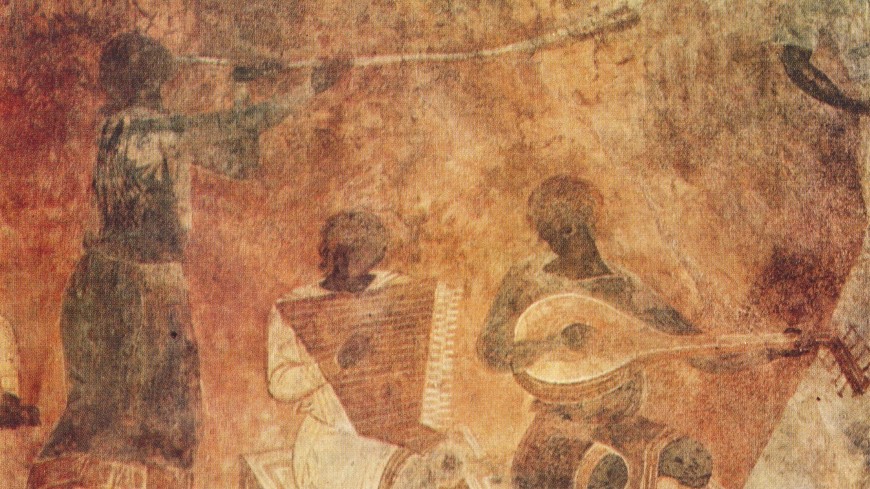
Image credit: Detail of “Musicians Playing Trumpet, Psaltery, Lute” at the Tower of Hrelyo at the Rila monastery in Bulgaria, 14th century. Photo by Jacqke, 2025.
